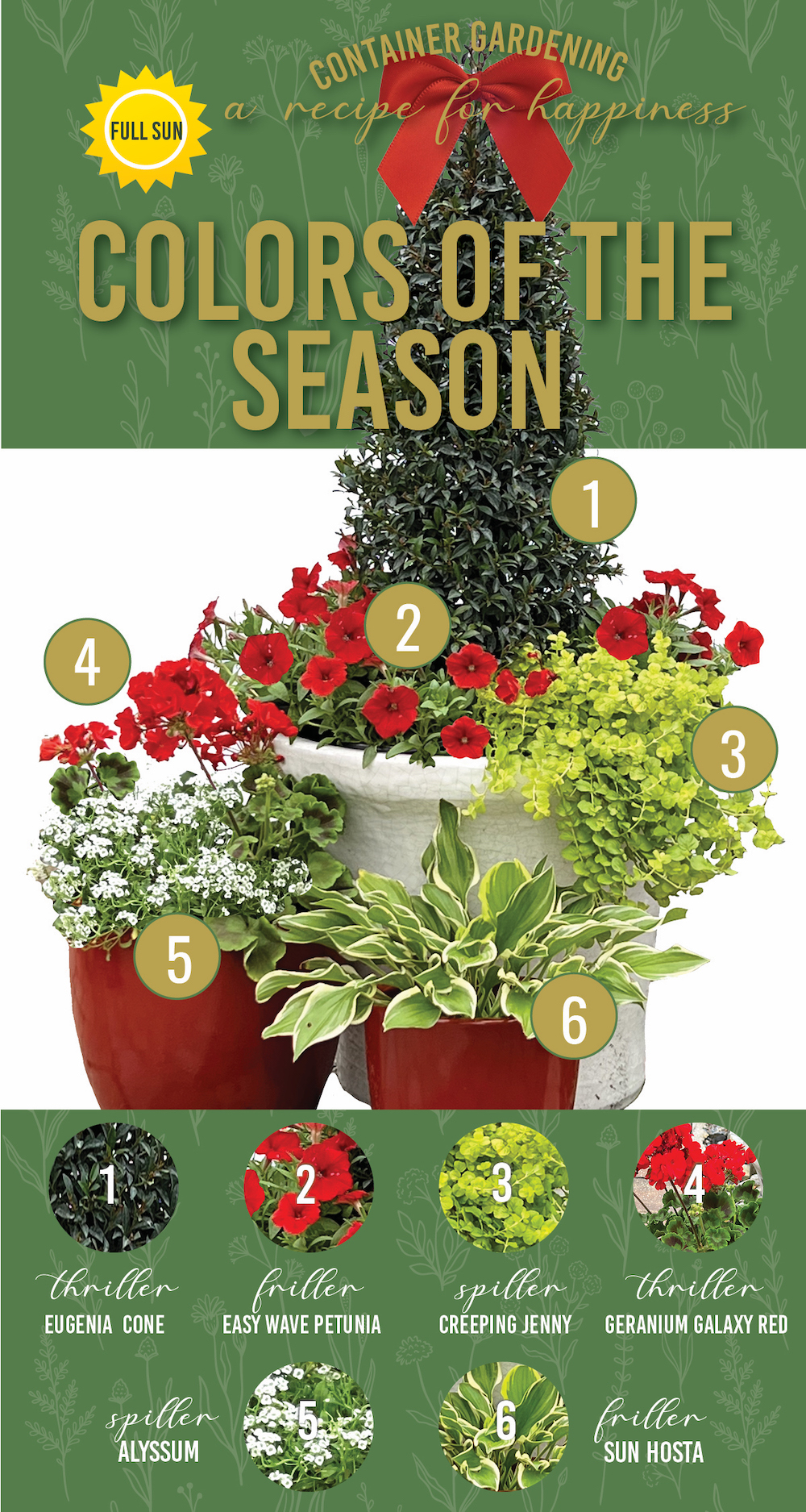
Start with an evergreen cone, spiral, or ball-shaped topiary. In this recipe, we have used a Eugenia cone. Other options include bluepoint juniper, boxwood, or even rosemary. Then pick some annuals that do well in the cooler temps of December, like the Easy Wave Petunia® and Alyssum. A green, red and white pallet will give you many flower options and leaf textures to choose from. Add some ribbon and lights to take let your Christmas spirit shine!
Eugenia Cone – Adds a formal touch with rich glossy leaves. If we get unusually cold, topiary eugenia can be overwintered indoors as an elegant houseplant. Just be sure to put in a sunny window.
Easy Wave Petunia – As the name tells us, these are easy to grow and will trail beautifully as well. Full sun to partial shade. They do well in our mild Florida winters.
Creeping Jenny – A must-have trailer also enjoys our mild temperatures and will come back from a frost.
Galaxy Red Geraniums– This scented geranium attracts bees and hummingbirds and is deer resistant and drought-tolerant.
Alyssum – This filler/spiller has a wonderful scent and is a perfect choice for adding white to your combinations.
Sun Hosta – This is a medium-sized hosta that does well in Florida. It is a perennial and can take the sun. In the spring and summer, give it some afternoon shade.
Sign up for updates!
Sign up to receive exclusive offers, event notifications and announcements.
Lawn Care Services, Lawn Maintenance, Lawn Fertilization
Lawn Pest Control, Lawn Weed Control
Aeration and Top Dressing
Water Features, Koi Ponds,
Waterfalls, Bubbling Fountains
Garden Center & Pond Supply Store
General Services Areas
Jacksonville (Jax), Jacksonville Beach, Neptune Beach, Atlantic Beach, Ponte Vedra Beach, Ponte Vedra, Fernandina Beach, Amelia Island, Orange Park, St. Johns, Nocatee
The seasonal lawn fungus threats are at their peak in Spring and Fall when nights are cool and humidity is high here in Northeast Florida. A good lawn fungus application is recommended. There are natural solutions such as baking soda and neem oil but rarely do lawn care pest control companies go that route for commercial applications.
A well-maintained lawn is the best defense against most lawn issues. A healthy lawn is less susceptible to long-term fungal disease outbreaks. Plus, minor outbreaks may go away on their own as some die with seasonal temperature variations and increases or decreases in rain and watering. Those same variations in temperature, water supply, and nutrition put the poorly maintained lawn at greater risk of damage from disease when an outbreak occurs. To understand this better consider that a healthy body heals quicker than a sick one.
Dethatching and aerating the turf along with the proper type of fertilizer at the proper timing for fertilization improves turf disease resistance. Mowing the grass at the proper height with a sharp blade likewise reduces turf disease susceptibility. And no good deed goes unpunished as putting out that same high nitrogen fertilizer you were using earlier in the year will mostly grow weeds and forms of fungus in the Fall. Reduce the days and duration of watering in the fall and increase again in spring.
Lawn fungus appears in many forms including white, yellow and brown patches, multiple colored spots on the grass blades, a powdery or stringy coating on the grass and slick, slimy darkened colored grass. Whatever type of fungus you may have, know that it spreads by spores. So walking on it increases the risk of spreading the spores to other parts of your lawn.
There are two types of lawn fungicides, foliar liquids and granular systemic. The liquid is fast-acting with less residual benefit whereas the granular works its way up through the root system over time. For long-term treatment, alternate both modes of application foliar and granular since different fungicides absorb differently and build resistance to treatments.
For seasonal lawn fungus here at Earth Works we use and recommend a broad-spectrum fungicide that is available in both foliar and granular form by the brand name HeadwayG with azoxystrobin & propiconazole. This treats various brown patches, rust, ring spots, powdery mildew, blight, red thread, and root rot. Typically treat twice and fourteen days apart. The untreated fungus can spread and be very damaging to the lawn over time. So don’t mow when the fungus is present which would encourage its spread.
Earth Works operates a retail Garden Center/Plant Nursery in Jacksonville and provides landscaping, hardscaping, water features, lawn care service, lawn spraying, and drainage solutions. Stop by our retail center or contact us online or by phone at 904-996-0712.
Earth Works proudly serves clients in Northeast Florida, including Jacksonville, Ponte Vedra Beach, Atlantic Beach, Neptune Beach, Jacksonville Beach, Nocatee, St. Johns, Fleming Island, Orange Park, Middleburg, Green Cove Springs, Amelia Island, Fernandina, and St. Augustine.
Sign up for updates!
Sign up to receive exclusive offers, event notifications and announcements.
Lawn Care Services, Lawn Maintenance, Lawn Fertilization
Lawn Pest Control, Lawn Weed Control
Aeration and Top Dressing
Water Features, Koi Ponds,
Waterfalls, Bubbling Fountains
Garden Center & Pond Supply Store
General Services Areas
Jacksonville (Jax), Jacksonville Beach, Neptune Beach, Atlantic Beach, Ponte Vedra Beach, Ponte Vedra, Fernandina Beach, Amelia Island, Orange Park, St. Johns, Nocatee
The Queen palm is a fast-growing palm and an elegant choice for landscapes in Jacksonville and throughout Northeast Florida. The long feathery pinnate leaves are not only beautiful but can create shade if placed in the right spot. Queen palms can be used to line the property or planted as single specimens to create focal points in your landscape design. This palm tree grows fast approximately two feet per year up to typically forty feet in height. Earth Works sells 15-gallon, 30-gallon, and field-grown Queen Palms year-round. We offer delivery and planting services year-round. Our knowledgeable and friendly staff can help you find the right palm tree design for your landscape.
If you are looking for a cold hardy palm tree that looks like a tropical palm, the Queen palm is a good choice. As they mature, Queen Palms shed their outer layers and reveal an attractive silver color on their trunk. The contrast of the light-colored trunk with the dark green palm fronds is a spectacular look that creates a tropical vibe when paired with a good landscape design in Jacksonville.
Queen Palm genus and species Syagrus romanzoffiana Common names: Queen Palm & Cocos Palm
Drought Tolerance: Moderate
Origin: Argentina, Brazil, Uruguay
Zone: 9-11
Typical Height: 40ft
Salt Tolerance: Moderate
Growth Rate: Moderate to Fast
Earth Works operates a retail Garden Center/Plant Nursery in Jacksonville and provides landscaping, hardscaping, water features, lawn care service, lawn spraying, and drainage solutions. Stop by our retail center or contact us online or by phone at 904-996-0712.
Earth Works proudly serves clients in Northeast Florida, including Jacksonville, Ponte Vedra Beach, Atlantic Beach, Neptune Beach, Jacksonville Beach, Nocatee, St. Johns, Fleming Island, Orange Park, Middleburg, Green Cove Springs, Amelia Island, Fernandina, and St. Augustine.
Living in Jacksonville at the time, McGregor and Fechtel and their wives met by chance during a wedding in St. Petersburg. “Our good friends said we had to meet Doug and Terri because they are a fun couple,” said Fechtel. “Little did we know that eight months later, we were going to start our own business.”
After graduating from college with finance degrees, McGregor worked as a banker and Fechtel as a financial planner when they decided to make the change. “We loved our jobs until the market crashed in 1987, threatening our positions,” McGregor recalled. “We decided to walk away from our coat-and-tie jobs. We neither had kids nor big mortgages, so we planned our exit strategy and started the company.
“I had worked in a garden center growing up, and Mark mowed grass as the “boy next door.” We knew landscaping was the kind of work we liked,”
After growing their Lawn Care Business, the pair soon expanded their services to irrigation and landscaping. In 1999, they bought a swath of heavily wooded land bordering Beach Boulevard which became Earth Works Garden Center.
Jason Duffney, who joined McGregor and Fechtel as a junior business partner in ?, was hired in 2003 as a part-time employee while a freshman at the University of North Florida. “Jason started with us when he was 19 years old. By the time he was 33, he had grown with the company and became one of our business partners,” said Fechtel.
A native of Lecanto, Florida, Duffney had previous experience working in a nursery as a teenager before he moved to Jacksonville to earn a finance degree from UNF. “I came in as a nursery kid pulling weeds and making deliveries,” he said. Jason learned quickly and became well-versed in pond building. He contemplated starting a pond business of his own at one point when McGregor and Fechtel approached him with a proposition.
“They wrangled me in and said, ‘don’t be stupid. Let’s talk about how all of us can grow,” Duffney recalled. In charge of Earth Works’ pond operations, he has built it into the award-winning Water Garden division it is today.
As Earth Works’ third business partner, Duffney’s mission is to update and streamline the company so it can serve customers better.
Working together, we balance each other out, said McGregor. “Mark and I have different personalities” “I’m more Type A, and he’s a laid-back guy. I don’t think we’ve had ten disagreements in over 30 years. We like each other. We’re really good friends, and our families are close.”
In the business, Duffney heads operations, McGregor oversees finances, and Fechtel manages sales. “Mark and Doug are opposites, and I fall somewhere in the middle, which makes for a nice blend,” Duffney said. “If we are dealing with clients or employees, everyone brings a different skill to the table.”
Maintaining a lush tropical landscape requires learning about your plant’s cold tolerance and the threat of chilling temperatures above freezing. When purchasing plants for your landscape, it is essential to know which USDA hardiness zone they’re growing in and each variety’s cold hardiness rating. For instance, the large geographic area of Jacksonville, Florida, is USDA Hardiness Zone 9a (20F- 25F) and borders 8a (15-20F) to the West. If the plants in your landscape and collection cannot tolerate temperatures as low as the minimum temperatures then they aren’t considered hardy for Jacksonville’s zone. View USDA Hardiness zones from around the country and find yours by zip code at USDA Agricultural Research Service.
Avoid planting your most cold-sensitive plants with northern exposure and consider other more hardy plantings around them as wind blocks if you must. It’s common knowledge that houseplants and tropicals won’t survive freezing temperatures. However, there is less appreciation for the fact that chilling temperatures within specific ranges above freezing can also result in plant stress, damage, and death.
“A chilling temperature is any temperature that is cold enough to cause plant injury but not cold enough to freeze the plant,” according to the University of Florida/IFAS. “These temperatures usually range from just above 32°F to about 59°F. Chilling injury to tropical foliage plants is also dependent on the duration of exposure to a chilling temperature.”
Plants are triggered to begin acclimation or hardening in Autumn as daylight hours, and temperatures decline. Non-native plants in Jacksonville’s humid subtropical gardens face more significant fluctuations of temperature in the chilling temperature range than our neighbors in Central and South Florida’s tropical hardiness zones. While Jacksonville has an average October temperature between 81F- 66F, forecasts call for a low of 46F with 10-15mph wind on October 18, 2022. Chilling temperature plant damage can appear as wilting, yellowing, reddish-brown spots, and even mushiness.
“Tropical and subtropical crops such as ageratum, alternanthera, angelonia, basil, celosia, cleome, coleus, cosmos, lantana, pentas, poinsettia, portulaca, sweet potato vine, vinca and zinnia are classified as cold-sensitive because their development stops at a base temperature of 46 F or higher,” according to Michigan State University. “Another group of greenhouse crops is classified as cold-intermediate (or cold-temperate) crops as their development stops at moderately low temperatures of 40 to 45 F. These crops include calendula, dahlia, geranium, impatiens, lobelia, some petunia cultivars, verbena and wax begonia.” Many of our local gardens contain a mix of these plants and others with varied cold sensitivity.
Consider our Overwintering and Indoor Propagation article if you are preparing to protect your houseplants and tropicals during a cold spell and before freezing temperatures are forecast for your area. If chilling temperature damage occurs, ensure the affected plants are watered and avoid the temptation of fertilization, which can stimulate new growth and further stress the plant.
For more information on your plant’s cold tolerance how to protect your plants every season and for comprehensive solutions to your specific lawn, garden and landscaping needs contact Earth Works of Jacksonville at 904-996-0712. Earth Works operates a retail Garden Center/Plant Nursery in Jacksonville and provides landscaping, hardscaping, water features, lawn care service, lawn spraying, and drainage solutions.
Earth Works proudly serves clients in Northeast Florida, including Jacksonville, Ponte Vedra Beach, Atlantic Beach, Neptune Beach, Jacksonville Beach, Nocatee, St. Johns, Fleming Island, Orange Park, Middleburg, Green Cove Springs, Amelia Island, Fernandina, and St. Augustine.
Consider these October Gardening tips for improved lawn and garden enjoyment during the cooler months ahead of next Spring. These tips are specifically for Northeast Florida gardeners and are heavily influenced by weather changes, including the end of the rainy season, fewer daylight hours, and a 10F degree drop in temperature.
-Pay attention to your plants watering needs as October’s monthly rainfall averages 4′”, a significant drop from rainy season averages between June and September. Although it’s chillier with fewer hours of sunlight, October can still register highs in the 80s, accompanied by windy conditions that rapidly dry out the soil. And remember irrigation schedule water restrictions fall from twice to once per week watering when Daylight Savings Time ends on Sunday, November 5, per the City of Jacksonville Ordinance Code Chapter 366.
-You can fertilize your perennials, bulbs, citrus, palms, and other select trees and shrubs during October. However, how often and what time of year to fertilize for maximum benefit can depend on the type of plant and type of fertilizer NPK assay and whether it’s a liquid, powder, or granular. Even though Florida county Fertilizer blackout periods around the state are typically lifted by the end of September, continue being careful to overuse fertilizers and apply them correctly, as they can harm your plants and cause environmental damage.
-If applying a Winterizer fertilizer on our Florida warm-season grasses, do so with a nitrogen-free product and apply before dormancy.
-Consider applying organic mulch to your gardening beds to protect bare roots and soil from falling temperatures and nutrient runoff. Earth Works Lawn Care can provide you a mulching quote.
-Tender warm-season bulbs and tubers such as caladiums and gladiolus can be dug up, inspected for fungus, cleaned of dirt, and stored in peat moss, perlite, or vermiculite in a cool location until Spring planting season.
-Overseeding with ryegrass can be done in October to add Winter color to your dormant warm-season grass lawn. Both perennial and annual ryegrass is available for those considering these October Gardening Tips.
-Houseplants kept outside during the warmer months should be examined for pests and treated accordingly. Continue with your fertilization requirements for your houseplants and prepare to move them and other tender tropicals indoors ahead of any air temperature drops below their healthy growing requirements.
-Prepare the ground for Fall herbs and vegetable garden beds, perennials, and Spring bulbs. Add compost and soil amendments specifically formulated for the growing requirements of your plantings. For the veggie beds, consider planting beans, broccoli, cabbage, carrots, cauliflower, collards, cucumbers, endive, kale, kohlrabi, lettuce, mustard, onions, radishes, summer squash, and turnips.
-Continue weeding warm-season weeds, and if considering using a pre-emergent herbicide, apply ahead of the seed germination of cold-season weeds. “Regardless of where you live, the application window for fall pre-emergents should be when temperatures are below 70 degrees and dropping,” according to Sod Solutions. “It should be noted that a pre-emergent herbicide that is applied before you overseed in the fall will keep your seed from growing.”
-Avoid trimming your trees and shrubs except for instances of dieback, disease, and damage. Trimming your trees and shrubs at the wrong time can jeopardize leaf and flower buds that have already been set, resulting in poorer growth and blooms in Spring depending on whether they set their blooms on old or new wood.
-October is a terrific time to plant trees and shrubs as the cooler temperatures reduce stress and facilitate faster acclimation.
-Monitor the water temperature in your koi pond and reduce the amount of food they are fed and consider lower protein formulations available at the Earth Works garden center.
-Aeration and Top Dressing renews your lawn soil with beneficial microbes, and the required micro-nutrients improve oxygen supply to plant roots, and reduce soil erosion and runoff. Earth Works’ lawn care division provides this service. Our garden center likewise has many varieties of high quality soils for your gardening needs.
-This is a good time to begin planning any landscaping projects on your mind with a member of our landscape design team at Earth Works. Along with being a good time to plant it can reduce wait times for ordering products and beats the Spring rush.
For more specific October gardening tips speak directly with a member of our Earth Works Garden Center staff. And for comprehensive solutions to your specific lawn, garden and landscaping needs contact Earth Works of Jacksonville at 904-996-0712. Earth Works operates a retail Garden Center/Plant Nursery in Jacksonville and provides landscaping, hardscaping, drainage solutions, water features, lawn care service, and lawn spraying.
Earth Works proudly serves clients in Northeast Florida, including Jacksonville, Ponte Vedra Beach, Atlantic Beach, Neptune Beach, Jacksonville Beach, Nocatee, St. Johns, Fleming Island, Orange Park, Middleburg, Green Cove Springs, Amelia Island, Fernandina, and St. Augustine.
Florida Winterizer Fertilization of warm-season grasses if done should be done with a nitrogen-free product and applied prior to dormancy. Although many brands promote the sale of Winterizing fertilizers that include nitrogen, these are not appropriate for warm-season grasses. They encourage new grass blade development that alters the dormancy cycle that, by design, is nature’s way of protecting the plant from cold damage—waking the plant before a freeze puts it at risk of increased stress and death. “Many of the so-called winterizer fertilizers available in our area can cause more damage than good,” according to UF/IFAS. “The time to fertilize our warm-season grasses in Florida is during the growing season, not when the grasses are going to “sleep” for the winter.”
The three macro-nutrients listed on the label of all fertilizers are nitrogen, phosphorus, and potassium, abbreviated as NPK. If choosing a Wintering lawn fertilizer, we only recommend an NPK with phosphorus and potassium. “Adding phosphorus to soil low in available phosphorus promotes root growth and winter hardiness, stimulates tillering, and often hastens maturity,” according to University of Nebraska Plant & Soil elibrary. “Potassium is a vital component of numerous plant functions, including nutrient absorption, respiration, transpiration, and enzyme activity.” Both phosphurus and potassium are essential for plant maintenance and support, according to the Noble Research Institute.
Our Florida Winterizer Fertilization recommendation is for an NPK of only phosphorus and potassium. This nitrogen-free formulation is most readily available for retail sale with a 0-10-10 NPK.
It’s also essential to know your soil pH when supplementing with fertilizers. These macro-nutrients are only fully bioavailable at a pH of 6.5 or above and decreasingly available below. “In a very acid soil of pH 5.0 only 40% of the nitrogen is available, 35% of the phosphorus and 50% of the potassium,” according to Allotment Garden.org. “Increasing to an average plot’s pH 5.5 takes the nitrogen and potassium up to 70% availability but the phosphorus is still only at 45% availability. It’s not until the pH hits 6.5 that all the big 3 nutrients are fully available to fuel the plants.”
Where can I get my soil analyzed? The University of Florida Extension Office in Duval County provides free soil pH analysis that takes typically 7-10 business days to get results. Samples should be dry which is best provided to them in paper bag whereas plastic holds moisture. Samples should be gathered from a few different areas of the landscape and dropped off in person at the extension office. Contact the University of Florida Extension Office in Duval County for more information at (904)255-7450. Find out more about soil and soil testing in our article Soil Testing In Northeast Florida.
For comprehensive solutions to your specific lawn, garden and landscaping need contact Earth Works of Jacksonville online and at 904-996-0712. Earth Works operates a retail Garden Center/Plant Nursery in Jacksonville and provides landscaping, hardscaping, water features, lawn care service, lawn spraying, and drainage solutions.
Earth Works operates a retail Garden Center/Plant Nursery in Jacksonville and provides landscaping, hardscaping, water features, lawn care service, lawn spraying, and drainage solutions. Stop by our retail center or contact us online or by phone at 904-996-0712.
Earth Works proudly serves clients in Northeast Florida, including Jacksonville, Ponte Vedra Beach, Atlantic Beach, Neptune Beach, Jacksonville Beach, Nocatee, St. Johns, Fleming Island, Orange Park, Middleburg, Green Cove Springs, Amelia Island, Fernandina, and St. Augustine.
Sign up for updates!
Sign up to receive exclusive offers, event notifications and announcements.
Lawn Care Services, Lawn Maintenance, Lawn Fertilization
Lawn Pest Control, Lawn Weed Control
Aeration and Top Dressing
Water Features, Koi Ponds,
Waterfalls, Bubbling Fountains
Garden Center & Pond Supply Store
General Services Areas
Jacksonville (Jax), Jacksonville Beach, Neptune Beach, Atlantic Beach, Ponte Vedra Beach, Ponte Vedra, Fernandina Beach, Amelia Island, Orange Park, St. Johns, Nocatee
Make an impactful seasonal statement with a Fall container garden grouping.
Try arranging three related pots in different sizes. The Seagrass Planters shown here are lightweight options made of liconfiber®. Set the largest pot in the back, with the medium pot to one side and the smallest in front between the other two. Then gather beautiful plants in Fall colors of oranges, reds, yellows, and purples. Find plants with different leaf textures, flower sizes, and shapes to create interest. You can follow the thriller, filler, and spiller recipe in each pot or pick a single plant in a size to fit each pot. The options are endless.
Shrimp Plant-This evergreen year-round bloomer is perfect for a fall arrangement. Its deep red blooms are hummingbird attractors too!
Petra Croton -With its multicolored leaves, this plant can say Fall by itself. It is a tropical plant, so bring it inside or cover it when it freezes. But the beautiful tropical look is well worth the effort.
Alternanthera little Ruby – A zone 9+perennial evergreen, or should we say “ever purple,” will give you rich color all year.
Marigold Bolero– These French marigolds fit the theme with splashes of yellow and red blooms.
Chrysanthemums – also known as mums- are iconic autumn plants. After using them in your fall displays, plant these in your garden. Mums are easy-to-grow perennials that can live for years and continue to bloom.
Coleus Wicked Witch – This stunning annual with deep burgundy ruffled leaves bordered in chartreuse will add a fun fluffy texture to your combo.
Summer Sunset Asiatic Jasmine – Don’t forget ground covers when looking for a spiller. This Jasmine is perfect in these pots but even better as a rich variegated alternative to the common green Asiatic Jasmine.
Salvia Sally Fun– Add a touch of purple with this excellent pollinator-attracting perennial. They are heat and drought-tolerant as well as deer resistant.
For comprehensive solutions to your specific lawn, garden, and landscaping needs, contact Earth Works of Jacksonville online or at 904-996-0712. Earth Works operates a retail Garden Center/Plant Nursery in Jacksonville and provides landscaping, hardscaping, water features, lawn care service, lawn spraying, and drainage solutions.
Earth Works proudly serves clients in Northeast Florida, including Jacksonville, Ponte Vedra Beach, Atlantic Beach, Neptune Beach, Jacksonville Beach, Nocatee, St. Johns, Fleming Island, Orange Park, Middleburg, Green Cove Springs, Amelia Island, Fernandina, and St. Augustine.
Fall landscaping advantages include air and soil temperatures, rainfall rates, plant physiology, and availability of landscaping products and services.
1. Warm days and cool Autumn nights are favorable for landscaping compared to the extremes associated with Summer and Winter. Likewise, Springs’ volatile temperatures commonly result in many plantings’ tender new growth’s demise. Moderate Fall temperatures also contribute to an enjoyable landscaping experience.
2. Warm Fall soil supports microbial activity and vigorous root development that strengthen plants ahead of Winter and prepare them to push out a healthy flush of Spring foliage. The frigid soil temperatures are typically associated with Winter shutdown microbial activity and plant growth, encourage dormancy, and prevent seed germination. Root zone temperatures are a vital component of the scientific study of plants. Still, it’s often a neglected consideration of the inexperienced gardener. “Fall planting means strong roots. 80% of a plant’s root growth occurs in the late summer and fall months,” according to High Country Gardens. “While you won’t see as much stem and leaf growth in the fall, the plants are busy growing new roots.”
3. Adequate amounts of rainfall for plant health without the harm associated with the rainy season is a crucial Fall landscaping advantage. The torrential downpours, thunderstorms, and landscape-damaging winds of the July through September rainy season pass with the onset of Fall. Rainy season’s high winds snap limbs and topple trees while flooding rains deprive the soil of oxygen and offer an invitation to root fungus and soil pathogens. And less heat equates to lower watering requirements to maintain your landscape plantings.
4. The plants we associate with landscaping, including trees, shrubs, annuals, and perennials, develop in association with environmental conditions that serve as part of the basis of our recognition of the seasons. “Seasonality refers to both a regularly changing environment and the biological responses conditioned by that environment,” according to the Journal of Experimental Botany. “Knowing how plants respond to the sequence of environmental changes through the year is therefore an important topic, not just for the plant sciences, but also because of the role of plants in daily life: this aspect of seasonality forms a bridge for public understanding.”
5. Garden Centers and landscapers are typically their busiest in Spring creating shortages of landscaping materials and longer wait times for landscape design installations. During the Fall, families focus increasingly on back-to-school activities and upcoming holidays. Less demand pressure in Fall increases the availability of landscaping and hardscaping materials, such as pavers that your contracted landscape company can install with decreased wait times.
Take advantage of Fall Landscaping weather by booking your Landscape Design Consultation today by contacting us at 904-996-0712. Earth Works operates a retail Garden Center/Plant Nursery in Jacksonville and provides landscaping, hardscaping, water features, lawn care service, lawn spraying, and drainage solutions.
Earth Works proudly serves clients in Northeast Florida, including Jacksonville, Ponte Vedra Beach, Atlantic Beach, Neptune Beach, Jacksonville Beach, Nocatee, St. Johns, Fleming Island, Orange Park, Middleburg, Green Cove Springs, Amelia Island, Fernandina, and St. Augustine.
In the aftermath of Hurricane Ian or any storm, we’d recommend following these lawn cleanup tips for storms.
-Inspect trees and roofs for broken or fallen limbs. Remove them before doing other yard debris removal to avoid any double working. If significant damage is identified that you cannot safely deal with, consider contacting a professional tree surgeon.
-Cut up larger pieces of tree limbs with a chain saw and lopping shears. -Rake up sticks, twigs, and leaf debris. Don’t use lawn mowers for this as it can damage mower and mower blades, resulting in flying debris that causes personal injury and property damage.
-Mow the lawn after all debris is removed. Chopping up storm debris with a lawn mower can also leave large chunks of debris in your yard that can kill the turf as it can take months to deteriorate.
-After evaluating your trees, shrubs, and garden beds for potential plant damage trim or remove damaged growth. Make lemonade from lemons and consider replacing trees and/or refreshing landscape beds and shrubs with new varieties. Visit your favorite garden center for new and replacement plants. This could be a great time to schedule a design consultation and have Earth Works complete a landscape makeover.
-Separate yard debris from other household trash and containerize it if required by your municipal trash service. Some services allow large piles of rubble, whereas others need it all to be containerized to a specific size and weight. Refer to your local regulations and potential new pickup times after a storm. -Avoid piling yard trash up for trash pickup in an area that will smother your good turf, as in bad storms and hurricanes. Realize that it can take longer than usual for removal by your municipal trash service.
-Assess any drainage issues that occurred during the storm and consider drainage solutions appropriate for your circumstances. -Resume your regular irrigation schedule after giving the landscape time to dry out.
Take advantage of Fall Landscaping weather by booking your Landscape Design Consultation today by contacting us at 904-996-0712. Earth Works operates a retail Garden Center/Plant Nursery in Jacksonville and provides landscaping, hardscaping, water features, lawn care service, lawn spraying, and drainage solutions.
Earth Works proudly serves clients in Northeast Florida, including Jacksonville, Ponte Vedra Beach, Atlantic Beach, Neptune Beach, Jacksonville Beach, Nocatee, St. Johns, Fleming Island, Orange Park, Middleburg, Green Cove Springs, Amelia Island, Fernandina, and St. Augustine.
Share Your Story!
Manage Consent
To provide the best experiences, we use technologies like cookies to store and/or access device information. Consenting to these technologies will allow us to process data such as browsing behavior or unique IDs on this site. Not consenting or withdrawing consent, may adversely affect certain features and functions.
Functional
Always active
The technical storage or access is strictly necessary for the legitimate purpose of enabling the use of a specific service explicitly requested by the subscriber or user, or for the sole purpose of carrying out the transmission of a communication over an electronic communications network.
Preferences
The technical storage or access is necessary for the legitimate purpose of storing preferences that are not requested by the subscriber or user.
Statistics
The technical storage or access that is used exclusively for statistical purposes.The technical storage or access that is used exclusively for anonymous statistical purposes. Without a subpoena, voluntary compliance on the part of your Internet Service Provider, or additional records from a third party, information stored or retrieved for this purpose alone cannot usually be used to identify you.
Marketing
The technical storage or access is required to create user profiles to send advertising, or to track the user on a website or across several websites for similar marketing purposes.