A warm La Nina Winter and its impacts are the focus of our January Lawn and Garden Tips for Northeast Florida. While January is typically the region’s coldest month a warm one has its drawbacks especially for plants.
Why Are Winter Temperatures Higher This Year? La Nina is predicted by NOAA to be warmer and wetter than the average Winter for Northeast Florida. “Above-average temperatures are favored across the South and most of the eastern U.S. as La Nina climate conditions have emerged for the second Winter in a row according to NOAA’s Climate Prediction Center. Drier-than-average conditions are favored in south-central Alaska, southern California, the Southwest, and the Southeast.”
Dramatic Fluctuations In Temperatures More Harmful Than Lows Worse than the threat of freezing for many of our plants is the threat from extreme temperature fluctuations. “If the temperature falls steadily and plants have time to acclimate to the cold, they can adapt,” according to Sharon Yiesla, plant knowledge specialist at The Morton Arboretum in Lisle. “What usually does the damage is a quick weather change or a big difference between the temperature during the day and deeper cold at night.” Plants likewise deal with freezing temperatures better when dormant. The greatest diurnal temperature variation tends to occur in the desert for a reason. In case of cold damage, make sure the affected trees or shrubs have water and avoid fertilizing or pruning them until Spring, which best serves the healing process.
Warm Winter Brings Tree Pollen Early To Northeast Florida That’s not Spring, but pollen in the air. A warm La Nina Winter in Northeast Florida results in trees releasing pollen early. “Across most of the country, trees don’t release their pollen until early spring,” according to Allergy & Asthma Specialists of North Florida. “But, thanks to our temperate climate here in North Florida, local trees usually start producing an abundance of pollen starting in February (and sometimes as early as December).” In 2021 Jacksonville ranked 30th worst city for Spring allergies by the Asthma and Allergy Foundation of America. Pollen allergy symptoms include itchy throat, congestion, runny nose, sneezing, coughing, and headaches.
January Plant Pruning For Northeast Florida January is the appropriate time in Northeast Florida to prune roses and deciduous plants, including crape myrtles, pears, and plums. Even Double Knock Out roses that bloom every 5-6 weeks from Spring to Frost should be pruned once a year around this time of year through early Spring. Evergreens, in general, can be pruned any time of year. Prune your azaleas after they bloom, which can vary widely depending on the variety. “Bloom times are divided into three flowering groups of early, mid, and late or fall flowering varieties,” wrote Lorna King for Garden’s Path. “The early group starts to flower in late Winter to early Spring, roughly from February to April. Midseason is comprised of late Spring and early summer, or May and June. And the late or fall group flowers from midsummer and into fall, or mid-July to October.” Reblooming azaleas should be pruned after the Spring bloom only. If pruned after the Fall blooms, that could stimulate growth put at risk by Winter cold.
Planting Choices for January Annuals are an obvious choice for colorful plantings outdoors in Winter. Pansies, petunias, snapdragons, violas, and dusty millers are popular. Camellias, the Queens of Winter with many currently blooming cultivars, is a great planting choice. Houseplant enthusiasts have a cornucopia of choices for adding to their collection in Winter, even though dealing with lower light, humidity, and temperature. Cooler months are prime time for planting large shade trees, fruit trees, and palms. Visit the Earth Works Garden Center and speak with a garden guide about the care of your specific plant choices.
Prep Soil In Winter For Beautiful Spring Turf Prepare early for a beautiful Spring lawn with AERATION & TOP DRESSING. Our naturally sandy soil requires nutrient replenishment for your best Spring & Summer lawn. Proper care of your lawn during dormancy will make for a healthy, vigorously growing lawn turf that holds up best to pests and pathogens.
A combination of twice per week rain events or waterings continues to be our recommendation in January. Keep an eye out to see if El Nina provides the necessary precipitation or supplement when necessary. Earth Works Lawn Care can visit to provide you an estimate for AERATION & TOP DRESSING, lawn service, including lawn pest & fertilization spraying quotes, are available for free online.
Schedule Your Pond Clean Out In Winter
Earth Works provides quotes for the annual winter pond cleanout service for Aquascape ecosystem ponds we built and can quote any pond system design whether it’s a commercial or DIY constructed pond. Earth Works designs and builds low-maintenance ecosystem ponds that collect the majority of debris in the skimmer basket, but some debris settles to the pond bottom that requires a periodic cleanout. Unserviced pond debris buildup is a water quality concern. Thus, we recommend an annual winter pond clean-out servicing.
“So we recommend once a year,” Jason Duffney, Earth Works owner said at the 2021 Winter Pond Clean Out Seminar. “That’s what we have found is the secret sauce. Don’t wait beyond three years.” Thus, when contacting Earth Works to schedule a pond clean out our standard quotations are based on the pond size, equipment configuration, and design. The longer you wait and the dirtier it gets the more expensive the cost to the ecosystem and your pocketbook. Don’t wait. Contact us to book today!
Get Your Landscape Design Scheduled In Time for Spring Outdoor Living
A warm La Nina Winter can quickly fill landscaping companies Spring schedules. Consider booking your landscape design consultation sooner than later. Then spend some time gathering the pertinent documents and photos of landscapes you like that represent the vision that you create with your designer. Don’t wait until it’s too late to get your choice of project completion dates. Check out our landscape design consultation video to better understand our process. Before you book consider the Earth Works recommendation from these December clients the Shahs.
Earth Works operates a retail Garden Center in Jacksonville and provides landscaping, hardscaping, water features, lawn care service, lawn spraying, and drainage solutions. Visit us or for specific lawn, garden, and landscaping needs, contact Earth Works of Jacksonville online or at 904-996-0712. Earth Works proudly serves clients in Northeast Florida, including Jacksonville, Ponte Vedra Beach, Atlantic Beach, Neptune Beach, Jacksonville Beach, Nocatee, St. Johns, Fleming Island, Orange Park, Middleburg, Green Cove Springs, Amelia Island, Fernandina, and St. Augustine.
Concrete retaining wall benefits include aesthetics, affordability, durability, erosion control, and add functionality to your landscape design. Additionally retaining walls expand usable space in the landscape, form boundaries, direct traffic, and reduce maintenance.
-Aesthetics: You can’t put a price on the joy you get from a pleasant experience with friends and family on and around your well designed safe and durable seating wall or along a raised flower bed built with concrete wall block as focal points in your outdoor living space.
-Affordability: Concrete retaining wall blocks have a big impact in landscape designs at competitive prices to retaining walls constructed of other materials including wood, rock, and metal. Factors effecting cost of concrete retaining wall block projects include the design complexity, block style, overall footprint, elevation, grade, whether its stepped, the choice of base material to be used and accommodations for drainage and stability. Every project is unique and Earth Works landscape designers consult with clients onsite before collaborating with our design team and implementing the client approved design.
-Durability: Concrete wall blocks are cast concrete, gravel, sand, and cement. Studies demonstrate that hollow concrete block masonry are stronger than solid brick walls. Concrete block walls are stronger than walls made of low-density cinder block that aren’t recommended for high-load-bearing projects and prohibited by some building codes. Besides a gravel base additional retaining wall block structural supports are typically required with slopes and projects exceeding certain heights and footprints. A preferred method for additional structural support are use of alternating layers of compacted, and backfilled, soil reinforced with geogrid, a geosynthetic material sandwiched between courses and embedded in the substrate.
-Erosion control: Retaining walls by definition retain soil and prevent erosion. Earth Works provides a variety of retention wall drainage systems that could involve perforated pipe, filter fabric, and drainage stone in proximity to the project. The best drainage solutions for retaining walls also take into consideration an assessment of drainage of the entire property that can involve channel drains, French drains, and connecting downspouts.
-Functionality: Concrete retaining walls provide a variety of functional benefits to your landscape including fixing grades that can be too steep or sloping. Your concrete retaining wall as part of your walkways, pathways, raised beds, patios, and seating walls expands your usable outdoor living space. Our landscape designers look forward to sharing with you the retaining wall benefits for your project and creating a project that meets your aesthetic and functional requirements.
Earth Works operates a retail Garden Center/Plant Nursery in Jacksonville and provides landscaping, hardscaping, water features, lawn care service, lawn spraying, and drainage solutions. Contact us with your questions and to book design consultations.
Earth Works proudly serves clients in Northeast Florida, including Jacksonville, Ponte Vedra Beach, Atlantic Beach, Neptune Beach, Jacksonville Beach, Nocatee, St. Johns, Fleming Island, Orange Park, Middleburg, Green Cove Springs, Amelia Island, Fernandina, and St. Augustine.
This list of 60+ FREE seed catalogs of reputable suppliers is provided as a resource to increase your gardening enjoyment and foster landscape design ideas. While our gardening enthusiasm is unlimited, there are limitations to the diversity of any supplier’s selection of seeds. We have seeds and seedlings at the Earth Works garden center. Some seed companies specialize in flowers, while others focus on fruits and vegetables. Using reputable seed suppliers is essential as seed quality varies. Beware of seed scams promoted on social media and seeds sold in unmarked packaging material. The seed business is regulated by the United States Department of Agriculture (USDA). Seeds are categorized by types, including breeder, foundation, registered and certified. Information on reputable seed company labels should include the kind and variety of seed, origin, net weight, seed purity, and expected germination percentage. Free seed catalogs are a good start in broadening your knowledge and planting options.
Earth Works operates a retail Garden Center/Plant Nursery in Jacksonville and provides landscaping, hardscaping, water features, lawn care service, lawn spraying, and drainage solutions. Contact us with your questions and to book design consultations at 904-996-0712.
Earth Works proudly serves clients in Northeast Florida, including Jacksonville, Ponte Vedra Beach, Atlantic Beach, Neptune Beach, Jacksonville Beach, Nocatee, St. Johns, Fleming Island, Orange Park, Middleburg, Green Cove Springs, Amelia Island, Fernandina, and St. Augustine.
Congratulations to our 2021 employee of month award winners recognized at our monthly meetings scheduled on the first Thursday of each month.
January 2021 Employee of Month Patti Sanders joined the Earth Works design team this past summer and jumped right in with a great attitude and a smile. She had gone to school for landscape design but ended up in management and sales for a few major companies. She moved to Jacksonville 2 years ago and was a manager for Lowes Garden Center in Mandarin. She realized how much she missed her passion for design and sought out Earth Works. After learning the Earth Works Way, she is off to a great design future with the Earth Works team. Thanks, Patti, for doing a great job for our clients!
February 2021 Employee of Month, Matt Friend, is the Jaguar Trevor Lawrence’s new biggest fan! He also is one of our all-time most enjoyable employees to work with all day. Even on tough days, Matt ALWAYS has a smile. Every day, he shows up extra early ready for any challenge with his “can do” attitude. Since joining our team three and a half years ago, he has brought us many years of FUN with his witty commentary and excellent dancing and singing skills. Thank you, Matt, for brightening up our long days!!
March 2021 Employee of Month Jarred Taylor joined the Earth Works team 2 years ago when he did his summer internship. He was well-liked by everyone and immediately accepted by all. It didn’t take long to see that Jarred’s computer and design skills, as well as a great work ethic, would be a great asset to our team. We said at that time, “Wouldn’t it be great if Jarred came to work with us after school?”. Our wish came true and we are honored to have Jarred as our lead designer. In the few months he has been back, his organizational skills and ability to work closely with the design team has been a tremendous help to us.
April 2021 Employee of Month Christina Lowe (nickname Dee) has been easy to work with from day one. Dee started in the Garden Center and quickly picked up on everything she was asked to help out on. She learned about plants, helped cover the register and front desk, and worked with customer service helping shoppers pick out plants for their landscapes. Her flexibility and positive attitude came into play when the Landscape division needed help over at our “bluff” location as the Bluff Grounds Supervisor. Dee increased her value to the company by learning new skills, loading material for jobs, and helping keep the bluff organized. Recently, she has come back to the Garden Center in time of need and has quickly transitioned to helping us route incoming plants, cover the front desk when needed, and helping customers. She exemplifies teamwork, systems, and commitment with everyone in any department. We are grateful to have her on our team for over 3 years. Thank you Christina!
May 2021 Employee of Month Larry Yancey came to us a year ago as a lawn maintenance foreman with a great and flexible attitude. From the start, his dependability was noteworthy. You can set your clock for his timely arrival to gather his crew and be the first truck out for the day’s adventure. He is very methodical in his work and his customers love him. This past winter, Larry single-handedly ran all the maintenance customer’s extra job requests that were outside the weekly, routine dispatch schedule. His hustling work ethic helped the maintenance department achieve its’ best month ever! Thanks, Larry, for being a dedicated, skillful teammate!
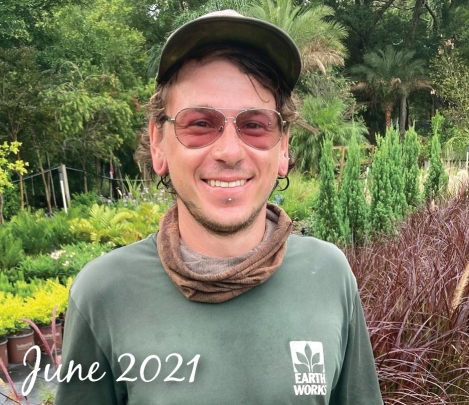
June 2021 Employee of Month Erik Kalwicki came to Earth Works almost one year ago and has been very flexible and helpful in multiple departments. With his great laid back attitude, he is very patient and understanding. Erik is very consistent with his methodical and meticulous work habits. He has made improvements to the Bluff and its functional flow and keeps tabs on inventory. He helps keep the plants looking good for our installs. He also helps the maintenance department run smoothly with sharpening blades, checking oil, and cleaning air filters. He enjoys music, gardening, and long road trips but most of all he loves jelly donuts! Thank you, Erik, for being a great team player and always getting the job done!
July 2021 Employee of Month Sean Friedman has been with us for 3 years in our lawn maintenance division doing a wonderful job while never receiving nor offering complaints. His customers regularly give him raving reviews. Sean’s communication between our clients and our team is excellent. He lives our points of culture (integrity, excellence, teamwork, and fun) every day with his positive can-do attitude. While he may be a true plant nerd, he also truly cares about being a star employee, wonderful father, and husband. Thanks, Sean for being a great employee!
August 2021 Employee of Month Sean O’Toole joined us this past spring to help with our outside team but a broken foot injury just days later allowed our customers to experience his extremely warm, detail-focused customer service skills at the front desk. Rarely do customers leave the garden center without Sean knowing their names. He follows up with them to ensure our team and customer expectations are met. His connections with customers and numerous Google reviews have made Sean a valuable addition to our nursery team. He is honing his outside skills as he heals, wrangling any palms and product out back that he has not sold yet. With his fun & can-do attitude, he looks forward to assisting us with our drop-off deliveries in the next couple of weeks. This will offer our customers even more opportunities to experience Sean’s outstanding customer service. Congratulations, Sean!
September 2021 Employee of Month Tim Greer has worn many hats since arriving 3 years ago. He is a vital link between our customers and foremen. Customers love him for his exceptional customer service. The foremen know they can reach out to him for a fast response on their field issues. Most recently, he has stepped into and excelled in his role as the Bluff Manager taking on any task that needs to get done; including welding trailer parts! He lives our points of culture (teamwork, integrity, excellence, and fun 24/7 always looking out for our best interests. Thank you, Timbo, for your part in leading our landscape team to success!
October 2021 Employee of Month Jackson Harris came to the landscape department 3 years ago as an excellent team player with a great work ethic from the beginning. He will always happily do what is asked of him. He spent a few weeks covering the Bluff plant router position. Though he can be a smart aleck, he also can be very humble expressing gratitude for his Earth Works job. On work sites, he exemplifies professionalism and has become a strong member of the landscape and pond crews. He asks great questions and is always curious to learn more. Recently, Jackson has transitioned into a Landscape Foreman position. On Saturdays, you are likely to see him wandering the nursery and supporting the business. Thank you for being a steady and strong teammate, Jackson!
November 2021 Employee of Month Doug Fisher exhibits all of our points of culture arriving one and a half years ago. He was promoted to a foreman position last summer and has exceeded all expectations. We constantly get calls from his very happy customers. He does awesome work and has great attention to detail. He brings a good attitude and never complains, even when he would be right to do so. Thank you, Doug, for being a great team player always ready to help out anytime or anywhere!
December 2021 Employee of Month Adam Cooprider arrived 2-1/2 years ago as a crewman with little to no landscaping experience. Every day since he has consistently worked to improve. He shows up to work on time bringing a great attitude to every job. Recently, he has stepped up and filled in for foremen to keep jobs running for us and our customers. He is eager to take on more responsibility to help us grow. As a great team player, Adam does whatever is asked of him at any time. Thanks for all your hard work, Adam!
Earth Works operates a retail Garden Center in Jacksonville/Plant Nursery and provides landscaping, hardscaping, water features, lawn care service, lawn spraying, and drainage solutions.
Earth Works proudly serves clients in Northeast Florida, including Jacksonville, Ponte Vedra Beach, Atlantic Beach, Neptune Beach, Jacksonville Beach, Nocatee, St. Johns, Fleming Island, Orange Park, Middleburg, Green Cove Springs, Amelia Island, Fernandina, and St. Augustine.
Paver patios, walkways, and driveways add to your property value, but be aware of common paver problems and solutions associated with poor craftsmanship.
SINKING PAVERS AND LEVELING ISSUES are common paver problems associated with poor site grading and an insufficient amount or type of aggregate base material installed to provide a stable foundation for the pavers. Popular aggregate base materials include recycled concrete (crushcrete), gravel, and geotextile materials. Choosing the correct aggregate is essential for the stability of pavers. Northeast Florida construction sites are commonly built on sand that holds water due to our being at or near sea level. Soil composite considerations are standard for reputable hardscaping professionals. The amount of base material required to avoid sinking pavers and leveling issues can vary based on soil composition and what is found during excavation. For instance, concrete driveways are poured on top of old cracked ones. We’ve experienced circumstances wherein additional excavation was required, and the use of extra base was needed. Strong concrete edging helps maintain the integrity of paver stability. Tree roots can also lift pavers. However, unlike concrete driveways and pathways cracked by tree roots, the equivalent paver driveways, patios, and walkways can be easily reset without a jackhammer and pouring additional concrete.
PLANTS AND DEBRIS BETWEEN UNSEALED PAVERS are common paver problems. Polymeric sand fills in-between the cracks and prevents anything from washing between or washing out and causing your pavers to become unlevel, said Earth Works Foreman David Arthur. The polymeric sand binds the pavers keeping out weeds and debris. Sealing pavers further protects them from damage and enhances their color.
DRAINAGE issues contribute to a variety of common paver problems, including sinking and leveling issues mentioned above, plus pooling of water resulting in mold and mildew buildup and associated slip and fall hazards. Proper drainage is essential for the longevity and safety of paver projects, so drainage considerations are an integral component of Earth Works design consultations. While drainage isn’t sexy, it’s essential for client satisfaction with their outdoor living space.
Contact us to book your hardscaping design consultation to avoid these common paver problems. We are a member of the Interlocking Concrete Pavement Institute and refer to them for additional information.
Earth Works operates a retail Garden Center/Plant Nursery in Jacksonville and provides landscaping, hardscaping, water features, lawn care service, lawn spraying, and drainage solutions.
Earth Works proudly serves clients in Northeast Florida, including Jacksonville, Ponte Vedra Beach, Atlantic Beach, Neptune Beach, Jacksonville Beach, Nocatee, St. Johns, Fleming Island, Orange Park, Middleburg, Green Cove Springs, Amelia Island, Fernandina, and St. Augustine.
Earth Works of Jacksonville consistently stocks a high-quality mix of 3-4” and 6-8” shubunkins, comets, wakins, and hibuna Florida pond goldfish varieties. Goldfish, Carassius auratus, although in the same family as koi, will not grow as large. Domestication of goldfish from crucian carp dates back to 200 AD in China. “During the Tang Dynasty (AD 618 to 907), goldfish with preferred phenotypes were selected to be raised in ornamental ponds and water gardens,” according to The evolutionary origin and domestication history of goldfish. “The goldfish was introduced into Japan and Europe at the beginning of the 17th century and introduced to North America ∼1850 where it quickly became popular.”
An advantage of growing goldfish in a pond includes a greater likelihood of reaching their genetic growth potential. In contrast, aquarium-grown fish often become stunted due to a lack of space to grow. Goldfish are bottom feeders that will eat a wide variety of flake and pellet foods along with plants, snails, and other invertebrates.
We only stock fish from Blackwater Creek Koi Farms for consistent, high-quality fish and biosecurity. Mixing fish from different suppliers increases the risk of illness and disease and the need for quarantining new fish. Stocking from only one high-quality vendor eliminates the need for quarantining new fish.
Available Florida Pond Goldfish Varieties Shubunkin goldfish are calico patterned orange, red, and black speckled over bluish base color and have heart-shaped tails. There are three varieties of Shubunkins, including the American (that we sell), London, and Bristol. Shubunkins grow to a maximum length of 12 inches.
Comet goldfish have bright red patterns over a white base color, often looking like small koi. Comet goldfish originated in the United States. Comets grow to a maximum length of 14 inches.
Wakin goldfish are principally distinguished by a double-tail with varied color patterns with several sub-varieties, including Calico and Red & White. Wakins grow to a maximum length of 12 – 14 inches.
Red Hibuna goldfish, also called common goldfish are solid reddish-orange or a mix of red patterns on white and grow to a maximum length of 12 inches. These are hardy fish and a likely feature for the average backyard pond.
Watonai goldfish are a double-tail variety genetically crossing humped-back Ryukin and fantail Wakin goldfish exhibiting longer flowing tails than wakins. “Watonai have the long slender body of the Wakin, but with a much larger tail which it carries spread horizontally,” according to Blackwater Creek Koi Farms. “The width of the tail fin should equal the length of the body. They can get fairly large, but the maximum body length is just slightly smaller than these other hardy varieties.”
Goldfish and koi can be trained to eat from your hand. Biology Teacher Gara Leen demonstrates (in the video below) a hand-feeding training technique for koi and goldfish using feeding rings in her pond.
We do not supply Black Moors, Bubble Eye, Fantails, Jikin, Lionhead, Orandas, Ranchus, Sabao, Tamasaba, and Ryukins. These pond stocking recommendations are strictly for ponds that do not connect to other natural water bodies, as these fish would then be considered invasive.
For stocking your pond with fish and comprehensive solutions to your specific lawn, garden, and landscaping needs, contact Earth Works of Jacksonville online or at 904-996-0712.
Earth Works operates a retail Garden Center/Plant Nursery in Jacksonville and provides landscaping, hardscaping, water features, lawn care service, lawn spraying, and drainage solutions.
We proudly serve clients in Northeast Florida, including Jacksonville, Ponte Vedra Beach, Atlantic Beach, Neptune Beach, Jacksonville Beach, Nocatee, St. Johns, Fleming Island, Orange Park, Middleburg, Green Cove Springs, Amelia Island, Fernandina, and St. Augustine.
December’s cold, dry weather requires a focus on watering and caring for plants while enjoying holidays by the fire pit. Last month was the seventh coldest November (58F average) on record, but the predictions are for milder average temperatures in December. We are experiencing an early month warmup before the shortest day of the year, on the December 21 Winter Solstice, and a return to colder weather. December high and low temperatures (67F high; 43F low) are the 2nd lowest averages of the year behind January. While December 2019 saw only one freezing day in Jacksonville, there were six in 2020. Keep up to date with your area’s weather forecasts and be prepared to protect your tender plants, pets, and livestock.
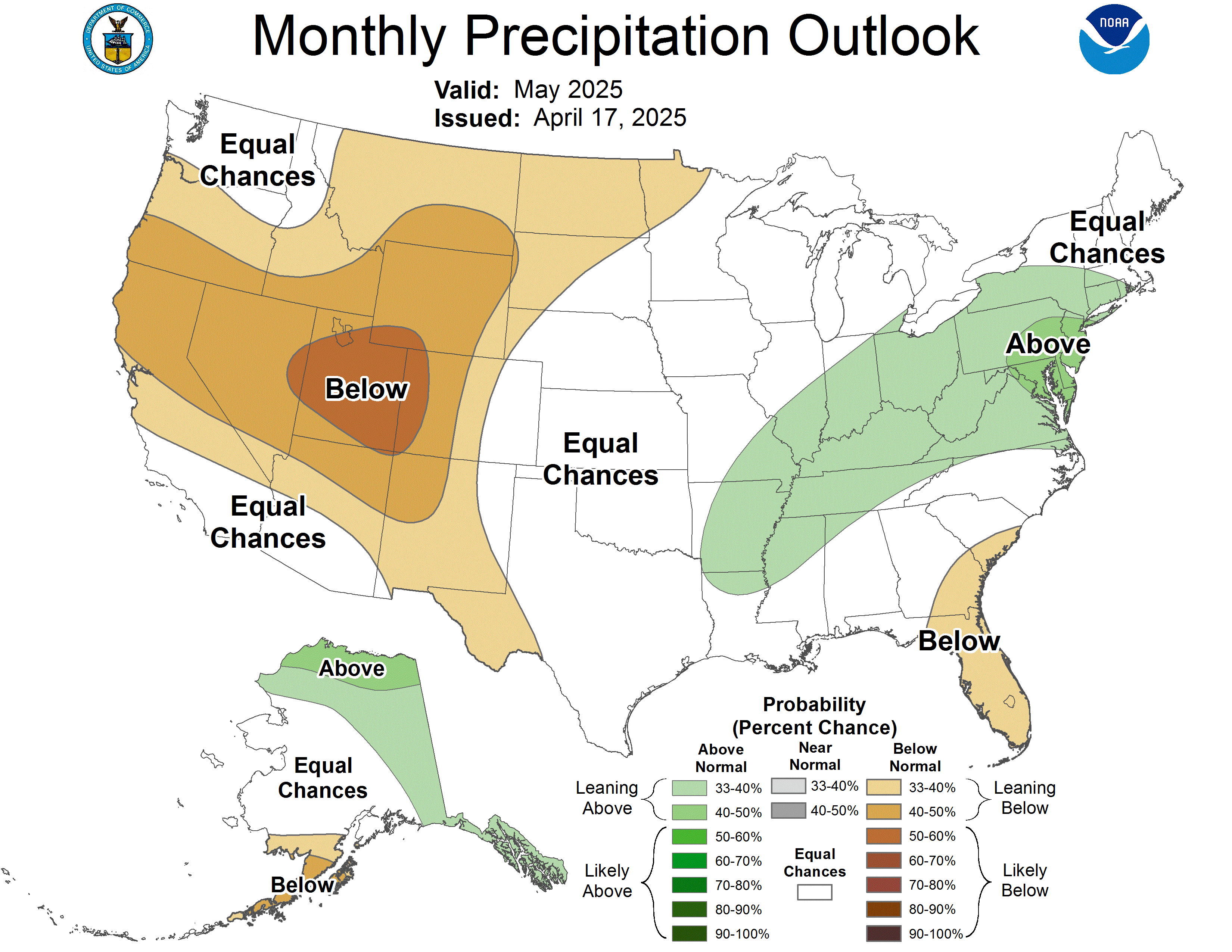
HOW OFTEN SHOULD WE WATER OUR LAWN IN DECEMBER? November 6th and 7th accounted for the majority of Jacksonville’s monthly rain total of 1.64 inches, which is nearly an inch below average for November, which is typically the driest month of the year. While drying out is suitable for reducing the threat of lawn fungus, too little water and watering at the wrong time can also cause problems. The National Weather Service predicts a continuation of below-average precipitation throughout the Southern United States in December.
Earth Works Lawn Care Operations Manager Chad Lakin urges that a healthy lawn needs two watering events per week in December. They can both be rain events or supplemented with a combination of irrigation and hand watering. New lawns, plants, and landscapes should be watered daily for the first month to get them established. Irrigation is restricted to once per week in Jacksonville, coinciding with a return to Standard Time that began on November 6. Stipulations for Jacksonville’s watering ordinance include: 1) No watering from 10 a.m. to 4 p.m. 2) Odd number addresses, or addresses ending with letters N-Z, or no address may water only on Saturday. 3) Even number addresses or those ending with A-M may water only on Sunday. 4) Non-residential addresses may water only on Tuesday and 5) Apply up to ¾-inch or less of water one time per week.
WHAT DOES LAWN TURF NEED IN DECEMBER? Proper care of your lawn during dormancy will directly impact its health in Spring and Summer. Lakin recommends Fall fertilization for root health with an NPK of 0-0-26, which helps protect against grey leaf spot fungus during the growing season. Now is an excellent time to consider soil AERATION & TOP DRESSING your lawn ahead of Spring, a service Earth Works Lawn Maintenance provides. Call or email Earth Works for a quote.
WHICH VEGETABLES CAN I PLANT IN DECEMBER? December vegetable planting recommendations are the same for November and December, with a few additional veggies added to the soil in January. University of Florida IFAS recommendations for December include Arugula, Beets, Broccoli, Brussel Sprouts, Cabbage, Carrots, Cauliflower, Celery, Collards, Kale, Kohlrabi, Lettuce, Mustard, Onions, Radish, Spinach, Strawberry, & Turnips. The cabbage at our vegetable tables looks really lovely and healthy now.
WHAT DO I NEED TO START MY CONTAINER GARDEN? We recommend Wild Earth Soil Mix for your raised beds or container gardening, a rich, light-weight compost mix available by the bag and yard. Espoma Organic Biotone Starter is an excellent planting fertilizer. As always, we have everything from earthworm castings to bat guano for your specific planting soil amendment needs.
BESIDES VEGETABLES, WHAT CAN I PLANT IN DECEMBER? Palms, fruit, and other trees can be planted in the cold, dry weather of December here in Northeast Florida. Winter is also the time of year to plant colorful annuals, including petunias, supertunias, violas, snapdragons, decorative kale, and Dusty Miller. Earth Works has a large selection of annuals for your garden beds. Poinsettias are plentiful during December, and Anthurium is another long-lasting, heart-shaped flower in a more limited supply with red or white blooms.
WHAT SHOULD I BE CONCERNED WITH MY PLANTS INDOORS IN DECEMBER? Getting your plants acclimated to indoor living after being brought inside requires extra attention to their light and watering needs. Our heating systems create far different conditions from those our outdoor plants are accustomed to. Regular inspection required watering, rotating, and adjusting plant positions for lighting and away from drafts, fertilization, and remedying pests problems are all part and parcel for active plant parents in Winter.
CAN I START MY BONSAI HOBBY IN DECEMBER? Bonsai is the Japanese art of growing dwarf trees in pots that can start anytime. These potted plants can be started indoors or out with as little as soil, container, and plant. Earth Works Garden Center Manager Matthew Barlow has decades of experience growing, training, and caring for bonsai plants and is available to answer your specific questions about bonsai. Earth Works likewise has bonsai plants ready to add to your collection or share as gifts during the Christmas holidays.
DO MY KOI FISH NEED SPECIAL CARE IN DECEMBER? The main concerns involving koi in December revolve around water temperature. Rhonda King, Earth Works Garden Center Associate Manager, discusses in the attached video cold water concerns for koi ponds, including: -The benefits of a pond thermometer. -Using the proper cold water food for koi digestive health. -Now is the time to schedule your pond cleanout before Spring.
IS WINTER A GOOD TIME TO SCHEDULE A LANDSCAPE DESIGN CONSULTATION? You should have a complete vision and plan for your landscaping before putting a shovel in the dirt. Still, Winter is a perfect time to schedule your landscape design consultation. Working with a professional designer can provide you a written plan to implement all at once or in phases. It can take weeks, even months, to schedule and implement your plan. Don’t wait too late to get your project scheduled to meet your desired completion date.
Don’t let the cold, dry weather of December deter you from caring for your plants and planning ahead for Spring and Summer. Contact us with your questions and for comprehensive solutions to your specific lawn, garden, and landscaping needs, at 904-996-0712. And remember that Earth Works has gift cards available in any denomination that can be used for any of our products and services. During the month of December 25% of gift card sales are donated to our local charity the Sanctuary on 8th Street.
Earth Works operates a retail Garden Center/Plant Nursery in Jacksonville and provides landscaping, hardscaping, water features, lawn care service, lawn spraying, and drainage solutions. Contact us at 904-996-0712.
Earth Works proudly serves clients in Northeast Florida, including Jacksonville, Ponte Vedra Beach, Atlantic Beach, Neptune Beach, Jacksonville Beach, Nocatee, St. Johns, Fleming Island, Orange Park, Middleburg, Green Cove Springs, Amelia Island, Fernandina, and St. Augustine.
Elephant ear varieties are popular foliage plants in the US that though toxic, are a starchy food for hundreds of millions of people worldwide. As Araceae family members, they include the genera Alocasia, Colocasia, Xanthosoma, and Caladiums. Some grow along the banks of ponds, rivers, and streams while others prefer uplands. Their corms are marketed as bulbs and potted up for sale as landscape material and houseplants. Select varieties are cooked rendering harmless the calcium oxalate toxin in their tissue that’s also found in rhubarb, dieffenbachia, and philodendrons.
Colocasia typically grows well in swampy areas along river banks, while Alocasia, Xanthosoma, and Caladiums tend to instead prefer moist, well-draining organic soil. They spread via rhizomes that form corms giving rise to additional stems.
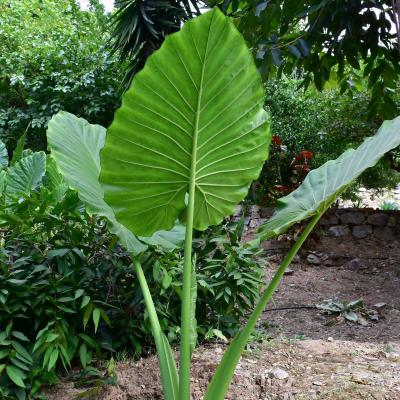
There is a great deal of literature on distinguishing between Alocasia and Colocasia. The petiole or leaf stem of Alocasia is connected at the leaf notch which causes the leaf to point upward whereas the petiole is farther down from the notch in Colocasia causing the leaf to droop. Xanthosomas typically have arrow-shaped leaves that are waxy and heavily veined. Caladiums are much smaller with leaves that appear as fragile as tissue paper that point downwards. Microscopic differences in the flower structure are the most accurate method of distinguishing between varieties that are otherwise widely misnamed.
The common name ‘elephant ear’ used in the USA is interchangeable with their food variety names including taro (Colocasia esculenta) in Asia and the South Pacific, Eddoes (Colocasia antiquorum) in the West Indies and Brazil. At the same time, Malanga or Cocoyam (Xanthosoma sagittifolium) is prominent in diets in the Americas and Africa. Adding to the confusion, “Colocasia antiquorum has been subsumed into Colocasia esculenta and is now listed as a variety of that species,” according to San Marcos Growers. Both Colocasia esculenta and Xanthosoma sagittifolium are considered invasive species in Florida. “No matter what cultivar you select, never plant elephant ears in or near a natural waterway; many spread rampantly and become a problem,” according to the University of Florida.
“It is an ancient crop in Asia, being introduced into Japan more than 2500 years ago,” wrote the Encyclopedia of Food Sciences and Nutrition regarding taro. “It is considered a food staple for more than 500 million people in the regions of Asia, Africa, Central America, and the Pacific Islands,” wrote Advances in Food and Nutrition Research regarding taro. “In the southern Mediterranean, it is consumed more than potatoes.”
“Cocoyam (Xanthosoma sagittifolium) is among the world’s six most important root and tuber crops,” according to Food Science & Nutrition. “However, it remains an underexploited food resource. The challenge of underutilization is exacerbated by the existing confusion in taxonomy and nomenclature which limits researchers in exploiting data from one area of indigene to another.” Notwithstanding the confusion of distinguishing between them, these corms are the potato of the tropical world. “Of all the vegetables, malanga causes the most confusion,” according to The Spruce Eats. “It looks so much like the related taro and eddo corms that a number of common names are applied to this group and they’re often used interchangeably.” The best authorities on elephant ear dishes may be at your local farmers’ market, ethnic food store, and restaurant.
The plant trade markets a large number of elephant ears with multiple synonyms for the same species. The Plant List is a working list of all known plant species that identifies the species per variety as 79 Alocasia, 73 Xanthosoma, 16 Colocasia, and 12 Caladiums. The heavily marketed caladiums with their diverse color patterns are sold under 179 synonyms.
Alocasia amazonica ‘Bambino’ is a jewel (dwarf) variety reaching 12” in height with white venation on the thick dark green arrow-shaped leaves. They grow best in well-draining soil and are a relatively easy-care houseplant preferring bright indirect light.
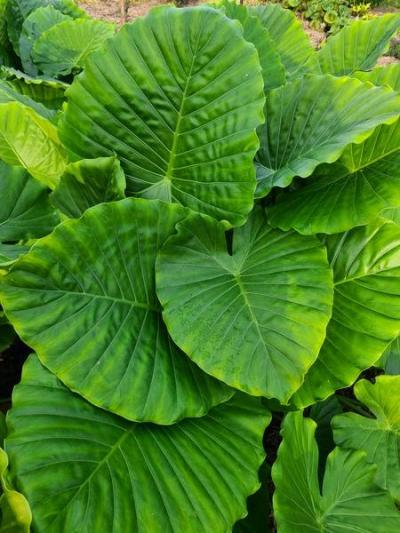
Alocasia Gagaena California is a fast-growing variety reaching 4’ maximum height with light green leaves and deep venation that lends a crinkled look to the large upward-pointing leaves. They are considered among the most cold-hardy of varieties grown outdoors.
Alocasia Lauterbachiana, the purple sword elephant ear grows to 4′ maximum height with long narrow, sword-like leaves. Lauterbachiana prefers well-draining soil and bright indoor light. Keep away from drafts as they are quite cold-sensitive and prefer temperatures above 60 degrees.
Alocasia Maharani is also known as the gray dragon is a jewel variety with a 14″ maximum height. They like bright indirect light and moist though well-draining soil. Keep Maharani at temperatures above 60 degrees.
Alocasia Odora is also known as Night Fragrant Lily exhibiting upturned leaves and peach-colored fragrant blooms in Spring and Summer. They prefer full to partial shade growing 4-6’ in height in moist, rich organic soil.
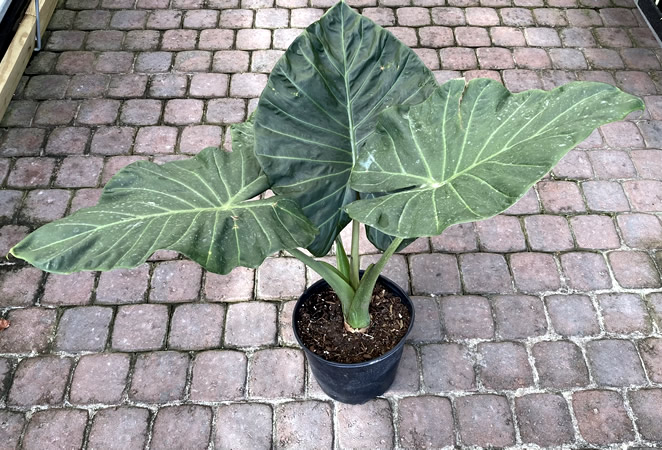
Alocasia Regal Shield grows to a 5′ maximum height with thick, dark green leaves and burgundy undersides. They don’t like wet feet, but moist rich organic well-draining soil and filtered light outdoors and indirect light indoors. They enjoy humidity and do best in temperatures above 65F degrees.
Alocasia Yucatan Princess has dark green leathery foliage with a hint of purple on red stalks reaching 6’ maximum height. Yucatan Princess is a mutation of Alocasia sarawakensis thus often referred to as Alocasia Sarawakensis Yucatan Princess. They prefer moist, well-drained soil and indirect or filtered light.
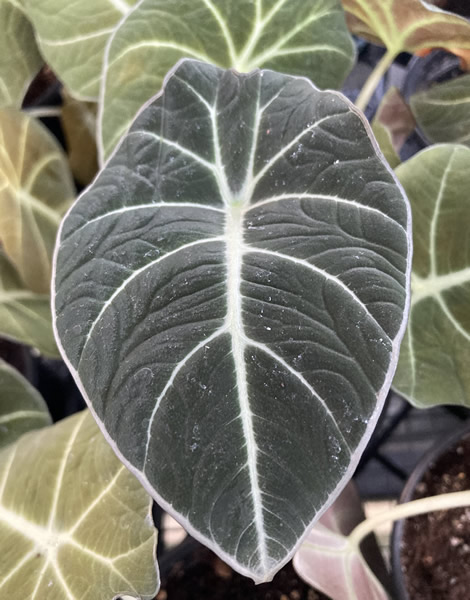
Alocasia Reginula, also known as Black Velvet Alocasia has a rich green nearly black color with silver-white venation reaching a maximum height of 3′, but are typically much smaller and suited for terrariums. They prefer temperatures above 60 degrees in well-draining soil with indirect sunlight.
Syngonium podophyllum is a vining aroid with arrow-shaped leaves that are often confused with caladiums. Unlike caladiums and other aroids discussed here, Syngonium spreads by aerial or adventitious roots and can be propagated by stem and leaf node cuttings. Syngonium prefers well-draining, aerated soil, indirect light, high humidity, and temperatures above 60 degrees.
Syngonium podophyllum
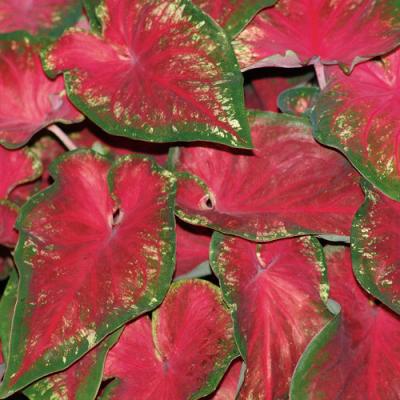
Caladiums grow to a maximum height of 2’ and are widely propagated and sold as bulbs (actually are corms) and as potted plants. Most color varieties prefer indirect or filtered light and do best in well-draining soil. They are not frost hardy resulting in dieback as Fall temperatures drop below 60 degrees.
Earth Works Garden Center/Plant Nursery, Landscaping, and Lawn Care divisions that make available and care for a wide selection of genera Alocasia, Colocasia, Xanthosoma, Caladiums, and Syngonium. A reminder that all Aroids should be considered toxic requiring caution around children and pets.
For comprehensive solutions to your specific lawn, garden, and landscaping needs, contact Earth Works of Jacksonville online and at 904-996-0712. We proudly serve clients in Northeast Florida, including Jacksonville, Ponte Vedra Beach, Atlantic Beach, Neptune Beach, Jacksonville Beach, Nocatee, St. Johns, Fleming Island, Orange Park, Middleburg, Green Cove Springs, Amelia Island, Fernandina, and St. Augustine.
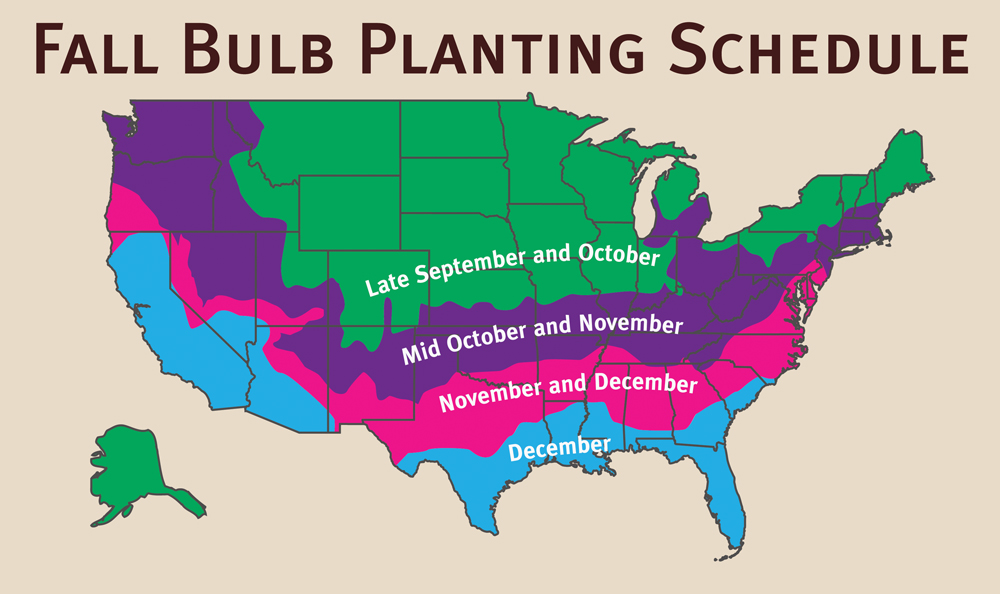
Breaking dormancy for cold-hardy seeds and bulbs requires mimicking plant germination cycles, techniques called stratification, which is accomplished by controlling temperature and moisture for a period of time. Stratification has been in practice for hundreds of years and was first described in the 1664 writings of English Horticulturist John Evelyn. Evelyn’s emphasis on the relevance of stratification had to do with efficiently growing trees to replenish timber for British Navy ships. In botanical terms, stratification is distinguished from “chilling” which is the amount of cold time fruiting plants require to blossom, also known as vernalization. Although it sounds complicated stratification is easy to do when you are equipped with the right information for each of your plant choices.
It’s important to understand that there are two types of dormancy both endo-dormancy and ecto-dormancy. Endo-dormancy is before chilling whereas in ecto-dormancy chilling has already occurred and the plant is ready to begin growing once the temperature rises sufficiently. “As the plant enters endo-dormancy, it tracks chilling units to track the passage of the winter. Chilling units are hours of time spent above freezing,” according to Michigan State University. “As long as the plants are in endo-dormancy they have the ability to acclimate to colder temperatures and withstand winter cold. After chilling is completed the plants are no longer in endo-dormancy. They are now in eco-dormancy. The plants are dormant only because of cold or cool weather. Warmer temperatures into the mid-40s will cause them to begin growth. Once the plants start to grow, they lose the ability to readjust to colder temperatures. There is usually a slow progression of development when the plant begins to grow as the temperatures slowly rise.”
Most Northeast Florida native and tropical plants germinate in warmth, but the cold-hardy varieties with thick seed coatings often require a set period of cold temperature and moisture to soften the shell and break dormancy. “Having such a tough shell ensures that germination occurs only when conditions are right,” according to The Guardian. “Weather fluctuates; you don’t want your seed jumping into germination just because autumn has a few cold nights and then a warm one. It’s not spring yet and those cold nights did not represent winter. So time and temperature are the keys necessary to unlock germination for many seeds.”
Considering breaking dormancy requirements are specific for each species follow the seed and bulb package stratification recommendations for time, temperature, and planting media. Additionally, if chilling in the refrigerator is deemed appropriate, ensure that the temperature, packaging material, and germination media are also appropriate. Stratification in the refrigerator is typically better done in paper than plastic, which improves air circulation and reduces threats from pathogens. While some plants germinate best wrapped in a damp paper towel in the back of the refrigerator others do just fine in a pot of soil outside. Do your research.
Seeds that require cold stratification include Anise Hyssop, Asparagus, Milkweed, Baby’s breath, Black-eyed Susan, Butterfly bush, Caper, Chinese Lanterns, Columbine, Coneflower, Delphinium, Echinacea, Geranium, Lavender, Lobelia, Oregano, Poppies, St. Johns Wort, Sunflower, Violet, and Yarrow. Although Earth Works typically offers seedlings of many of these varieties of plants when they produce seeds stratification is required for germination.
Tulips grown from bulbs in Florida require cold stratification to break dormancy, as do daffodils and hyacinths. “To grow tulips successfully, the bulbs need cold treatment, but not moist stratification or storage in a damp soil medium,” according to SFGATE.com. “Although tulips prefer a moist planting site, the bulbs are mainly responding to the cold temperatures rather than water availability.” A few of the bulbs that don’t require chilling for Florida gardens include Anemone, Allium, Caladium, Crinum lily, Gladiolus, Oxalis, and Turks Cap.
By learning to mimick plant germination cycles successfully and breaking dormancy techniques you will significantly increase the varieties of plants you can successfully grow and enjoy year after year in your lawn and garden.
Earth Works operates a retail Garden Center/Plant Nursery in Jacksonville and provides landscaping, hardscaping, water features, lawn care service, lawn spraying, and drainage solutions. Contact us with your questions and to book design consultations.
For comprehensive solutions to your specific lawn, garden, and landscaping needs, contact us at 904-996-0712. We proudly serve clients in Northeast Florida, including Jacksonville, Ponte Vedra Beach, Atlantic Beach, Neptune Beach, Jacksonville Beach, Nocatee, St. Johns, Fleming Island, Orange Park, Middleburg, Green Cove Springs, Amelia Island, Fernandina, and St. Augustine.
We expect our turf grass to go dormant in the cooler months, but don’t turn your back on Fall Winter watering as the lawn and garden need that moisture. “The month with the fewest wet days in Jacksonville is November, with an average of 5.3 days with at least 0.04 inches of precipitation,” according to WeatherSpark.com. “The drier season lasts 8.2 months, from September 27 to June 2.”
We are halfway through our third week of November here in Jacksonville, and it has rained just three times this month, mainly on the 6th & 7th. Then we got a sprinkle on the 12th. In November 2020, it rained several times each week in Jacksonville for a total of 17 times that month. That was a much more favorable set of circumstances. Like a soaker hose, the water is delivered with greater frequency in small regular doses. Nothing is perfect though, as too frequent watering can result in shallow root systems and invite fungus.
“As Jacksonville heads into the driest month of the year in November, the potential for a flash drought will grow without persistent rain in the forecast,” according to News4jax.com. “A flash drought often begins as a small rain deficit in one county and then expands like fire across the landscape. Flash droughts are often accompanied by erratic precipitation over sharply defined geographic areas.”
There is only a slight chance of rain over the next 10 days. And November, along with October, has the clearest skies of the year for Jacksonville. Some days may be overcast without much precipitation ahead of a cold front, which can give us a head fake that we will get rain that never materializes. Rain totals thus far for November are what they were for all of Nov 2020, but when it comes down all at once, the soil doesn’t absorb as much of it as it is lost to stormwater runoff.
“Irrigation frequency will vary based on grass species, rainfall amounts, soil type and amount of compaction, shade presence, geographical location in the state, and, most importantly, by season,” according to the University of Florida. “Irrigation systems should be reset seasonally to reflect the differing water requirements of grasses based on time of year. Ideally, University of Florida guidelines call for watering lawns on an “as-needed” basis. This can be determined by observing the grass for signs of water stress, which indicate that water lost in transpiration is not being replaced and the plant’s needs for water are not being met. The signs that you need to look for are: • Leaf blades are folded in half lengthwise in an attempt to conserve water. • The grass takes on a blue-gray tint rather than maintaining a green color. • Footprints or tire tracks remain visible on the grass long after they are made.”
The Fall season watering is more crucial than Winter, primarily considering higher daily temperatures in Northeast Florida. As seen in the chart by Meyers and Horn, Florida Turf Growers, our St Augustine turfgrass requires a greater frequency of rain or watering in Fall than Spring. Measured in Gainesville the St Augustine grass can go 3-9 days between watering in Spring and only 2-8 days in Fall.
Obviously, our flower beds, landscape plants, and garden will need rain or regular Fall Winter watering. Drought conditions cause plant stress. “Without periodic rains or irrigation, your plants will stop producing fruit and will drop any fruit they have already produced,” according to UF Gardening Solutions. “Remember, most Florida soils drain easily and don’t retain water. Adding organic matter to the soil will help the soil retain moisture, conserving you water and saving you effort.”
Earth Works recommends keeping your turf, landscape, and garden healthy with at least two rain or watering events per week while abiding by local watering restrictions. Contact Chad Lakin, Earth Works Lawn Maintenance Operations Manager, with your specific lawn care questions at 904-996-0712 and get a free quote for your lawn care.
Earth Works operates a retail Garden Center/Plant Nursery in Jacksonville and provides landscaping, hardscaping, water features, lawn care service, lawn spraying, and drainage solutions. Contact us with your questions and to book design consultations.
We proudly serve clients in Northeast Florida, including Jacksonville, Ponte Vedra Beach, Atlantic Beach, Neptune Beach, Jacksonville Beach, Nocatee, St. Johns, Fleming Island, Orange Park, Middleburg, Green Cove Springs, Amelia Island, Fernandina, and St. Augustine.
Share Your Story!
Manage Consent
To provide the best experiences, we use technologies like cookies to store and/or access device information. Consenting to these technologies will allow us to process data such as browsing behavior or unique IDs on this site. Not consenting or withdrawing consent, may adversely affect certain features and functions.
Functional
Always active
The technical storage or access is strictly necessary for the legitimate purpose of enabling the use of a specific service explicitly requested by the subscriber or user, or for the sole purpose of carrying out the transmission of a communication over an electronic communications network.
Preferences
The technical storage or access is necessary for the legitimate purpose of storing preferences that are not requested by the subscriber or user.
Statistics
The technical storage or access that is used exclusively for statistical purposes.The technical storage or access that is used exclusively for anonymous statistical purposes. Without a subpoena, voluntary compliance on the part of your Internet Service Provider, or additional records from a third party, information stored or retrieved for this purpose alone cannot usually be used to identify you.
Marketing
The technical storage or access is required to create user profiles to send advertising, or to track the user on a website or across several websites for similar marketing purposes.