Proper palm pruning beautifies these stately specimens in the landscape and protects them from stress from poor care and environmental pressure. Benefits of Proper Palm Pruning Include: • Preserving the health of the palm. • Improving their appearance. • Eliminating places for pests to hide. • Reducing wind resistance during bad weather. • Reducing fire hazards from the highly flammable dead fronds. There are self-cleaning palms for people who don’t want to worry about pruning. Self-cleaning palms include King Alexander (Archontophoenix alexandrae), Royal palm (Roystonea regia), Chinese Fan palm (Livistona chinensis), and Christmas palm (Adonidia merrillii).
The first step in proper palm pruning is to inspect and assess the source of any damage to the palms. Trimming your palm tree is no substitute for appropriate fertilization and care. You can’t fix mineral deficiencies and damage from pests, pathogens, and disease by pruning the tree.
What Tools do I Need to Properly Prune Palms? Proper palm pruning tools include: gloves, eye protection, pruning shears, loppers, telescoping pole saw, ladder, rubbing alcohol, bleach, or other comparable disinfectants to clean tools before and after use to avoid spreading pathogens and disease between plants. Tree trimming services should use ladders or a bucket truck rather than climbing with spiked shoes that damage the trunks and invite pests, pathogens, and diseases. Ask others who prune your palm trees to disinfect their tools and don’t allow them to climb them with spiked shoes.
How Often Should I Trim my Palms? Typically once per year in Spring is the best time and frequency to trim palm trees. Avoid removing the healthy green fronds. Instead, focus on eliminating brown and yellowing palm fronds damaged at the end of their life cycle. The fruiting flower stalks, or inflorescence, can be removed at this time to conserve the plants’ energy and reduce hazards from falling fruit and the corresponding mess, odor, and insect attraction.
Proper Palm Pruning Techniques Start pruning below the canopy and work up and around the tree to a horizontal frond position like arms on a clock at 9 and 3. Palms are monocots, plants that emerge from one leaf. Each new leaf emerges from the apical meristem, commonly referred to as the heart of the palm at the very top of the tree. “Death of the apical meristem in a palm results in the death of that stem in clustering species and death of the entire palm in single-stem species,” according to the University of Florida IFAS. “It also means that stem wounds, which would eventually be compartmentalized and grown over in dicot trees, are permanent in palms.” Due to the circumference of the palm trunks continuing to expand trim fronds 1/2-3/4″ back from the tree trunk on smaller palms such as Pygmy date palm (Phoenix roebelinii) and 4-6″ from the trunk on large palm trees. The remaining portion of the frond on the trunk is referred to as the boot, which will die and in most species form a crisscrossing pattern that will eventually fall off or can be carefully removed.
The Sylvester date palm tree (Phoenix sylvestris) is known for its signature diamond-cut trunk. To create the diamond-cut tree farms prune for this look with a reciprocating saw that prevents trunk damage while exposing their orange genetic coloration. Although the color will fade in the months and years ahead it can be restored by pressure washing. Loppers and pole saws are recommended for Sylvester date palm tree annual pruning and a reciprocating saw, NOT a chainsaw when striving to duplicate the diamond cut. The beauty of your tropical landscape will increase along with the health of your palms by using these proper palm pruning techniques.
For comprehensive solutions to your specific lawn, garden, and landscaping need, contact us at 904-996-0712. Earth Works operates a retail Garden Center/Plant Nursery in Jacksonville and provides landscaping, hardscaping, water features, lawn care service, lawn spraying, and drainage solutions.
Earth Works proudly serves clients in Northeast Florida, including Jacksonville, Ponte Vedra Beach, Atlantic Beach, Neptune Beach, Jacksonville Beach, Nocatee, St. Johns, Fleming Island, Orange Park, Middleburg, Green Cove Springs, Amelia Island, Fernandina, and St. Augustine.
Consider these six essential February lawn and garden tips for a beautiful close to winter and a healthy, and robust Spring season ahead.
1) In February, continue protecting plants from frost and freeze damage. While the threat of frost and freezing temperatures vary on average the last freeze day in Jacksonville is February 15 and January 23 in coastal Jacksonville Beach. However, on January 30 Jacksonville Beach reached a low temperature of 31 while at Jacksonville International Airport (JIA) they recorded a low of 22F with the lowest temperature ever recorded on that date being 20F back in 1966. Where you live has a significant bearing on the risk of frost and freezing temperatures. JIA recorded six below-freezing temperature days in January, whereas there was just one on the 30th at Craig Airport. Even with a warmer than usual Winter resulting from La Nina January was unpredictably cold. The News4Jax Insider reports that forecast models suggest that, “starting Feb. 23, the Eastern U.S. should begin to warm and warm considerably, pointing to an early start to spring.” With the damage already done, there will be many people shopping to replace plants in the coming months. Don’t be blindsided by another frost or freeze!
2) Rake, mulch, or compost leaves, but don’t leave them unattended on your lawn turf. While many deciduous trees drop leaves in Autumn and Winter, the evergreen Live oak typically sheds its leaves over several weeks between February and March and then immediately flushes out a crop of new leaves. After shedding their leaves, oaks follow up by dropping male flowers (catkins), which are loaded with pollen and have the texture of steel wool that can easily clog pond and pool filters. When unattended leaf litter and catkins can smother your lawn turf. While proponents of native landscapes aren’t concerned with grass in the landscape some community HOAs, for instance, require lawns to be well maintained and millions of families enjoy a beautiful well-kept lawn. While we provide lawn care services we appreciate landscaping with Florida native plants that are adapted to area climate and soil conditions and have landscape designers ready to work with you in developing whatever your preference of lawn and garden.
3) Keep weeds on your lawn under control by hand pulling or use of a pre-emergent herbicide before average temperatures reach 65-70F. As temperatures warm heading into Spring, the threat from the Winter weeds is replaced by the emergence of warm-season weeds. In our temperate climate, there is some crossover in the seasonal varieties of lawn weeds. -Florida perennial weeds include buttonweed, clover, dallisgrass, dandelion, nutsedge, and dollarweed. -Florida annual weeds include chickweed, crabgrass, beggarweed, pulsey, goosegrass, and spurge. Earth Works Lawn Care division eliminates these concerns with weed spraying and fertilization services.
Weed And Feed products typically include pre-emergents. UF recommends March 1 for the earliest Weed and Feed applications in North Florida. “You will not injure your lawn by waiting to fertilize but you can certainly injure your lawn by fertilizing too early,” writes Larry Williams, the Residential Horticulture Agent for the UF/IFAS Extension Office in Okaloosa County. Difficulties in avoiding too late applications of pre-emergent herbicides and too early fertilization give some credence to using herbicides and fertilizers separately. Read more about When Should I Apply Weed And Feed.
4) Do not forget to water your lawn throughout February when receiving less than two rain events per week. Consistent with La Nina weather forecasts, Jacksonville’s rainfall for January was below average, receiving only one inch of precipitation compared to the annual January average of three inches. We are under once per week irrigation restrictions in Duval County until the second Sunday in March, according to Chapter 366 of the City’s Ordinance Code. However, there are exceptions for new landscaping and there are no restrictions on hand watering.
5) Throughout the Winter months, including February, it’s recommended to plant cold-hardy annuals such as alyssum, delphinium, dusty millers, ornamental kale, and cabbage, along with violas that hold up to our coldest temperatures. “Trees and shrubs that will be in bloom include red maple, star magnolia, and spirea,” according to the University of Florida. “Despite the cooler weather, some gardeners can begin to plant warm-season crops, while others should stick to plants that can survive the cold.” Areas around the St. Johns River, its tributaries, and the beaches stay significantly warmer than other inland areas.
6) Regularly inspect houseplants and those brought indoors during the winter. Be watchful for pests such as Spider mites that form webs along leaf margins. Spider mites and various other pests can be effectively treated with Neem oil. Rotate plants to provide them 360-degree access to inspect and for them to get the best use of available light sources.
Spider mites and their web on Alocasia
Don’t neglect plants brought indoors that might be bunched together, not allowing adequate light and inspection access. Watch for signs of too much or too little water and sunlight. Some plants such as the Heart-shaped, Hoya kerrii will turn yellow from too much light or too little water. Succulents can begin turning purple from various causes, including sudden light and temperature changes, too much light or the wrong wavelength provided by certain grow lights. If having an issue with your indoor plants, take photos and bring them in to speak with an associate at the Earth Works garden center.
Inspect houseplants: This Hoya kerrii turned yellow from too much light or too little water.
We hope the February lawn and garden tips benefit your efforts and for comprehensive solutions to all your specific lawn, garden, and landscaping needs, contact us at 904-996-0712.
Earth Works operates a retail Garden Center/Plant Nursery in Jacksonville and provides landscaping, hardscaping, water features, lawn care service, lawn spraying, and drainage solutions.
Earth Works proudly serves clients in Northeast Florida, including Jacksonville, Ponte Vedra Beach, Atlantic Beach, Neptune Beach, Jacksonville Beach, Nocatee, St. Johns, Fleming Island, Orange Park, Middleburg, Green Cove Springs, Amelia Island, Fernandina, and St. Augustine.
Consider these tips for new landscape watering as these plant requirements vary from those already established in the lawn and garden. Even the healthiest trees, shrubs, and flowers planted in ideal circumstances need substantial time, care, and proper irrigation to become established in the landscape. Regular irrigation in the month after planting ensures the plants remain healthy and attractive as they establish. The time it takes for a nursery-grown tree to become established ranges from 4 to 15 months, depending on trunk size. Even a three-gallon shrub can take as long as seven months to take hold. Remember, these plants were watered daily, some twice a day in the nursery.
New Landscape Watering Guidelines for New Plants
Frequency and the amount of water are essential factors in establishing plants. A typical automatic overhead irrigation system is not sufficient. Generally, your new landscaping will need an extra consistent drip system or hand watering to ensure long-term success.
The following Guidelines Will Need To Be Adjusted For Variables:
One-gallon plants: Gently hand-water daily for at least two weeks (less in rainy or cool seasons), gradually tapering off to every other day, then three times a week through the first month (2-3 months in summer). Flowers will require regular watering throughout the warm season. Container plantings will need a drip system or hand watering indefinitely.
Three-gallon shrubs: Apply at least one gallon of water directly to the root ball every other day for the first two weeks; tapering off to twice a week for the first three months (longer if in summer or drought conditions). Use of regular overhead irrigation will be sufficient after that.
Larger shrubs (15 gallon+) and trees 2″-4″ diameter: Be sure the water runs long enough to soak the entire root ball. Place your hose at the base of your shrubs or trees slowly for 10-15 minutes each. Do this daily for at least one month, then every other day for the following month (2 months June-September). Continue hand watering twice a week for the next three months, then weekly until established.
Extra-large trees (4″+ diameter trunk): Drip or hand water daily for six weeks. Continue every other day for the next five months, then weekly until established (at least 15 months).
Reason to Water Less:
-Heavy or consistent rain.
-Damp soil conditions.
-Deep shade.
-Drought tolerant plants (still need some water to establish).
“Avoid watering between 10 a.m. and 4 p.m,” according to the University of Florida. “A significant amount of irrigation will be lost to evaporation when watering with overhead irrigation during the heat of the day. Check with your municipality and water management district for the latest watering restrictions.
While we strongly encourage water conservation, extra water is required to establish your new landscape successfully. If your county has watering restrictions take note of any allowances for extra watering and hand watering to establish new plants. “Exceptions under certain circumstances are allowed (such as using a hand-held irrigation tool, micro-irrigation systems, maintenance, and repair or watering to establish new landscaping,” according to the City of Jacksonville.
Earth Works operates a retail Garden Center in Jacksonville and provides landscaping, hardscaping, water features, lawn care service, lawn spraying, and drainage solutions. Visit us or for specific lawn, garden, and landscaping needs, contact us online at Earth Works or give us a call at 904-996-0712.
Earth Works proudly serves clients in Northeast Florida, including Jacksonville, Ponte Vedra Beach, Atlantic Beach, Neptune Beach, Jacksonville Beach, Nocatee, St. Johns, Fleming Island, Orange Park, Middleburg, Green Cove Springs, Amelia Island, Fernandina, and St. Augustine.
Organic top dressing lawns, although labor-intensive, provides your beautiful lawn vital ecological benefits. Top dressing lawns, simply put, is spreading a thin 1/4”-1/2” layer of organic material on the lawn. Our service aerates the soil before top dressing to reduce compaction, which allows better oxygen, water, and nutrient absorption. In a few months, the benefits become obvious.
The earliest lawns of 17th century England were owned by only a handful of nobles and the wealthy who could afford a well-kept patch of grass. Lawn ownership increased dramatically after industrialization and the invention of the lawn mower. Now you’d better have a well-maintained lawn if your community has a Home Owners Association (HOA). Organic top dressing helps keep your well-kept patch of grass healthy and beautiful while reducing the need for fertilization, pesticides, and watering.
Benefits of top dressing lawns include: -Reduces compaction & thatch buildup. -Reduces stress from foot traffic. -Improves water retention. -Replenishes organic nutrients. -Fortifies with micronutrients. -Reduces fertilization and irrigation needs.
“A recent field study conducted in a local development showed an average increase of soil organic matter of nearly 60% with compost topdressing,” according to the University of Florida. “Do your own “citizen science” and see if you are able to enjoy a beautiful lawn with fewer inputs this year. It’s time to top-dress your turf!“
Earth Works Lawn Care provides aeration and top dressing service within our Northeast Florida service area. We encourage homeowners to either do-it-yourself every few years or contact Earth Works Lawn Care to schedule this important service. Schedule a Lawn Care Account Manager visit to your home for a quote. And see our other lawn services and get a free quote online.
Earth Works operates a retail Garden Center in Jacksonville and provides landscaping, hardscaping, water features, lawn care service, lawn spraying, and drainage solutions. Visit us or for specific lawn, garden, and landscaping needs, contact us online at Earth Works or give us a call at 904-996-0712.
Earth Works proudly serves clients in Northeast Florida, including Jacksonville, Ponte Vedra Beach, Atlantic Beach, Neptune Beach, Jacksonville Beach, Nocatee, St. Johns, Fleming Island, Orange Park, Middleburg, Green Cove Springs, Amelia Island, Fernandina, and St. Augustine.
With La Nina bringing warm winter weather conditions to Northeast Florida our lawns and gardens are likely to experience more pests earlier in the season. Ants, aphids, chinch bugs, grubs, mole crickets, mosquitos, sod webworms, termites, and wood-boring beetles, may all arrive and reproduce early this year. “Warm means that insects could become active sooner,” said Eileen Buss, a University of Florida associate professor of entomology. The warmer winters essentially act as an alarm clock for plants and bugs, which spring into action, Buss said.”
There are complications though as not all pest species respond the same way to warm winter weather. “A warm winter day could cause insects to become active (e.g., woolly bear caterpillars) when they normally would be dormant,” explained Integrated Crop Management News. “Activity uses up stored fats they depend on to survive until the spring. Without access to food, these active insects could starve to death before food becomes available.” However, Iowa’s average low January temperature is in the twenties compared to Florida’s high fifties and Jacksonville high forties. Insects typically begin to enter a hibernation-like torpor state called diapause when temperatures drop into the low forties. Whereas, regional species of fleas begin to die off below 37F other species of insects produce glycerol using it as a sort of antifreeze that allows them to walk around during warm Winter weather and not die during a periodic cold snap.
Florida lawn and garden pests develop in fewer days during warm winter weather as the insect growth rate is temperature-dependent. “Every insect requires a consistent amount of heat accumulation to reach certain life stages, such as egg hatch or adult flight,” according to Utah State University. “Degree day values interpret that heat accumulation. When used to determine treatment timing, they are an important component of an Integrated Pest Management program, providing a cost effective tool to reduce insect feeding damage.”
Be vigilant in monitoring your lawn and garden plants during warm winter weather, checking the undersides of leaves, and being ready for applying preventative treatments.
Insects aren’t the only threat as fungus spore survivability improves with warm Winter weather. La Nina Winter conditions forecast less precipitation throughout the Southeast. While ensuring your lawn and landscape have adequate weekly watering, don’t overwater, which is an invitation to fungus. Be on the lookout for Brown Patch fungus in your turf prevalent when evening temperatures are below 70F. Signs of Brown Patch fungus are rings and small irregular patches of dead grass.
Learn the signs and symptoms of pests and pathogens in your landscape to reduce the risk and threats of infestations. Ensure your lawn care service is proactive in assessing and preventing these potential warm Winter weather threats with adequate treatments early. Earth Works Lawn Care division offers free quotes for Lawn and Landscape disease and pest control services.
Earth Works operates a retail Garden Center in Jacksonville and provides landscaping, hardscaping, water features, lawn care service, lawn spraying, and drainage solutions. Visit us or for specific lawn, garden, and landscaping needs, contact us at 904-996-0712. Earth Works proudly serves clients in Northeast Florida, including Jacksonville, Ponte Vedra Beach, Atlantic Beach, Neptune Beach, Jacksonville Beach, Nocatee, St. Johns, Fleming Island, Orange Park, Middleburg, Green Cove Springs, Amelia Island, Fernandina, and St. Augustine.
Congratulations to our 2021 employee of month award winners recognized at our monthly meetings scheduled on the first Thursday of each month.
January 2021 Employee of Month Patti Sanders joined the Earth Works design team this past summer and jumped right in with a great attitude and a smile. She had gone to school for landscape design but ended up in management and sales for a few major companies. She moved to Jacksonville 2 years ago and was a manager for Lowes Garden Center in Mandarin. She realized how much she missed her passion for design and sought out Earth Works. After learning the Earth Works Way, she is off to a great design future with the Earth Works team. Thanks, Patti, for doing a great job for our clients!
February 2021 Employee of Month, Matt Friend, is the Jaguar Trevor Lawrence’s new biggest fan! He also is one of our all-time most enjoyable employees to work with all day. Even on tough days, Matt ALWAYS has a smile. Every day, he shows up extra early ready for any challenge with his “can do” attitude. Since joining our team three and a half years ago, he has brought us many years of FUN with his witty commentary and excellent dancing and singing skills. Thank you, Matt, for brightening up our long days!!
March 2021 Employee of Month Jarred Taylor joined the Earth Works team 2 years ago when he did his summer internship. He was well-liked by everyone and immediately accepted by all. It didn’t take long to see that Jarred’s computer and design skills, as well as a great work ethic, would be a great asset to our team. We said at that time, “Wouldn’t it be great if Jarred came to work with us after school?”. Our wish came true and we are honored to have Jarred as our lead designer. In the few months he has been back, his organizational skills and ability to work closely with the design team has been a tremendous help to us.
April 2021 Employee of Month Christina Lowe (nickname Dee) has been easy to work with from day one. Dee started in the Garden Center and quickly picked up on everything she was asked to help out on. She learned about plants, helped cover the register and front desk, and worked with customer service helping shoppers pick out plants for their landscapes. Her flexibility and positive attitude came into play when the Landscape division needed help over at our “bluff” location as the Bluff Grounds Supervisor. Dee increased her value to the company by learning new skills, loading material for jobs, and helping keep the bluff organized. Recently, she has come back to the Garden Center in time of need and has quickly transitioned to helping us route incoming plants, cover the front desk when needed, and helping customers. She exemplifies teamwork, systems, and commitment with everyone in any department. We are grateful to have her on our team for over 3 years. Thank you Christina!
May 2021 Employee of Month Larry Yancey came to us a year ago as a lawn maintenance foreman with a great and flexible attitude. From the start, his dependability was noteworthy. You can set your clock for his timely arrival to gather his crew and be the first truck out for the day’s adventure. He is very methodical in his work and his customers love him. This past winter, Larry single-handedly ran all the maintenance customer’s extra job requests that were outside the weekly, routine dispatch schedule. His hustling work ethic helped the maintenance department achieve its’ best month ever! Thanks, Larry, for being a dedicated, skillful teammate!
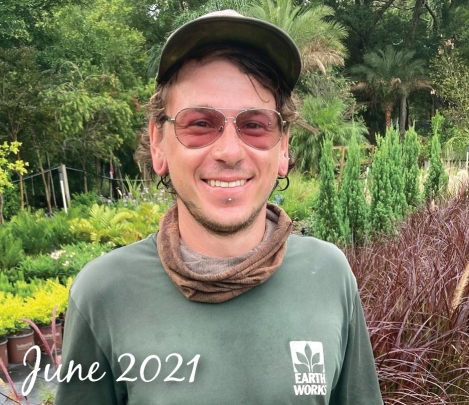
June 2021 Employee of Month Erik Kalwicki came to Earth Works almost one year ago and has been very flexible and helpful in multiple departments. With his great laid back attitude, he is very patient and understanding. Erik is very consistent with his methodical and meticulous work habits. He has made improvements to the Bluff and its functional flow and keeps tabs on inventory. He helps keep the plants looking good for our installs. He also helps the maintenance department run smoothly with sharpening blades, checking oil, and cleaning air filters. He enjoys music, gardening, and long road trips but most of all he loves jelly donuts! Thank you, Erik, for being a great team player and always getting the job done!
July 2021 Employee of Month Sean Friedman has been with us for 3 years in our lawn maintenance division doing a wonderful job while never receiving nor offering complaints. His customers regularly give him raving reviews. Sean’s communication between our clients and our team is excellent. He lives our points of culture (integrity, excellence, teamwork, and fun) every day with his positive can-do attitude. While he may be a true plant nerd, he also truly cares about being a star employee, wonderful father, and husband. Thanks, Sean for being a great employee!
August 2021 Employee of Month Sean O’Toole joined us this past spring to help with our outside team but a broken foot injury just days later allowed our customers to experience his extremely warm, detail-focused customer service skills at the front desk. Rarely do customers leave the garden center without Sean knowing their names. He follows up with them to ensure our team and customer expectations are met. His connections with customers and numerous Google reviews have made Sean a valuable addition to our nursery team. He is honing his outside skills as he heals, wrangling any palms and product out back that he has not sold yet. With his fun & can-do attitude, he looks forward to assisting us with our drop-off deliveries in the next couple of weeks. This will offer our customers even more opportunities to experience Sean’s outstanding customer service. Congratulations, Sean!
September 2021 Employee of Month Tim Greer has worn many hats since arriving 3 years ago. He is a vital link between our customers and foremen. Customers love him for his exceptional customer service. The foremen know they can reach out to him for a fast response on their field issues. Most recently, he has stepped into and excelled in his role as the Bluff Manager taking on any task that needs to get done; including welding trailer parts! He lives our points of culture (teamwork, integrity, excellence, and fun 24/7 always looking out for our best interests. Thank you, Timbo, for your part in leading our landscape team to success!
October 2021 Employee of Month Jackson Harris came to the landscape department 3 years ago as an excellent team player with a great work ethic from the beginning. He will always happily do what is asked of him. He spent a few weeks covering the Bluff plant router position. Though he can be a smart aleck, he also can be very humble expressing gratitude for his Earth Works job. On work sites, he exemplifies professionalism and has become a strong member of the landscape and pond crews. He asks great questions and is always curious to learn more. Recently, Jackson has transitioned into a Landscape Foreman position. On Saturdays, you are likely to see him wandering the nursery and supporting the business. Thank you for being a steady and strong teammate, Jackson!
November 2021 Employee of Month Doug Fisher exhibits all of our points of culture arriving one and a half years ago. He was promoted to a foreman position last summer and has exceeded all expectations. We constantly get calls from his very happy customers. He does awesome work and has great attention to detail. He brings a good attitude and never complains, even when he would be right to do so. Thank you, Doug, for being a great team player always ready to help out anytime or anywhere!
December 2021 Employee of Month Adam Cooprider arrived 2-1/2 years ago as a crewman with little to no landscaping experience. Every day since he has consistently worked to improve. He shows up to work on time bringing a great attitude to every job. Recently, he has stepped up and filled in for foremen to keep jobs running for us and our customers. He is eager to take on more responsibility to help us grow. As a great team player, Adam does whatever is asked of him at any time. Thanks for all your hard work, Adam!
Earth Works operates a retail Garden Center in Jacksonville/Plant Nursery and provides landscaping, hardscaping, water features, lawn care service, lawn spraying, and drainage solutions.
Earth Works proudly serves clients in Northeast Florida, including Jacksonville, Ponte Vedra Beach, Atlantic Beach, Neptune Beach, Jacksonville Beach, Nocatee, St. Johns, Fleming Island, Orange Park, Middleburg, Green Cove Springs, Amelia Island, Fernandina, and St. Augustine.
We expect our turf grass to go dormant in the cooler months, but don’t turn your back on Fall Winter watering as the lawn and garden need that moisture. “The month with the fewest wet days in Jacksonville is November, with an average of 5.3 days with at least 0.04 inches of precipitation,” according to WeatherSpark.com. “The drier season lasts 8.2 months, from September 27 to June 2.”
We are halfway through our third week of November here in Jacksonville, and it has rained just three times this month, mainly on the 6th & 7th. Then we got a sprinkle on the 12th. In November 2020, it rained several times each week in Jacksonville for a total of 17 times that month. That was a much more favorable set of circumstances. Like a soaker hose, the water is delivered with greater frequency in small regular doses. Nothing is perfect though, as too frequent watering can result in shallow root systems and invite fungus.
“As Jacksonville heads into the driest month of the year in November, the potential for a flash drought will grow without persistent rain in the forecast,” according to News4jax.com. “A flash drought often begins as a small rain deficit in one county and then expands like fire across the landscape. Flash droughts are often accompanied by erratic precipitation over sharply defined geographic areas.”
There is only a slight chance of rain over the next 10 days. And November, along with October, has the clearest skies of the year for Jacksonville. Some days may be overcast without much precipitation ahead of a cold front, which can give us a head fake that we will get rain that never materializes. Rain totals thus far for November are what they were for all of Nov 2020, but when it comes down all at once, the soil doesn’t absorb as much of it as it is lost to stormwater runoff.
“Irrigation frequency will vary based on grass species, rainfall amounts, soil type and amount of compaction, shade presence, geographical location in the state, and, most importantly, by season,” according to the University of Florida. “Irrigation systems should be reset seasonally to reflect the differing water requirements of grasses based on time of year. Ideally, University of Florida guidelines call for watering lawns on an “as-needed” basis. This can be determined by observing the grass for signs of water stress, which indicate that water lost in transpiration is not being replaced and the plant’s needs for water are not being met. The signs that you need to look for are: • Leaf blades are folded in half lengthwise in an attempt to conserve water. • The grass takes on a blue-gray tint rather than maintaining a green color. • Footprints or tire tracks remain visible on the grass long after they are made.”
The Fall season watering is more crucial than Winter, primarily considering higher daily temperatures in Northeast Florida. As seen in the chart by Meyers and Horn, Florida Turf Growers, our St Augustine turfgrass requires a greater frequency of rain or watering in Fall than Spring. Measured in Gainesville the St Augustine grass can go 3-9 days between watering in Spring and only 2-8 days in Fall.
Obviously, our flower beds, landscape plants, and garden will need rain or regular Fall Winter watering. Drought conditions cause plant stress. “Without periodic rains or irrigation, your plants will stop producing fruit and will drop any fruit they have already produced,” according to UF Gardening Solutions. “Remember, most Florida soils drain easily and don’t retain water. Adding organic matter to the soil will help the soil retain moisture, conserving you water and saving you effort.”
Earth Works recommends keeping your turf, landscape, and garden healthy with at least two rain or watering events per week while abiding by local watering restrictions. Contact Chad Lakin, Earth Works Lawn Maintenance Operations Manager, with your specific lawn care questions at 904-996-0712 and get a free quote for your lawn care at www.earthworksjax.com
Earth Works operates a retail Garden Center/Plant Nursery in Jacksonville and provides landscaping, hardscaping, water features, lawn care service, lawn spraying, and drainage solutions. Contact us with your questions and to book design consultations.
We proudly serve clients in Northeast Florida, including Jacksonville, Ponte Vedra Beach, Atlantic Beach, Neptune Beach, Jacksonville Beach, Nocatee, St. Johns, Fleming Island, Orange Park, Middleburg, Green Cove Springs, Amelia Island, Fernandina, and St. Augustine.
Understanding the essential tree facts for hurricane season is crucial to reducing the threat of damage from storms here in Florida. Hurricane season is officially from May 22 until November 30, 2021. This is the time when many Floridians will face tropical storms and possibly hurricanes. The Florida Panhandle is currently facing landfall of Tropical Storm Fred with rain bands impacting Jacksonville while Tropical Depression Grace is tracking through the Caribbean, and Tropical Depression 8 that could become Henri is gaining strength near Bermuda.
The following are a few tree facts for hurricane season preparation.
1. Older trees may need pruning to reduce the risk of overhanging limbs to structures and power lines. Remove dead, diseased, cracked, and broken limbs at risk of falling during high wind events and hurricanes. A licensed arborist can provide professional assessments of what needs to be done to protect the specific trees before and after hurricane season. With eighteen inches of rain in the last six weeks, the ground is saturated with water that weakens root systems.
2. Some trees are at greater risk of attracting lighting, with those struck most often being oak, pine, and palms. When hit, the tree will attempt to repair itself but should be monitored over some months. Ultimately the damaged tree may require pruning or complete removal.
3. Tree species with shallow roots and large canopies, when combined with saturated soil, are at higher risk of coming down during high wind and rain events. Examples are Maples, Willows, Elms, and Birches.
4. Recently planted younger trees’ root systems may still be inadequate to protect against extreme wind and rain and can be at serious risk of falling. Staking trees when planted and leaving them staked throughout the season is best. Many can be stood back up, replanted, and secured if they fall. Still, they can be badly damaged in such events where the roots become ajar, exposed, or damaged.
Though tragic, it’s hardly a surprise when we see news coverage of a limb or large tree that fell into a home or that crushed a vehicle during high wind and rain. Regardless of the conditions of our trees, when faced with an impending storm event, it is best to assess the situation. Be aware of your surroundings, especially what is above, and take necessary precautions to protect friends, family, and yourself.
Visit our garden center for all your plants and gardening supplies. Contact Earth Works Landscaping department to schedule a consultation for all your landscaping, hardscaping, and drainage solution needs. Earth Works operates a retail Garden Center/Plant Nursery in Jacksonville and provides landscaping, hardscaping, water features, lawn care service, lawn spraying, and drainage solutions. Contact us with your questions and to book design consultations.
Earth Works proudly serves clients in Northeast Florida, including Jacksonville, Ponte Vedra Beach, Atlantic Beach, Neptune Beach, Jacksonville Beach, Nocatee, St. Johns, Fleming Island, Orange Park, Middleburg, Green Cove Springs, Amelia Island, Fernandina, and St. Augustine.
The signs of damage from heavy rain and over watering can take weeks to appear. Some damage in the form of fallen limbs and trees occurs quickly and is easy to see. In July 2021, Hurricane Elsa passed Jacksonville with tropical-storm-force wind and rain. It added to a week with more than 5 inches of rain that mostly fell on July 4th and 7th. While that amount of rain wouldn’t stop fireworks and doesn’t warrant alarm bells going off, it came during a month-long period of above-average rainfall that contributed to bringing down part of a tree that crushed one of our owner’s automobiles. We scurried about during the last week of September 2022 as Hurricane Hermine was approaching to hopefully avert similar damage from high winds and rain.
Chad Lakin, Earth Works Lawn Care Operations Manager recommends that your lawn should receive a half-inch of water three times per week from rain and/or irrigation. During weeks when it rains for three or more days dropping an accumulated weekly total of 1.5 inches of rain or more you should consider turning off the automatic timer on your sprinkler system and only water as needed. And be aware that irrigation regulations in Duval County restrict sprinkler system operation to twice per week. Be sure to check and abide by your county guidelines.
SEVEN FACTORS AFFECTING LAWN AND GARDEN DAMAGEFROM HEAVY RAIN include elevation, grade, soil composition, percentage of impervious area, drainage system, landscape design, and fungal pathogens.
Elevation: Much of Northeast Florida is at or slightly above sea level with a high water table. “Almost 25,000 kilometers of Florida’s coast is below 3.5 meters in elevation,” according to the US Environmental Protection Agency. “The northeastern region of Florida is one of varied natural, geographical, and topographical environments. The region is a part of the Atlantic Coastal Plain and contains an assorted mix of land cover types that span from coastal marshes to upland hammocks and scrub areas.”
Grading: Proper site grading requires a slope of the landscape away from home and other structures and into drainage systems that include swales and retention ponds. “The ground immediately adjacent to the foundation shall be sloped away from the building at a slope of not less than one unit vertical in 20 units horizontal (5-percent slope) for a minimum distance of 10 feet measured perpendicular to the face of the wall,” according to Florida Building Code 1804.4 [Excavation, Grading and Fill] Site Grading. “If physical obstructions or lot lines prohibit 10 feet of horizontal distance, a 5-percent slope shall be provided to an approved alternative method of diverting water away from the foundation. Swales used for this purpose shall be sloped a minimum of 2 percent where located within 10 feet of the building foundation. Impervious surfaces within 10 feet of the building foundation shall be sloped a minimum of 2 percent away from the building.” These measures reduce the threat of flooding and erosion from rainwater that doesn’t percolate into the soil.
Soil Composition: Our Northeast Florida soils tend to be sandy, allowing better percolation of water than clay soils. Heavy rains can saturate soil that can’t absorb additional water resulting in increased flooding, erosion, and runoff. “When soils become saturated from heavy rainfall, loss of nitrogen (N) becomes a major concern,” according to Kruger Seeds. “After soils are saturated, the two processes that can reduce the amount of available N are denitrification (microbial conversion of nitrate to nitrogen gases) and leaching.” Leaching of nutrients from the soil during heaving rains can change soil pH. “Rain leaches alkaline elements including calcium, magnesium and potassium from the soil into runoff water, leaving acidic elements like hydrogen, aluminum and manganese to replace the bases,” according to SFGATE. “This means that areas with high annual rainfall amounts, such as parts of New England, generally have more acidic soil than the arid deserts of Arizona.”
Impervious area: Impervious areas include driveways, walkways, decks, and patios. Municipalities in Northeast Florida have restrictions on the percentage of impervious surfaces allowed. Coastal communities have the most strenuous rules. Atlantic Beach limits impervious area to 45% and requires onsite water retention storage. Hardscaping projects must take into consideration all sources of water conveyance to comply with the city code. “The downspouts from the house they are all connected underground and run to the swale,” said John Cacchione, Earth Works landscape designer. “So all of the water from the roof is collected. Nothing is going out into the street.” Make sure your landscaping company understands and readily complies with applicable regulations.
Drainage system: The wide variety of drainage system designs available requires routine maintenance to work effectively. Clogged gutters, French drains, and storm drains won’t function as designed. Standing water over time becomes lethal for turf and many varieties of plants. “During a flood, the greatest danger to your grass is suffocation,” according to the Turfgrass Group. “Grass needs sunlight, water, air—CO2, to be precise—and nutrients to grow. When your turf is submerged, the grass cannot get the CO2 it needs. It can survive this way for a day or two, but after four of five days, the chances of survival drop significantly. Generally, cool water and cool temperatures are the least destructive. If the air temperature is above 80 degrees and the water is shallow enough to be warmed, even a day or two could kill the grass.”
Landscape Design: Your choice of plants can have a significant impact on whether your lawn and garden are damaged or flourish after heavy rains. Native plants evolved in the local environment doing better in native soil and weather conditions than many non-natives. A professional landscape designer takes rainfall, soil composition, and drainage into consideration when establishing your landscape plan. Xeriscaping is popular but could require bringing in soil and regrading the landscape if the ground holds a lot of water during raining season. Alternatively, cannas, hostas, Japanese maple, and taro are a few examples of plants well suited for moist soil. Plant choices should be appealing to your taste and be in conditions to succeed and not succumb to damage from heavy rain.
Fungal Pathogens: Fungus thrives in wet conditions above and below the soil surface, growing on wet leaves while attacking roots. “Although the upper plant parts can deal with rainy periods pretty well, the roots are where most problems occur,” according to The Times-Picayune. “Excessively wet soil (especially combined with warm temperatures) can create stressful, and potentially destructive, conditions for the roots of bedding plants, perennials, vegetables, shrubs and even trees — especially newly planted ones.” Two serious fungal diseases are Gray leaf spot, Pyricularia grisea and Take-all root rot Gaeumannomyces graminis var. graminis. Gray leaf spot can infect blades when they are wet for less than a day at temperatures between 70F and 95F. “This fungus slows grow-in, thins established stands and can kill large areas of St. Augustine grass turf,” according to the University of Florida. “In Florida, St. Augustine grass is the only warm season turf grass affected by this important disease.”
Take-all root rot commonly attacks stressed lawn turf that destroys turf root systems over weeks leading to yellowing and irregular brown patches. “Take-all root rot is a stress-related disease, and the following stresses may trigger the disease: soil compaction and poor drainage, drought, excessive irrigation, improper mowing height, excessive thatch buildup, improper fertilization, excessive shade and the overuse of herbicides,” according to Louisiana State University.
Earth Works offers regular aeration that prevents soil compaction and top dressing for improving percolation and replenishing nutrients. For comprehensive solutions to your specific lawn, garden and landscaping need and to minimize the lawn and garden damage from heavy rain, contact Earth Works of Jacksonville at 904-996-0712. Earth Works operates a retail Garden Center/Plant Nursery in Jacksonville and provides landscaping, hardscaping, water features, lawn care service, lawn spraying, and drainage solutions. Contact us with your questions and to book design consultations.
We proudly serve clients in Northeast Florida, including Jacksonville, Ponte Vedra Beach, Atlantic Beach, Neptune Beach, Jacksonville Beach, Nocatee, St. Johns, Fleming Island, Orange Park, Middleburg, Green Cove Springs, Amelia Island, Fernandina, and St. Augustine.
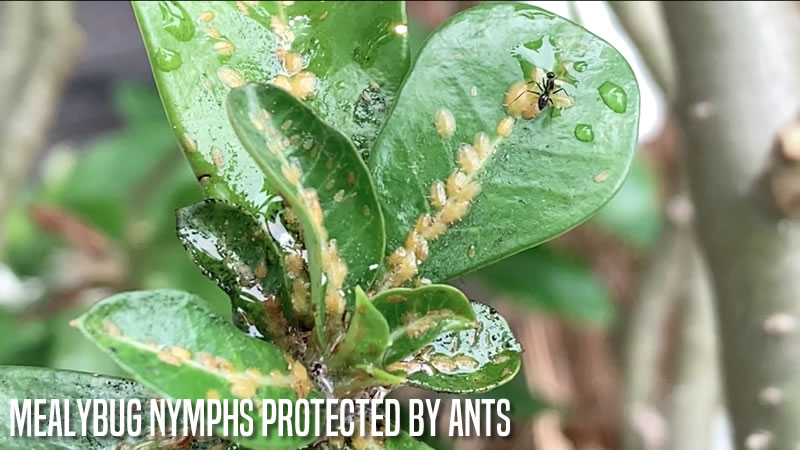
Regular observation and timely corrective actions are the keys to preventing mealybug infestation that unchecked can kill your affected plants. A staff member’s Desert Rose appeared pest-free during May’s dry weather, but in June quickly became heavily infested with multiple stages of the mealybug life cycle. Silky cocoons appeared at the base of stems and flower buds as adult females scurried about and immature crawlers (nymphs) settled into gelatinous protected coverings littering the leaf surfaces with ants on patrol protecting and farming them. While feeding with their piercing mouthparts mealybugs excrete toxins into the plant and dump their honeydew waste on leaf surfaces that attract ants and fungus that in turn reducing sunlight and required photosynthesis for the plant.
What do mealybugs look like? Mealybugs in their immature nymph stages look like scale and are closely related to them and aphids. Over 275 species of mealybugs are distributed everywhere in the world except Antarctica. Mealybug adult females are oval, white, and mobile, while mouthless winged adult males are rarely seen during their one or two-day life span that’s spent focused strictly on mating.
Where do mealybugs live? Mealybug occurrences are common in the garden and on houseplants with the mobile females scurrying about under leaves, around their silky cocoons, stems, even plant roots with mealies readily moving from one plant to another. Mealies feed on many ornamental plant varieties, citrus, lawn turf and threaten greenhouse horticultural operations. They also have a highly specialized commensal relationship that ecologists find fascinating. “In this study, the fire ant Solenopsis invicta was found to take advantage of the shelters constructed by the leaf roller Sylepta derogata to protect mealybugs (Phenacoccus solenopsis) against their natural enemies,” according to scientists at the South China Agricultural University, Guangzhou, People’s Republic of China. “This protective effect of fire ant tending on the survival of mealybugs in shelters was observed when enemies and leaf rollers were simultaneously present. Specifically, fire ants moved the mealybugs inside the shelters produced by S. derogata on enemy-infested plants.”
How do I get rid of mealybugs? Regular observation and having an action plan for dealing with threats before they get out of hand is the best approach to preventing mealybug infestation and resulting damage. Mealybugs can be removed manually and sprayed into a bucket for removal to avoid the same individuals returning to re-infest plants. Besides strictly using water Insecticidal soap and horticultural oil provide the next lowest environmental impact in mealybug management having no residual toxicity after dry that as a result protects other beneficial insects and pollinators. Neem tree seed extract is commercially available as neem oil containing azadirachtin that kills mealies, but is indiscriminate also killing beneficial insects and is moderately toxic to fish and amphibians, requiring overspray protection for water bodies and other potentially impacted areas.
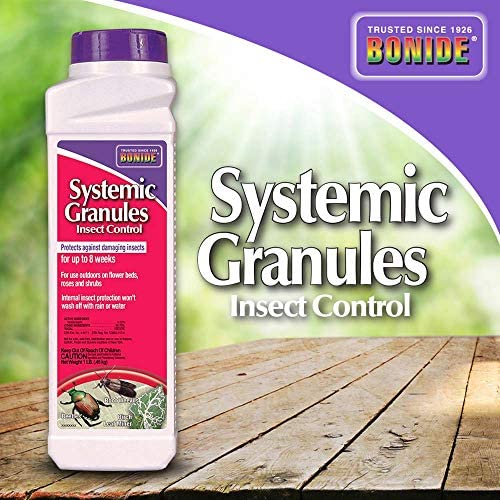
Insecticide treatment options include Bonide systemic insecticide containing dinotefuran available in granules and spray. Additionally, Ferti-lome Tree & Shrub drench, is an effective foliar treatment for mealybugs, which is taken up by the roots and provides protection internally throughout the year. “Cover-spray applications of broad-spectrum insecticides often lead to secondary pest outbreaks,” according to the University of Florida. “Scale insects and mealybugs are secondary pests that may increase following such disturbances to the ecosystem balances in a landscape. For this reason, we often see more scale insect and mealybug outbreaks in landscapes that have been exposed to intensive broad-spectrum insecticide applications.” Biological controls include Cryptolaemus montrouzieri, a brown lady beetle common name ‘Mealybug Destroyer.’ Their young are able to feed on the mealies without being attacked by the ants guarding them. As with introducing any variety of beneficial insects to the garden, there can be predation of them by other animals and suitable amounts of prey must be available for them to stay.
There are two varieties known varieties of mealybugs that affect turfgrass in Florida. Rhodesgrass mealybugs attack Bermuda and St. Augustine grass. Tuttle mealybugs are believed to mostly impact zoysia grass. “Systemic products like neonicotinoids are preferred because they have longer residual activity inside plant tissue,” according to the University of Florida. “Several combination products that contain pyrethroids and neonicotinoids (e.g. bifenthrin + imidacloprid) may provide initial high knock-down rates followed by longer systemic control.” Thus, while we cannot expect to permanently rid our lawns and gardens of mealybugs, we can manage their numbers and reduce the damage threat by preventing mealybug infestation. In the case of the staff member’s Desert Rose due to the extent of its infestation neem oil was applied (two tablespoons of neem oil per gallon of water) to leaves, stems, and trunk, which will be repeated in seven to 10 days until satisfactorily under control. Garden Center Manager Matt Barlow recommendation for long-term control is use of the Bonide systemic insecticide as he does with his desert roses, which he’s found has been quite successful.
Mealybugs are a threat to a variety of plants in our Florida gardens. Soft stemmed perennial foliage plants are particularly susceptible to mealybugs such as this clients’ coleus.
For comprehensive solutions to your specific lawn, garden and landscaping need contact us online or at 904-996-0712. Earth Works operates a retail Garden Center/Plant Nursery in Jacksonville and provides landscaping, hardscaping, water features, lawn care service, lawn spraying, and drainage solutions.
Happy Gardening!
Proudly serving clients in Northeast Florida including Jacksonville, Ponte Vedra Beach, Atlantic Beach, Neptune Beach, Jacksonville Beach, Nocatee, St. Johns, Fleming Island, Orange Park, Middleburg, Green Cove Springs, Amelia Island, Fernandina, and St. Augustine.