The warmest months of the year are times you expect to enjoy your pond and water garden the most, but anxiety arrives if your fish are suffering as a result of a poorly designed & equipped, dirty, overstocked pond that all contribute to low dissolved oxygen. There you are trying to enjoy some time pondside as that Summer warmth cooks the O2 out when the fish need it most. Supplemental aeration helps during these times of Summer by raising the dissolved oxygen levels. “Fish require a certain amount of oxygen in the water – at least 5 parts per million,” according to the University of Florida. “Any lower than that, and they begin to have trouble; when dissolved oxygen levels fall below 2 ppm, an immediate fish kill will occur.”
As Certified Aquascape Contractors, Earth Works of Jacksonville designs and builds healthy, low-maintenance ecosystem ponds and provides annual clean-out services to reduce the potential negative impacts of sludge and debris buildup and their consequential aerobic bacterial breakdown. Ecosystem imbalances can occur along with low DO when pond cleaning is not done as needed, in instances of excessive fish stocking, and where there is excessive algae growth. In addition, sludge and debris buildup is broken down by oxygen-dependent bacteria that further reduces the limited O2 supply available to fish. Small amounts of algae are a normal part of a healthy pond ecosystem. However, excessive nutrient buildup from debris and fish waste can result in algae blooms in your pond, with consequences similar to what’s observed in nature. “Trace minerals or nutrients needed by the algae are occasionally used up, causing some or even all, of the bloom to die back temporarily,” according to Freshwater Aquaculture, at US Department of Agriculture. “The resulting bacterial decomposition and loss of normal oxygen production can lead to oxygen depletions and fish kills.” Fish kills aren’t uncommon with ponders who forget and leave the hose filling the pond and many whose koi outgrew the pond and filtration system without getting it updated in time.
You want the best for your fish and you know when your wet pets are happy or not. “A habitually low oxygen level can be linked to slow fish growth and persistent fish sickness, and it may contribute to repetitive parasite outbreaks,” wrote Ellen Kloubec for Pond Trade magazine. “Continued exposure to low DO is also considered a precursor to bacterial infections in fish. Even short periods of oxygen deprivation can have damaging effects.”
It can seem like a cruel joke that your koi and goldfish are least active in Winter when they have the most available dissolved oxygen and are the most active when there is the least amount of DO available. So what are some of the solutions if you are experiencing problems with your pond system or want to be proactive in addressing potential threats before they arise? “Turning over the water is the best way to increase oxygen in your pond,” according to Practical Fishkeeping. “Waterfalls are another excellent way of bringing needed movement and gas exchange. As the thin film of water runs down the slope, it absorbs oxygen which then transfers to the pond below. An air pump will also aerate a pond, although many people believe that the bubbles themselves provide the oxygen content. This is not the case, as the increased surface area and water movement do the work.”
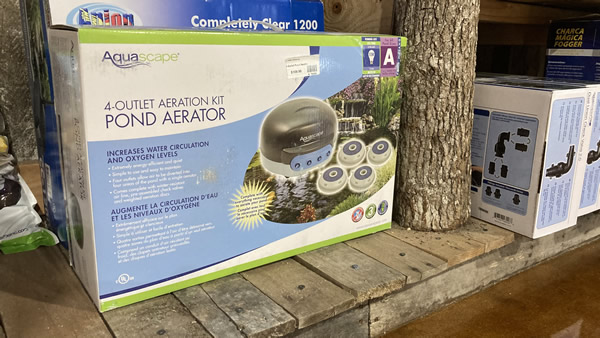
To supplement your pond and water garden dissolved oxygen fish requirements Earth Works Garden Center has available several models of Aquascape Pond Aeration kits that increase water circulation and oxygen levels. Unlike small aquarium-style air stones, these aerators provide greater output with large diffuser discs. “Oxygen is transferred as the bubbles rise through the water column,” according to Craig Tucker, Mississippi State University, published by the Southern Regional Agricultural Center and the Texas Aquaculture Extension Service. “Diffusers for large-scale aeration are usually discs, plates, or tubes constructed of glass-bonded silica, ceramic, porous plastic, or flexible perforated membranes. Diffusers are customarily arranged in a grid pattern over the bottom of the pond, with the number of individual diffusers determined by the oxygen transfer rate of the diffuser and the oxygen consumption rate in the water. Oxygen transfer increases with smaller bubble size, deeper bubble release point, and higher oxygen content in the bubbles.”
Although you cannot count on your fish telling you when they are suffering from low dissolved oxygen signs can include lethargy and them hanging out at the surface doing what’s called “piping” the fish version of gasping for breath. Keep your wet pets properly oxygenated for their health and your sanity when you see them suffering.
If you want a bigger pond for your growing wet pets or you need to get on our schedule for seasonal pond cleanouts contact the Earth Works Landscape Department at 904-996-0712! Earth Works designers and staff at the garden center are ready to assist you and we encourage strolls of the garden center ponds, water features, and wet pets!
Plus, remember that for comprehensive solutions to your specific lawn, garden and landscaping need contact Earth Works of Jacksonville online and at 904-996-0712. Earth Works operates a retail Garden Center/Plant Nursery in Jacksonville and provides landscaping, hardscaping, water features, lawn care service, lawn spraying, and drainage solutions. Proudly serving clients in Northeast Florida including Jacksonville, Ponte Vedra Beach, Atlantic Beach, Neptune Beach, Jacksonville Beach, Nocatee, St. Johns, Fleming Island, Orange Park, Middleburg, Green Cove Springs, Amelia Island, Fernandina, and St. Augustine. Happy Gardening!
Having professionals seal your pavers provides peace of mind that your investment is beautiful and adequately protected for years to come.
Benefits of sealing pavers include: BEAUTIFIES paver surface revealing increased color and texture. PROTECTS against stains, weathering, and wear. PREVENTS sand loss and deters plants and insects between joints. ADDS value to your investment.
Sealing your pavers requires additional budgeted expense for labor and materials over and above the paver installation cost and cannot be done immediately after installation. “It is not necessary to seal the pavers,” according to Tremron. “Sealing does however retard fading the color of the pavers and provides a measure of protection from some stains. “Before sealing, pavers must be clean and dry. It is recommended that you wait at least 30-60 days after installation before sealing. Once sealed, you will need to reseal approximately every three to five years.”
Earth Works of Jacksonville is a member of the Interlocking Concrete Pavement Institute (ICPI), a trade association that sets industry standards for design professionals and contractors. “Like any construction project, the quality of the finished product is highly dependent on the quality of the contractor doing the work,” according to ICPI. “You are investing in long-lasting interlocking concrete pavement. ICPI Certified Installers: • Have installed a minimum of 10,000 square feet of pavers • Attended a 2-day intensive training course on industry best practices for installation of interlocking concrete pavers • Passed a written certification exam • Complete continuing education requirements to stay on top of industry best practices.”
“Some of the patios we come across are pretty dirty,” said Tim Gibson, Earth Works foreman. “A lot of them have mildew and mold, which all comes out of course, and after the sealant goes down, it prevents it, but it does not eliminate the possibility of it coming back. The sealant protects the paver and helps stop ants and plants, but it doesn’t prevent them unless polymeric sanded. The reason we seal is to protect the paver from stains such as rust stains and vegetation stains. Plus, it enhances the color of the paver as well.” Steps for sealing your pavers include: -Pressure washing. -Rinse off to remove residue. -Dry and resand between pavers. -Seal and allow to dry before walking on.
Beware of uncredentialed paver installers and sealant applicators. “Some of them, they rove around, and some do excellent jobs, said Coloma Township Highway Commissioner Ruthie Rogers. “And some, they’re here and you never see them again. It’s kind of hit and miss and they move right on.”
Earth Works has been providing professional service in the Northeast Florida area for over thirty years. Related products and services offered by Earth Works of Jacksonville include: -Paver installation, repair, cleaning, sanding, and sealing -Full service design and installation services including landscaping, paver patios, kitchens, pergolas, and ponds. Plus, lawn pest control, fertilization, mowing, and trimming. -Full service garden center and outdoor living design showroom.
Plus, remember that for comprehensive solutions to your specific lawn, garden and landscaping need contact Earth Works of Jacksonville online and at 904-996-0712. Earth Works operates a retail Garden Center/Plant Nursery in Jacksonville and provides landscaping, hardscaping, water features, lawn care service, lawn spraying, and drainage solutions. Proudly serving clients in Northeast Florida including Jacksonville, Ponte Vedra Beach, Atlantic Beach, Neptune Beach, Jacksonville Beach, Nocatee, St. Johns, Fleming Island, Orange Park, Middleburg, Green Cove Springs, Amelia Island, Fernandina, and St. Augustine. Happy Gardening!
Earth Works has four display ponds at our garden center demonstrating the available pond options in Northeast Florida. Each of the ponds have signs posted next to them with the specifications for Do-It-Yourselfers and for clients who prefer that Earth Works design and complete their pond installation. “Hardly anybody ever thinks they go too big,” said Jason Duffney, Earth Works co-owner. “It’s usually on the pond size that they started too small and they are always upgrading. I’ve said it a million times that most of our customers build three ponds in their lifetime.” Many area homeowners build their own first pond and then have Earth Works build a more professional upgraded pond in the future. We are here to help in whatever way we can. There are three standard sizes on display at the garden center along with a customizable size that one of our designers can consult with you on creating in whatever size and shape you want.
Tadpole Springs Size: 4ft x 6ft Features: 400 Skimmer, Signature Series 1000 Biofall Filter, & 15×20 Pond Liner Pump size: Aquasurge 3000 Contact for pricing.
Frog Hollow Size: 8ft x 12ft Features: Pond liner, River Jack, Fish Cave, Auto Dosing System, & Signature Skimmer 1000 Pump size: Aquasurge Pro 2000-4000 Contact for pricing.
Dragonfly Pond Size: 11ft x 16ft. Features: 2ft waterfall, 6000 Biofall Filter Pump size: AquaSurge 4000-8000 gph Contact for pricing.
Turtle Bay Pond Size: 20ft x 20ft. Features: 3ft waterfall, 8ft x 8ft Bog, 15ft meandering stream. Pump size: Bog-AquaSurge 3000 gph Waterfall- Tsurumi 9PL 8500 gph Contact for pricing.
Visit the Earth Works Garden Center to see these water feature options, call 904-996-0714 or request to book a design consultation.
Earth Works is Northeast Florida’s Premier Aquascape Certified Contractor with over 30 years experience serving clients and delivering available pond options in Northeast Florida.
For comprehensive solutions to your specific lawn, garden and landscaping need contact Earth Works of Jacksonville online and at 904-996-0712. Earth Works operates a retail Garden Center/Plant Nursery in Jacksonville and provides landscaping, hardscaping, water features, lawn care service, lawn spraying, and drainage solutions. Proudly serving clients in Northeast Florida including Jacksonville, Ponte Vedra Beach, Atlantic Beach, Neptune Beach, Jacksonville Beach, Nocatee, St. Johns, Fleming Island, Orange Park, Middleburg, Green Cove Springs, Amelia Island, Fernandina, and St. Augustine. Happy Gardening!
Azaleas, Arborvitae, Bamboo, Boxwood, Yews, Ligustrum, Viburnum, and Oleander are readily available for hedges in landscape design. By adding a mix of trees, shrubs, vines, and flowers, the hedge becomes wildlife, attracting hedgerows while providing beauty, obstructing views, enhancing privacy, and a host of area ecological benefits.
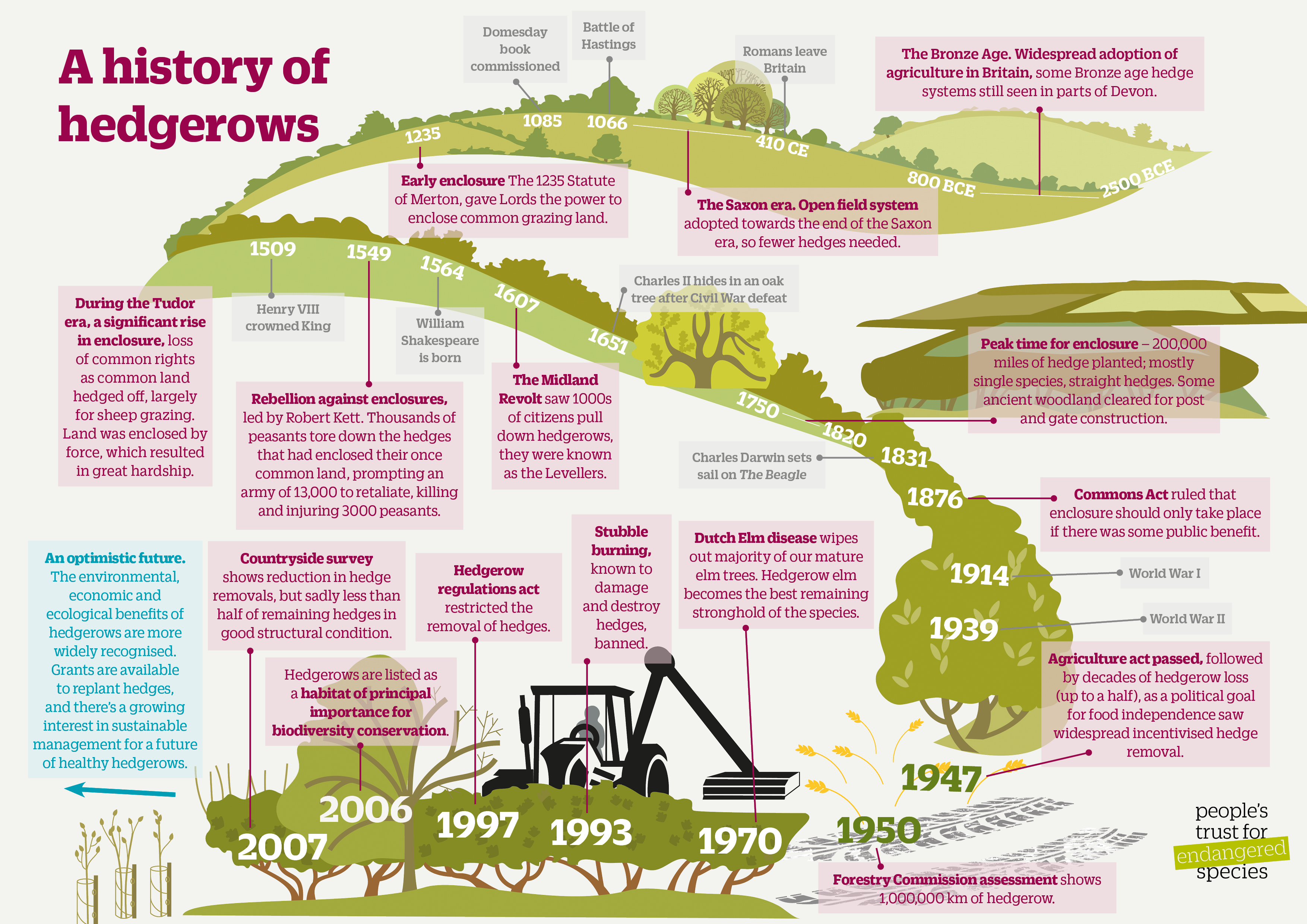
The word hedge, translated from its Old English root word, means enclosure. “Hedges have formed a part of our gardens for at least 2,000 years,” according to the Financial Times. “Among the earliest examples are those used in the landscaping of Roman villas.” Hedgerows consisting of plants anchored together forming living walls were widely used in the United Kingdom for hundreds of years. Still, they waned in popularity after WWII with the rise of industrial farming practices. “Symbolic of the English countryside and teeming with life, there are over 30 different regional styles of hedgerow in the UK,” according to Seedlipdrinks UK. “A border, a boundary, a home, and even a fruit basket, in late Spring, these iconic landmarks come into their own as bright young leaves sprout from bare branches and the first wildflowers appear.”
Americans don’t have this rich history with hedgerows. “Hedgerow plantings were uncommon in the early United States,” according to Oregon State University. “In the 1930s, the U.S. Department of Agriculture’s Shelterbelt Program briefly supported planting trees for windbreaks to prevent soil erosion in the Midwest. Today, as interest surges in sustainable farming methods, more people are turning to this age-old practice.” Government agencies, NGOs, and educational institutions now guide Americans on creating wildlife attracting hedgerows that serve as habitats and corridors while preventing erosion and improving soil conditions.
“Hedgerows certainly will have a natural, informal look, but it’s still important to keep aesthetics in mind,” according to the American Horticultural Society. “Year-round landscape interest can be achieved by selecting plants with attributes that span the seasons. Plants that flower and fruit at different times of the year not only help sustain wildlife, they add pops of seasonal color. Many wildlife-friendly plants contribute textural contrasts to the landscape, while others offer colorful fall foliage or attractive bark for winter interest. Repetition—repeating plants or colors within the hedgerow, or using hedgerow plants in other parts of the landscape—helps create visual flow and harmony within the landscape. Mass plantings or large drifts of color also help unify the space.”
While there are no regional styles of hedgerows that require you to arrange your collection of plants in a particular manner, there are available suggestions. “The most common planting plan is the double line. It is important to offset the 2 rows to give the necessary even distribution of plants along the mature hedge line,” according to Pierce Conservation District. “There are no hard and fast rules for determining the planting space for hedgerows; this depends on the plant selection. For a tight stock-proof hedge, spacing can be as close as 8 -12 inches apart. A good “backbone” plant, which will constitute 60 – 70% of the hedgerow should be among your initial selections. Choose a plant with a good growth rate, resilience to severe pruning, and thorny growth for good stock-proofing capabilities. Once a backbone plant is selected, adding 4-6 additional shrubs or small trees will add value as wildlife habitat as well as reduce any gaps resulting from a particular species dying out.”
Many of the hedgerows around us may have been created by accident within informal gardens as layers of plantings that provide habitat and food for pollinators, birds, amphibians, reptiles and a mammal or two. If interested in creating or adding to your own wildlife attracting hedgerows book a consult with an Earth Works Landscape Designer. Visit our garden center and a garden guide will assist you with a mix of plants for hedgerows in Northeast Florida.
For comprehensive solutions to your specific lawn, garden and landscaping need contact Earth Works of Jacksonville online and at 904-996-0712. Earth Works operates a retail Garden Center/Plant Nursery in Jacksonville and provides landscaping, hardscaping, water features, lawn care service, lawn spraying, and drainage solutions. Proudly serving clients in Northeast Florida including Jacksonville, Ponte Vedra Beach, Atlantic Beach, Neptune Beach, Jacksonville Beach, Nocatee, St. Johns, Fleming Island, Orange Park, Middleburg, Green Cove Springs, Amelia Island, Fernandina, and St. Augustine. Happy Gardening!
People ask what kind of grass I should have? What is the best type of grass? The truth is there is no best grass. Certain grasses are better for specific situations. We are here today on our Bermuda grass. Bermuda grass is the most wear tolerant grass you are going to find. Bermuda is also, one of the most drought-tolerant grasses you are going to find. That’s why you see it on athletic fields and golf courses. You can put a lot of traffic on it, and it bounces back and doesn’t wear out. St Augustine would be the exact opposite. It’s the least wear tolerant. There are benefits to St Augustine, and it’s probably the most common grass we use. It’s been around for years, and we’ve used it for years. In our view, St. Augustine is easier to take care of than Bermuda grass.
You can look at ours and see there are a few weeds in here. The good news is you can kill the weeds in Bermuda grass. With Bermuda grass, we use multiple herbicides to control the weeds, and with St Augustine, we only use a few. So it’s easier for homeowners to take care of Bermuda and a little easier to keep up.
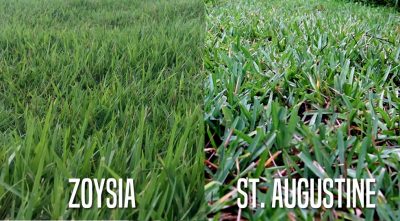
Two other types of grass we use would include zoysia grass, which is somewhat in between Bermuda and St. Augustine. Bermuda is a very fine leafed grass, and St. Augustine is a very coarse grass. Zoysia grass is in between with a medium coarseness to the leaf blades. Zoysia is a nice grass, very thick, with a better feel if you are standing on it. Some people, especially from the north, say St. Augustine feels and looks like crabgrass because it is very broadleaf.
Sod options in Northeast Florida
So a little about zoysia grass is that its good grass, but it does take a lot longer to establish. So if you don’t water it well if you don’t take care of it for that first year, it doesn’t get established, and it takes much longer to recover if you have problems with it. Once it’s established, it’s great grass. It’s a bit more wear tolerant than St Augustine and probably a little more drought tolerant, but not in the beginning. In the beginning, it has to be babied and taken care of to get it going.
Sod Options for Northeast Florida
So those are the three main types of grass that we use. The fourth one we don’t use as much would be Bahia. Bahiagrass is the most drought tolerant. So Bahia grass is the only one we recommend putting down without irrigation. The other three types of grass you definitely want to put irrigation down with it.
All of the grasses have different varieties. With Bahiagrass, you have two varieties. It’s either Argentine or Pensacola. Argentine Bahia is preferred because it doesn’t get the seed heads. However, the Pensacola Bahia will reseed itself because it does put up a seed head. We used to see the Pensacola Bahia on the roadsides. Then many municipalities switched to Bermuda grass. So it has its uses including overseeding in Winter, and Bahia is a little less expensive as well. As far as the cost of the turf, Bahia is going to be your least expensive, then St. Augustine. Zoysia and Bermuda run about the same price and are going to be your more expensive grasses.
There are mowing differences between the grasses. First, St. Augustine grass is going to be cut the highest. It’s going to be mowed at 3-4″ almost the higher, the better. Next is going to be zoysia grass. It can be maintained at 2-3″. And then your Bermuda grass can be maintained at 1-2″. Bahia should be cut higher up around 3-4″ and closer to the cut length of St. Augustine.
The good news is that Earth Works of Jacksonville can help you out with all these grasses. They are all available. We take care of them. So you don’t have to sweat it. We can come out, mow it. We can treat it, take care of bugs, and take care of weeds. That’s what we are here for. We are here to help you make it easy. And we can keep you having a beautiful lawn.
For comprehensive solutions to your specific lawn, garden and landscaping need contact Earth Works of Jacksonville online and at 904-996-0712. Earth Works operates a retail Garden Center/Plant Nursery in Jacksonville and provides landscaping, hardscaping, water features, lawn care service, lawn spraying, and drainage solutions. Proudly serving clients in Northeast Florida including Jacksonville, Ponte Vedra Beach, Atlantic Beach, Neptune Beach, Jacksonville Beach, Nocatee, St. Johns, Fleming Island, Orange Park, Middleburg, Green Cove Springs, Amelia Island, Fernandina, and St. Augustine. Happy Gardening!
Landscape Designer Patti Sanders presents a showcase landscape design installation at a St. Augustine residence that involved curb appeal, transplantings, adjustments to the landscaping design during the install, and clarification of the terms of the landscape plant warranty. “It is a huge house down here close to the beach,” said Sanders. “So a lot of the plants we chose are salt resistant.” People seek out landscape designers that they trust will assist them in choosing the right plants for the right place in the landscape.
Curb Appeal
The homeowner is a realtor who knows the importance of curb appeal to property value. “It’s all about how your house shows on camera,” said Sanders. “It’s about how your house shows online if you are trying to sell. They’re not selling, but being a realtor, she knows the outside is essential. It adds value to your home as well.” Besides being aesthetically pleasing, all of the plants suggested to the homeowner on the design should be choices that will thrive in the landscape. If plants require special care, the landscape designer must provide that information to the homeowner. As a result, all plant choices consider the appearance, impact in the landscape, and growing conditions.
Adjusting Landscaping Plan And Transplants
“We’ve actually changed the drawing at least twice pretty majorly, but mostly not design-wise, but mainly just plant material that the homeowner wanted to have a little different choice in,…” said Sanders. “Sometimes we have to design on the fly. We want to follow your plan as much as possible. Originally we had proposed that we put some liriope and podocarpus over here (side of the yard facing neighbor), but we got enough of the orange bird of paradise from the backyard and transplanting here. It looks fantastic. So again, plants can change. We are very accommodating and flexible, and we need you guys involved as much as possible because this is another idea that the homeowner had to fill this spot. So it ended up working well.”
Front Yard “So with our plant choices, we kept it pretty simplistic did a lot of color towards the front,” said Sanders. “We’ve made the (flower) bed a little bit smaller. It’s going to look a lot cleaner. And then our plant choices if we look around here (garage side of the house facing the road) we’ve got a little bit of color as well, but we tried to keep it looking clean. The coonties that are up here in these palms are transplants from by the front door. The coonties are a Florida native, and they look more in a natural area here than they did upfront. We did keep the bottlebrush, which is a highlighted plant, really nice and attracts hummingbirds, but added some apostle iris, and we’ve got some roses and liriope. And by the front doors, we’ve added some ixora, some pentas, and she already had some existing blue daze. Now, remember we are very close to the beach. So again, everything has to be salt tolerant. And the ixora is salt tolerant. It is not as cold tolerant, but being here by the beach, it’s a plant we can choose, especially when it’s that close to the front of the building because this (front porch) gets protected.”
Backyard “It was just a bunch of stuff all pushed together,” said Sanders. “We went a little bit more symmetrical and a little bit to block the neighbors. This big bird of paradise here was actually in a corner lying on the ground. It had broken out of its pot. These two guys (birds of paradise) were in pots, and we wanted to put them in the ground. So what we’ve added is some heliconia, false bird of paradise for a tropical look, and lantana, which is another hummingbird and butterfly plant that is bright and colorful.” Behind the pool a new queen palm was installed. “There was one that wasn’t doing so hot,” said Sanders. “So we’ve replaced it.” The fresh, new layout with tropical foliage and vibrant colors sets a new tone for the homeowner from their balcony overlooking the pool and entertaining guests or relaxing poolside.
Sideyard “Down in here, we had a lot of Asiatic jasmines,” said Sanders. “We had originally proposed to cut out a lot of this, but she liked this little area here. So all we did was highlight this big white wall give some interest in the podocarpus and some camellias, which are fantastic plants. Camellias bloom from the Fall through the Winter into the early Spring, and you don’t see many blooming plants that do that. Another area that got added kind of last-minute was this little corner area here where we’ve added some more camellias, the yuletide, which is for Christmas (blooming). It’s a really dark green color (foliage). It has a fantastic little pink bloom, almost red, which kind of goes with the Stromanthe.” The designer does multiple walkarounds the entire property with the client on a multiple-day installation to ensure they are on the same page with the homeowner.
Maintaining Your Landscape Plant Warranty
“One important fact is that we give you guys a six-month plant warranty,” said Sanders. “We can extend that to a year if you go with our maintenance program.” To explore pricing to extend your plant warranty and sign up for the Earth Works lawn maintenance programs get a free instant quote with a visit to the Earth Works Lawn Care page. “With shared responsibility, issues such as disease or infestation can also be hard to pin on one or the other entity,” according to Landscape Architecture Magazine. “If the owner is going to take over maintenance while the plants are under the installing contractor’s warranty, the owner needs to know how to carry out responsible landscape maintenance or hire an entity that does. “
A properly working irrigation system is a requirement within the terms of the Earth Works landscape plant warranty. “That’s key because these brand new plants have to be watered at least once a day for the first 30 days,” said Sanders. “If they don’t get watered properly, we can’t warranty our plants. So whether you decide to go with us for irrigation or someone else, you have to make sure you’re watering is proper.”
For comprehensive solutions to your specific lawn, garden and landscaping need contact Earth Works of Jacksonville online and at 904-996-0712. Earth Works operates a retail Garden Center/Plant Nursery in Jacksonville and provides landscaping, hardscaping, water features, lawn care service, lawn spraying, and drainage solutions. Proudly serving clients in Northeast Florida including Jacksonville, Ponte Vedra Beach, Atlantic Beach, Neptune Beach, Jacksonville Beach, Nocatee, St. Johns, Fleming Island, Orange Park, Middleburg, Green Cove Springs, Amelia Island, Fernandina, and St. Augustine. Happy Gardening!
Landscape design as a profession is rooted in formal and informal layouts integrating clients traditional plant and hardscaping choices. “Formal designs are often geometric and symmetrical, with plants and landscape structures specifically shaped and arranged,”according to Hagen Homes. “Informal designs make use of more natural-looking, irregularly-placed plants and structures.” Increasingly, clients want landscape designs that better suit their lifestyle and choices that don’t fit with tradition. While some landscape designers limit customization at Earth Works the clients choices are the basis of their fully customized landscape design.
“We are out here in the Nocatee area in a new development, said Earth Works Landscape Designer John Cacchione. ‘I just want to show you a unique design that took into consideration bugs, water, Florida friendly plants, low maintenance for the customer, low water consumption for the irrigation system and things like that to consider when you are doing new landscape designs and installs.” A fully customized landscape design is unconventional by taking elements from various traditional designs to provide the client exactly what they want.
Clients share their landscape priorities with the designer, who provides feedback on the possibilities that can work from their knowledge rooted in art, horticulture, and applicable regulations. Whereas many clients wish to conserve water as a cost-saving measure, there are other reasons to do so such as Florida’s fragile ecosystems and water conservation requirements. Reputable landscape designers can explain the applicable land use regulations, including permeability and watering restriction, along with drainage requirements that may include onsite stormwater retention solutions. “Half of all the water taken from the public supply ends up watering private lawns—some 900 million gallons a day,” according to National Geographic. “Of the seven billion gallons of freshwater used daily across Florida’s agriculture, industry, power plants, and public water sectors, most is taken from the Floridan aquifer.”
Xeriscaped designs provide an alternative to highly water-dependent plants and lawns that may include the use of rocks as aesthetic elements that reduce maintenance and the presence of insects. “Anytime you can take these builder ninety-degree angles that every house has and break those up with plants or lines, veins of gravel and with boulders themselves that can change that line, said Cacchione. “You see how this comes together and takes away that really hard ninety-degree angle.” The importance of the artistic eye of the landscape designer cannot be overstated.
Some purists prefer adhering to specific landscape design styles rather than mixing them. “Cacti are far from the only plants appropriate for xeriscaping, according to National Geographic. “Other drought-resistant plants include agave, juniper, and lavender. Many herbs and spices are used in xeriscaping, such as thyme, sage, and oregano. Some plants used for food are drought-resistant, such as black walnuts, Jerusalem artichokes, and sapodilla, a sweet fruit native to Mexico.”
An advantage of strictly native plants is they provide additional ecological benefits to your landscape, and the area ecosystems wherein plants and animals evolved together. Florida-friendly plants include non-natives that don’t have the same ecological benefits as natives. However, strictly native design is rare due mainly to the lack of availability of the volume of native plants required to meet the demand for landscape material in Florida. Native plants are most commonly a component of informal designs that favor a natural un-sculpted landscape.
Though wanting a fully customized landscape design, clients still want a professional design they can be proud of that will flourish long after installation. “…,research shows landscaping goes beyond simply sticking flowers and shrubs in the ground,” said the Pennsylvania Association of Realtors. “According to the study, the biggest factor that buyers look for in home exteriors is a design that is sophisticated. Plant size and maturity comes in second.”
Benefits of onsite landscape design consultation as opposed to strictly online suppliers include an in-person site assessment that considers architecture, elevations, site and soil conditions followed by the designer providing a professional drawing representing workable possibilities. “Back here, I kept it open and natural because of the natural backdrop it had,” said Cacchione. “We framed the screen out to leave the opening of the preserve available. Back here, just tying into the drought tolerance of certain plants and native plants because they are just easy to grow, they will be friendly to you. Like the coonties, the tri-colored sage and the rosemary are just easy plants. You don’t think about using the sages and things in your landscape, but they add a cool texture to it once they grow up. Those get fairly large and add a nice element of color year-round.”
Additional perks that go with a fully customized landscape design with companies that offer installation are cost savings opportunities. “We’re doing a consultation fee that’s reimbursed if you go with us for the job if you spend a certain amount of money,” said Cacchione. “You get a unique job (design) that’s different than what a builder would do. We can repurpose some plants too that builders put in. We’re not going to throw away everything.”
For comprehensive solutions to your specific lawn, garden and landscaping need contact Earth Works of Jacksonville online and at 904-996-0712. Earth Works operates a retail Garden Center/Plant Nursery in Jacksonville and provides landscaping, hardscaping, water features, lawn care service, lawn spraying, and drainage solutions. Earth Works proudly serves clients in Northeast Florida, including Jacksonville, Ponte Vedra Beach, Atlantic Beach, Neptune Beach, Jacksonville Beach, Nocatee, St. Johns, Fleming Island, Orange Park, Middleburg, Green Cove Springs, Amelia Island, Fernandina, and St. Augustine.
Landscaping with Florida native plants is economical and benefits our Northeast, Florida ecosystems requiring less water, fertilizers, and pesticides to sustain than non-native plants. “They are acclimated to everything that Northeast Florida can hand them the cold, the heat, the extreme drought that we can have from time to time, but also the deluge of rain we get a couple of months of thunderstorms back to back to back,” said Matt Barlow, Earth Works garden center manager. “And they are also pest and disease resistant because they evolved right here.” Native plants are also important to the ecosystem as a source of food, shelter, and habitat for native wildlife including amphibians, birds, insects, mammals, reptiles and non-native migratory species.
Native plants host beneficial insects, pollinators, and decomposers that form a healthy natural ecosystem. For example, there are 24 oak tree varieties native to Florida, which support over 500 species of moths and butterflies. According to the National Wildlife Federation nearly 100% of songbirds depend on these insects as a key food source. Remove the native plants and the insect and dependent animal species populations crash. “More than 100 species of vertebrate animals are known to consume acorns in the US, including mammals such as white-tailed deer, gray squirrels, fox squirrels, flying squirrels, mice, voles, rabbits, raccoons, opossums, gray foxes, red foxes, and wild hogs,” according to the University of Florida. “Birds that feed on acorns include wild turkey, bobwhite quail, wood ducks, mallards, woodpeckers, crows, and jays.”
Outside of their natural environment non-native species have fewer natural predators resulting in invasiveness crowding out native species without providing a similar degree of benefits to the ecosystem. A few non-native invasive plants you may be familiar with include camphor trees, Japanese honeysuckle, kudzu, melaleuca, mimosa, sword fern, torpedo grass, and water hyacinth.
Earth Works carries a variety of Florida native plants including Walters Viburnum. “It’s a great slow-growing shrub that you can use as individual plants, as focal points, but also as a hedge row,” said Barlow. “They do grow thick and dense and are evergreen. They bloom white in the Spring. Once we come out of Winter and the temperature starts to warm up the flowers pop. They do hold their buds sometimes for a very long period of time. Their buds when they are closed are kind of a rosy color, which gives the shrub in Wintertime going into Spring this really nice look and then they pop open and their covered with tiny white flowers. These are a very easy addition to your garden.”
Walters Viburnum “These are a very easy addition to your garden.”
The Florida Native Plant Society lists 663 native plants in its database. However, most Florida native plants are not commercially available for purchase. Where native plants are grown commercially it is typically by small independent growers who cannot keep up with the commercial demand for the natives they grow. Propagating native plants to nurture commercially favorable ornamental characteristics results in what is called cultivars. “Many native plant experts and enthusiasts do not consider man-made cultivars as being native, although it might be argued that selections or hybrids could have occurred under natural conditions,” according to the University of Florida. “When purchasing native plants, ask for a plant by its scientific name. Also ask about the origin of the plant. Plants that were derived from seed or plants of natural populations in other parts of the country might not perform well in Florida.”
Zamia integrifolia the Coontie palm is another popular commercially available Florida native plant. “It’s called the Coontie palm, but it’s not an actual palm,” said Barlow. “It’s actually a cycad. It gives you a palm or tropical look without actually being a palm. They’re more of a small loose, but densely compacted shrub. Loose in the fact that they are not branched like other types of shrubs. There is a lot more separation and distance where all the stems come from the base rather than a branching type plant like a traditional shrub. They don’t require any pruning. So those of you who are looking for a low maintenance plant the coontie is a great addition. Also, the coontie is versatile. It can grow in the sun, part sun, and into almost some completely shaded conditions. It’s very versatile and easy to grow.”
Coontie palm. “They don’t require any pruning. So those of you who are looking for a low maintenance plant the coontie is a great addition.”
Florida native plants occur in diverse biomes including marshes and swamps, prairies, hammocks, sandhills, scrub forests, upland forests, and more resulting in the need to match your choice of natives to your conditions. It’s also important to understand the significance of your area’s plant communities. For Duval County alone the plant communities include; Beach Dunes, Hydric Hammocks, Mangrove Swamps, Maritime Forests, Pine Flatwoods, Saltwater Marshes, Sandhills, and Wetland Swamp Forests. Native plants adapt in these areas in relation to one another in ways that we continue striving to understand.
Salt tolerant native seagrapes are better suited for the coastal landscape than Florida’s state wildflower the Coreopsis found in fields and along roadsides across North Florida. Landscaping for Florida native plants requires considering the various categories of natives available including flowers, grasses, ground covers, palms, shrubs, trees, and vines. Search these categories at www.floridayards.org. Likewise, a variety of Florida native palms including the Florida State Tree, the Sabal Palm, and palmettos are available at Earth Works and seasonal varieties of other natives like anise.
There are small local companies that afford us the opportunity to buy Florida Native plant seeds and advocates of planting natives share them through local and national seed exchange programs and on social media. Visit our Seed Saving & Exchange blog that contains extensive information about these activities and information about groups like the 13,000 member Seed Savers Exchange.
For more information on landscaping with Florida native plants in Northeast Florida stop into Earth Works garden center and speak with Barlow, another garden guide, or schedule a consultation with one of our landscape designers to help you with your Florida-friendly landscape.
For comprehensive solutions to your specific lawn, garden and landscaping need contact Earth Works of Jacksonville online and at 904-996-0712. Earth Works operates a retail Garden Center/Plant Nursery in Jacksonville and provides landscaping, hardscaping, water features, lawn care service, lawn spraying, and drainage solutions.
Earth Works proudly serves clients in Northeast Florida, including Jacksonville, Ponte Vedra Beach, Atlantic Beach, Neptune Beach, Jacksonville Beach, Nocatee, St. Johns, Fleming Island, Orange Park, Middleburg, Green Cove Springs, Amelia Island, Fernandina, and St. Augustine.
Sanctuary on 8th Street Fall Gardening Collaboration with the Man in Overalls
Jason Duffney, Matt Barlow, & Doug McGregor prepare the irrigation and soil for a Fall season garden with the children at The Sanctuary on 8th Street and collaborate with Nathan, Man in Overalls for building new boxes and more opportunities for the community.
Arbor Day with the Sanctuary on 8th Street 2021
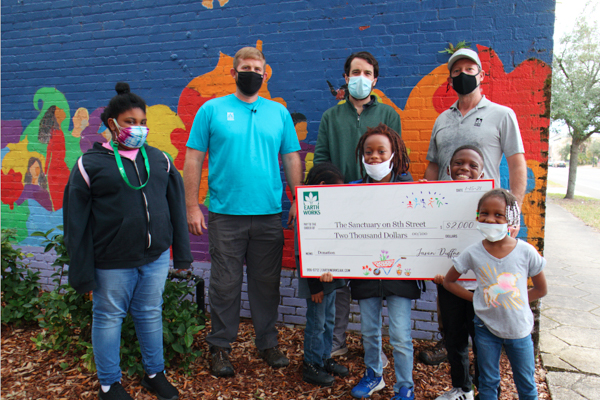
On Arbor Day Earth Works delivered a check for $2000 from proceeds collected from 25% of gift card sales over the 2020 holiday season.
Rick Cartlidge, executive director of the Sanctuary on 8th Street Educational Charity in the historic area of Downtown Jacksonville, Florida discusses their relationship with Earth Works, their mission helping children and how you can help.
Sanctuary on 8th Street Volunteer Day with Earth Works
Earth Work of Jacksonville workday for area volunteers who came out and improved the curb appeal and did general lawn and landscaping work at the Sanctuary on 8th Street in Jacksonville’s Springfield Community. Jason & Sean Duffney along with Mark & Patricia Fechtal and Timbo were joined by a dozen U.S. Navy personnel. Thank you to everyone who participated for your service to the Sanctuary and community. Event: Earth Works Volunteer Work Day Date: Saturday, Dec. 5, 2020 Location: Sanctuary on 8th Street 120 E. 8th Street, Jacksonville, Florida.
Sanctuary on 8th Street Community Garden Jason & Matt return to the Sanctuary on 8th Street community garden to work with children teaching them how to plant and care for a garden. Plus, they announce our upcoming Volunteer Work Day where everyone can join us to give the landscape at the front entrance more curb appeal. Meet us at the Sanctuary Saturday morning December 5, 2020 and help for as long as you wish!
Sanctuary on 8th Street Educational CharityCommunity Garden Jason Duffney & Matthew Barlow spend the afternoon teaching children how to tend the vegetable garden at the Sanctuary on 8th Street in the Springfield area of downtown Jacksonville, Florida. Thank you for the help from kindergarten through 2nd grade students who participated including Nehemiah, Kyree, Noah, Micah, & Kendall. Special thanks to Coach Henry & Ford and Assistant Director Jaime!
Plus, remember that for comprehensive solutions to your specific lawn, garden and landscaping need contact Earth Works of Jacksonville online and at 904-996-0712.
Earth Works operates a retail Garden Center/Plant Nursery in Jacksonville and provides landscaping, hardscaping, water features, lawn care service, lawn spraying, and drainage solutions. Contact us with your questions and to book design consultations. Earth Works proudly serves clients in Northeast Florida, including Jacksonville, Ponte Vedra Beach, Atlantic Beach, Neptune Beach, Jacksonville Beach, Nocatee, St. Johns, Fleming Island, Orange Park, Middleburg, Green Cove Springs, Amelia Island, Fernandina, and St. Augustine.
In-depth information into this recreational swim pond construction by Earth Works, Aquascape Inc., and contractors from around the country. This event took place in St. Augustine, Florida as part of an annual Winter Seminar coordinated by Aquascape Inc for the purpose of advanced training for Certified Aquascape Contractors.
Read Jason Duffney’s article on this recreational swim pond construction in the May/June 2021 issue of Pond Trade Magazine.
Brueggen Swim Pond 1 Year Anniversary of Installation
Jason Duffney met with Jenn and John Brueggen to get their thoughts after one year of their swim pond installation that was the featured build of the contractors in attendance at the 2021 Aquascape Inc. Winter Retreat.
St. Augustine Alligator Farm Aquascape Recreation Swim Pond Construction Part 1 Behind the Scenes at the start of Earth Works of Jacksonville collaboration with Aquascape Inc. in the Aquascape Recreational Swim Pond for a Eastern Collard Lizard – Advanced CAC Build at the home of the St Augustine Alligator Farm Director John & his wife Biologist Jenn Brueggen’s home. John Brueggen discusses what they are hoping for and Earth Works team members Jason Duffney & Sean Duffney along with Michael Quatromoni discuss this event that will involve 100 Certified Aquascape Contractors participating here & at the Aquascape Pond and Fountainscape Build at the St. Augustine Alligator Farm Zoological Park with onsite participation & education with Greg Wittstock, The Pond Guy & Ed Beaulieu.
Aquascape Recreational Swim Pond Construction for a Eastern Collared Lizard Part 2 Ed Beaulieu, the Pond Professor, Jason Duffney, and Michael Quatromoni discuss progress and setbacks ahead of being joined by 100 Certified Aquascape Contractors participating here & at the Aquascape Pond and Fountainscape Build at the St. Augustine Alligator Farm Zoological Park. Behind the Scenes at Day 2 of Earth Works of Jacksonville collaboration with Aquascape Inc. in the Aquascape Recreation Pond for a Eastern Collard Lizard – Advanced CAC Build at the home of the St Augustine Alligator Farm Director John & his wife Biologist Jenn Brueggen’s home.
Sneak Peek Teaser into Part 3 of the Recreational Swim Pond Construction Sneak peek into Part 3 in the video series about the St. Augustine Alligator Farm Zoological Park Director John Brueggen’s swim pond build by Aquascape and Earth Works. This is serious business folks!
St. Augustine Alligator Farm Aquascape Recreational Swim Pond Construction Part 3 Jason Duffney, Ed Beaulieu, and Chris Hansen are back for the third update on the swim pond install at John & Jen Brueggen’s home in Elkton, Florida near the St. Augustine Alligator Zoological Park where they will also be conducting an Aquascape contractor seminar Wednesday, February 3rd – Friday, February 5th, 2021.
St Augustine Alligator Farm Sneak Peek Part 1 Jason Duffney takes us behind the scenes with Director John Brueggen, and Aquascape Inc’s Pond Professor Ed Beaulieu, and Chris Hansen at the St. Augustine Alligator Farm Zoological Park prior to the Aquascape Inc pond construction and Certified Aquascape Contractors 2021 Winter Retreat. Part 1.
St Augustine Alligator Farm Sneak Peak Part 2 St Augustine Alligator Farm Director John Brueggen provides a behind the scenes sneak peek to Earth Works Jason Duffney and Aquascape Inc’s Pond Professor Ed Beaulieu, Chris Hansen and Travis prior to the new pond construction and the Certified Aquascape Contractors training sessions and Winter Retreat. Part 2.
St Augustine Alligator Farm Sneak Peek FINAL Part 3 Final Behind the Scenes Sneak Peek at the St Augustine Alligator Farm. Tune in to interesting stories from around the world along with specifics on requirements for healthy wildlife habitats and maintaining exotic species with Zoo Director John Brueggen and Ed Beaulieu as we prepare for the Aquascape Winter Retreat and build Feb 3-6, 2021.
Welcome Team Aquascape to the St Augustine Alligator Farm Zoological Park Jason Duffney, owner Earth Works of Jacksonville welcomes Team Aquascape to the St Augustine Alligator Farm Zoological Park event and Winter Retreat! Wednesday, February 3-5, 2021!
St. Augustine Recreational Swim Pond Reveal Wrapping up collaboration with Aquascape Inc. for the Aquascape Recreation Pond Build at the home of the St Augustine Alligator Farm Director John Brueggen & his wife Biologist Jenn Brueggen’s home. John Brueggen discusses what they are hoping for and Jason Duffney and Greg Wittstock discuss the outcome of this recreational pond.
Fill ‘Er Up! Recreation Pond Final Details – Part 5
Bring in the reinforcements! The CACs are here for the regional build event to help with the process of finishing up the recreation pond for the Alligator Farm. John also takes me in to show me his Gila monsters and their habitat.
Replicating the Desert for a *GILA MONSTER POND* – Part 4
Bring in the reinforcements! The CACs are here for the regional build event to help with the process of finishing up the recreation pond for the Alligator Farm. John also takes me in to show me his Gila monsters and their habitat.
Answering Your Questions: Concrete or Rubber Liner? – Recreation Pond Part 3
I’m taking some time to answer some of the questions you have had about the recreation pond build. Specifically, the under liner drainage and the architecture of the wall.
Giving Life to a RECREATION POND – Part 2
Today is the day! We break ground in St. Augustine, FL on the recreation pond for the St. Augustine Alligator Farm. I’ll show you how important it is to get these recreation ponds designed and planned the right way!
Alligator Expert Gets a RECREATION POND – Part 1
I am so stoked to be in St. Augustine, Florida to design and build a restorative recreation pond for John Brueggen, director of the St. Augustine Alligator Farm. Today, John gives us a tour of the farm which is such an inspiration.
*POND BUILD* for Florida Alligator Farm (Rec Pond Revealed)
Chris leads Build-a-Pond-Day at the historic Alligator Farm and Zoological Park in St. Augustine, Florida! Newbie attendees knock this 8′ x 11′ pond out in one day. Later, Ed reveals the reptile rec pond from the advanced build!
Wetland Filter for Reptile REC POND – Part 5
Groundwork on the reptile rec pond for our advanced CAC build continues. Today the crew constructs the wetland filter and Ed shares tips for excavation and setting boulders.
Cypress Log Edge for Reptile REC POND – Part 4
Establishing different elevations and grade levels makes all the difference on a flat property like this. Ed and Chris carve in a massive cypress log as a unique edging element for the reptile rec pond.
Groundwater Solutions for Reptile REC POND – Part 3
Ed and Chris implement groundwater solutions and install a 4-inch drain tile so they can create a solid base for their liner. The rocking of the reptile rec pond is now underway!
Intake Bay for Reptile REC POND – Part 2
Ed the Pond Professor arrives at the job site and notices we’ll need to make adjustments to our intake bay. The reptile rec pond comes in at a 30,000 gph requiring 500 gallons of water storage.
Reptile REC POND Design for Collared Lizards – Part 1
Chris joins the Earth Works team down in Florida to collaborate on a recreation pond for eastern collared lizards! The 20′ x 25′ reptile rec pond will utilize a tile drainage system to combat hydrostatic pressure from the groundwater.
Earth Works is proud to have hosted the 2021 Aquascape Winter build with Greg Wittstock, founder of Aquascape for Certified Aquascape Contractors from around the country. Participating CAC’s include:
Chris Pekarek | Poseidon’s Aquatic Designs
Stan Lepkowski | Delaware Water Features
Stan Lepkowski | Delaware Water Features
Greg Gill | Eastern Iowa Landscape
Bob Kerr | Gradex Company LLC
Zak Kladden | Majestic Water Gardens
Thomas Smith | Garden State Koi
Tim Dille | Garden State Koi
Enrique Gomez | Garden State Koi
Jason Borawski | Liberty’s Pavers, Ponds, & Water Features
Armando Amaya | Virginia Water Gardens
Charlie Ross | Virginia Water Gardens
Armando Amaya | Virginia Water Gardens
Crystal Urquizu | Virginia Water Gardens
Don | Virginia Water Gardens
Allan Schule | Sound Shore Pond Inc.
Bruno Maegerle | Pond Pros
Chris Ostrander | Living Water Landscape Service
Alex Oren | Landvista Aquascapes
William Seeds III | Seeds of Nature Watergardens
Brent Hullinger | The Pond Beyond, LLC
Yogi Davis | Bear Stone & Aquatic Design
John Griffith | Paradise Ponds
Patrick Kirby | AquaReale
Carl Petite | Columbia Water Gardens
Brad Cheney | Nature’s Image Aquatic Design LLC
Micah Miller | Easton Outdoors
Frank Council | Easton Outdoors
Evan Hamner | Easton Outdoors
Rico Rosa Arce | Easton Outdoors
Ethan Hammond | Amen Corner Ponds
Jeremy Vlcek | Vlcek Gardens
Jay McCormick | Aquatic Lifestyles LKC
Zachary Medori | Turpin Design/Build
Max Taylor | Turpin Design/Build
Dave DeGroot | Artisan Water Gardens
Martin V Dimitrov | Atlantic Ponds LLC
Cody Gilstrap | River Rock Water Gardens
Chris Sturdyvin | Chris’ Water Gardens
Mark Carlson | Chris’ Water Gardens
Franco Propato | Frank Propato Landscaping LLC
Greg Falvo | We Build. LLC
Sean Frost | Nature Scapes
Bubba Hogan | Dreamscapes Landscaping
Scott Anderson | Scott Anderson Design
Brad Fontaine | Florida Custom Aquatic Services
Adam Goit | Brookside Landscape and Design
Nate Shirley | Brookside Landscape and Design
Brad Fontaine | Florida Custom Aquatic Services
Trevor Gibson | Florida Custom Aquatic Services
John Underwood | The Pond Beyond
Matt Berry | Nature Scapes
Adam Klingenberg | Florida Custom Aquatic Services
Beth Roth | Triton Waterscapes
Kathy Rosen | Delco Ponds and Waterscapes
Jeff Norman | Great Lakes Pondscapes
Allison Norman | Great Lakes Pondscapes
Gunther| Six Flags Nursery Supply LLC
Stephen Perez | Stephens Landscaping of Clermont
Brandon Grope | PondScape LLC
Amanda Gunther | Six Flags Nursery Supply LLC
Jay Duke | Rivercrest
Greg Gill | Eastern Iowa Landscape
Steve Roth | Triton Waterscapes
Peter Donahue | GreenPete, LLC
Brian Rosen | Delco Ponds and Waterscapes
Aaron Cruz | Garden State Koi
Baldo Bautista | Garden State Koi
Kimberly Kontopodias | Across the Pond Aquascapes LLC
Maggie Hutt | Across the Pond Aquascapes LLC
April Dugan | April Dugan
Melanie Norman | Great Lakes Pondscapes
Brian Norman | Great Lakes Pondscapes
Lisa Ballantine | Ballantine
Ben Clark | Buddy’s Property Services, LLC
Garrett Wurzbach | Aqua Escapes LLC
Aaron Chico | Blue Lotus Waterscapes & Design
Zachary Watson | Site Pros Landscaping, Inc.
John Adams | Modern Design Aquascaping Inc.
Alissa Wells | Site Pros Landscaping, Inc.
Tim Wood | Aquatic Edge
Cameron Perez | Stephens Landscaping of Clermont
Tim Wood | Aquatic Edge
Casey Perez | Stephen’s Landscaping
Gabriel Botto | Island Aquascape Inc
Brad Birch | BBs Aquatic Service LLC
Robert Lofgran | Wasatch Ponds
Andrew Starkey | Aloha Landscaping and Services
Zoran | Zorancreative
Jerome Fischer Alabama Aquascapes
Kyle Brown | Modern Concepts Custom Outdoor Creations
Garth Price | Modern Concepts
Diana Cagle | Aqua Dreamscapes LLC
Pheonix Singleton | Ceto Waterscapes
Joel Lattimer | Lattimer Landscaping Inc
Luke Lattimer | Lattimer Landscaping Inc
William Adams | Lattimer Landscaping Inc
George Ruiz | TAMPA BAY PONDS & ROCKS
Carl Gennaro Jr | EnviroScapes Property Specialist, Inc
DAY ONE: Team Aquascape Winter Retreat 2021 It was a great first-day kickoff at Earth Works of the Team Aquascape Winter Retreat-St Augustine Alligator Farm pond builds. Aquascape, Earth Works, and contractors from around the country had been preparing for months for this week’s activities. The amount of energy and associated expense for all in attendance during these difficult times deserves recognition and praise.
Wednesday night was the kickoff for the event at the Earth Works garden center with meet & greet opportunities and an hour-long Q&A before the group between Greg, Mark Fechtel, and Jason Duffney about the thirty-plus year success story of Earth Works and its role in providing a wide range of outdoor living services including Aquascape water features and its core state of the art technologies that take the stress and strain out of water feature maintenance while providing high performance and client satisfaction.
The Tribe as the Aquascape gaggle of pond diggers is known is welcoming to everyone with Greg setting the tone with an outreached hand for those he’s had relationships with for decades, as well as first-timers to this Team Aquascape event. Over one hundred contractors attended including company owners, foremen, and reps that wear a myriad of other hats covering the wide range of duties achievers take on in building an idea into a successful business.
Greg espoused the benefits of sharing and learning from one another pointing out those members in attendance with five and ten plus years of experience with Aquascape. There are numerous Aquascape artists of the year and Jason Duffney is notably last year’s Aquascape Businessman of the Year. Greg encouraged tribe members to tap the knowledge base of those next to them as it is extensive among the tribe members in attendance.
The network of the Aquascape Tribe will doubtlessly strengthen this week. Aquascape contractors around the country will benefit as these technologies are installed at the St. Augustine Alligator Farm Zoological Park where thousands of guests pass through each year, and Zoo Director John Brueggen shares the success and potential of these applications with his international network of zoological society tribe members.
Plus, remember that for comprehensive solutions to your specific lawn, garden and landscaping need contact Earth Works of Jacksonville online and at 904-996-0712.
Earth Works operates a retail Garden Center/Plant Nursery in Jacksonville and provides landscaping, hardscaping, water features, lawn care service, lawn spraying, and drainage solutions. Earth Works proudly serves clients in Northeast Florida, including Jacksonville, Ponte Vedra Beach, Atlantic Beach, Neptune Beach, Jacksonville Beach, Nocatee, St. Johns, Fleming Island, Orange Park, Middleburg, Green Cove Springs, Amelia Island, Fernandina, and St. Augustine.