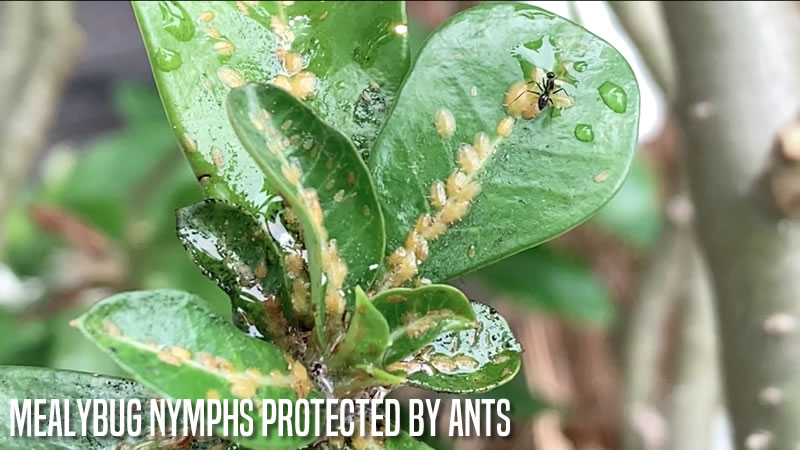
Regular observation and timely corrective actions are the keys to preventing mealybug infestation that unchecked can kill your affected plants. A staff member’s Desert Rose appeared pest-free during May’s dry weather, but in June quickly became heavily infested with multiple stages of the mealybug life cycle. Silky cocoons appeared at the base of stems and flower buds as adult females scurried about and immature crawlers (nymphs) settled into gelatinous protected coverings littering the leaf surfaces with ants on patrol protecting and farming them. While feeding with their piercing mouthparts mealybugs excrete toxins into the plant and dump their honeydew waste on leaf surfaces that attract ants and fungus which in turn reduces sunlight and required photosynthesis for the plant.
What do mealybugs look like? Mealybugs in their immature nymph stages look like scale and are closely related to them and aphids. Over 275 species of mealybugs are distributed everywhere in the world except Antarctica. Mealybug adult females are oval, white, and mobile, while mouthless winged adult males are rarely seen during their one or two-day life span that’s spent focused strictly on mating.
Where do mealybugs live? Mealybug occurrences are common in the garden and on houseplants with the mobile females scurrying about under leaves, around their silky cocoons, stems, even plant roots with mealies readily moving from one plant to another. Mealies feed on many ornamental plant varieties, citrus, lawn turf and threaten greenhouse horticultural operations. They also have a highly specialized commensal relationship that ecologists find fascinating. “In this study, the fire ant Solenopsis invicta was found to take advantage of the shelters constructed by the leaf roller Sylepta derogata to protect mealybugs (Phenacoccus solenopsis) against their natural enemies,” according to scientists at the South China Agricultural University, Guangzhou, People’s Republic of China. “This protective effect of fire ant tending on the survival of mealybugs in shelters was observed when enemies and leaf rollers were simultaneously present. Specifically, fire ants moved the mealybugs inside the shelters produced by S. derogata on enemy-infested plants.”
How do I get rid of mealybugs? Regular observation and having an action plan for dealing with threats before they get out of hand is the best approach to preventing mealybug infestation and resulting damage. Mealybugs can be removed manually and sprayed into a bucket for removal to avoid the same individuals returning to re-infest plants. Besides strictly using water Insecticidal soap and horticultural oil provide the next lowest environmental impact in mealybug management having no residual toxicity after dry that as a result protects other beneficial insects and pollinators. Neem tree seed extract is commercially available as neem oil containing azadirachtin that kills mealies, but is indiscriminate also killing beneficial insects and is moderately toxic to fish and amphibians, requiring overspray protection for water bodies and other potentially impacted areas.
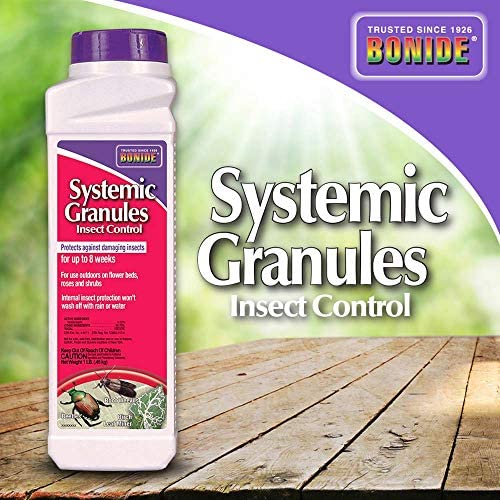
Insecticide treatment options include Bonide systemic insecticide containing dinotefuran available in granules and spray. Additionally, Ferti-lome Tree & Shrub drench, is an effective foliar treatment for mealybugs, which is taken up by the roots and provides protection internally throughout the year. “Cover-spray applications of broad-spectrum insecticides often lead to secondary pest outbreaks,” according to the University of Florida. “Scale insects and mealybugs are secondary pests that may increase following such disturbances to the ecosystem balances in a landscape. For this reason, we often see more scale insect and mealybug outbreaks in landscapes that have been exposed to intensive broad-spectrum insecticide applications.” Biological controls include Cryptolaemus montrouzieri, a brown lady beetle common name ‘Mealybug Destroyer.’ Their young are able to feed on the mealies without being attacked by the ants guarding them. As with introducing any variety of beneficial insects to the garden, there can be predation of them by other animals and suitable amounts of prey must be available for them to stay.
There are two varieties known varieties of mealybugs that affect turfgrass in Florida. Rhodesgrass mealybugs attack Bermuda and St. Augustine grass. Tuttle mealybugs are believed to mostly impact zoysia grass. “Systemic products like neonicotinoids are preferred because they have longer residual activity inside plant tissue,” according to the University of Florida. “Several combination products that contain pyrethroids and neonicotinoids (e.g. bifenthrin + imidacloprid) may provide initial high knock-down rates followed by longer systemic control.” Thus, while we cannot expect to permanently rid our lawns and gardens of mealybugs, we can manage their numbers and reduce the damage threat by preventing mealybug infestation. In the case of the staff member’s Desert Rose due to the extent of its infestation neem oil was applied (two tablespoons of neem oil per gallon of water) to leaves, stems, and trunk, which will be repeated in seven to 10 days until satisfactorily under control. Garden Center Manager Matt Barlow recommendation for long-term control is use of the Bonide systemic insecticide as he does with his desert roses, which he’s found has been quite successful.
Mealybugs are a threat to a variety of plants in our Florida gardens. Soft stemmed perennial foliage plants are particularly susceptible to mealybugs such as this clients’ coleus.
For comprehensive solutions to your specific lawn, garden and landscaping need contact Earth Works of Jacksonville online or at 904-996-0712. Earth Works operates a retail Garden Center/Plant Nursery in Jacksonville and provides landscaping, hardscaping, water features, lawn care service, lawn spraying, and drainage solutions.
Happy Gardening!
Proudly serving clients in Northeast Florida including Jacksonville, Ponte Vedra Beach, Atlantic Beach, Neptune Beach, Jacksonville Beach, Nocatee, St. Johns, Fleming Island, Orange Park, Middleburg, Green Cove Springs, Amelia Island, Fernandina, and St. Augustine.
Between June and September, Jacksonville receives as much precipitation as the other eight months combined, which brings not only lush lawns and gardens, but mosquitos, chinch bugs, and fungus. During extended periods of rainfall, cut back your automatically timed irrigation scheduled watering. Soil aeration, fertilization, and cultural practices, including cutting lawn turf at the proper height and watering at the appropriate time of day, all reduce the threat posed by summer lawn and garden pests and pathogens. While taking measures to remedy these threats to the lawn and garden we discourage overuse and runoff of treatments that can harm beneficial plant and animal species and the environment.
Mosquitos quickly get our attention biting exposed skin after hatching from stagnant water in as little as 24 hours. To minimize the health threat from mosquitos eliminate stagnant water collection receptacles in the landscape. Properly maintained ponds and water gardens are NOT breeding grounds for mosquitos. Still, birdbaths and bogs without filtration or aeration can be a mosquito haven that’s remedied with Mosquito dunks, the solid form of Bacillus Thuringiensis. Low-lying areas of the landscape that hold water also serve as a breeding ground for mosquitos. When mosquitos are present, avoid getting bit with a non-oily application of Natures Way All Natural Repellant, which kills and repels nuisance flying insects and is safe for people, pets, and the environment.
Southern chinch bugs are ever-present in the Northeast Florida environment. Their 3-4 life cycles per year cause damage in full sun and drought conditions, especially to St. Augustine lawn turf. Proper timing and application of pesticides are critical to addressing the threat from chinch bug eggs along with nymphs and adults. Increasing irrigation and dumping high nitrogen fertilizer on chinch bug-infested turf can cause more harm than good to the landscape and environment. Contact the Earth Works lawn care division for professional fertilization, disease, weed, and pest control service. Get Your Free Quote.
Fungal pathogens, including mold and mildew that prey on lawn and garden plants, are of particular concern during the rainy season. However, other fungi species, including mycorrhizae, are beneficial to plants and animals, demonstrating the importance of good cultural practices to only rid your garden of fungal pathogens. Take care of your soil with periodic aeration and soil amendments combined with targeted fungicide treatments available at Earth Works Garden Center to remedy downy and powdery mildews, root rot, and various other fungi in the lawn and garden. Also, ask the Earth Works lawn care division for a quote on such services.
Mosquitos, chinch bugs, and fungus are a threat with lush lawns the same as for rutted-up ones that hold water.
Plus, remember that for comprehensive solutions to your specific lawn, garden and landscaping need contact Earth Works of Jacksonville online and at 904-996-0712. Earth Works operates a retail Garden Center/Plant Nursery in Jacksonville and provides landscaping, hardscaping, water features, lawn care service, lawn spraying, and drainage solutions. Proudly serving clients in Northeast Florida including Jacksonville, Ponte Vedra Beach, Atlantic Beach, Neptune Beach, Jacksonville Beach, Nocatee, St. Johns, Fleming Island, Orange Park, Middleburg, Green Cove Springs, Amelia Island, Fernandina, and St. Augustine. Happy Gardening!
June lawn and garden tips for Northeast Florida start with the recognition that Summer begins on June 20. This is also the Summer Solstice, the longest day of the year as the Sun is at its highest point in the sky. June 1 is the first day of hurricane season. Rainfall totals for Jacksonville between January and June 2021 were 17”, which is one inch above average. However, May was a dry month with less than a half-inch of rainfall, with most of the monthly totals coming in February and April. As a result, the soil is dry and irrigation and hand watering crucial. Fortunately, the chance of rain increases each day of June historically to the greatest daily likelihood coming at the end of July. June is typically a wet month averaging nearly six inches of rainfall, with last year’s total being 8.9 inches. In June 2012, Jacksonville received over 21 inches of rain, with 12 inches of it associated with Tropical Storm Debby. Rain is good, but not too much.
June’s climate in Northeast Florida is typically prime time for planting a wide assortment of warmth and full sun-loving flowering plants and shrubs. Rising soil and air temperatures of spring and early summer make for good conditions for planting palms and drought-tolerant choices, including African Iris, bromeliads, bulbine, crotons, figs, fountain grass, lantana, agaves, birds of paradise, junipers, and fruit trees. Vegetables for planting directly in the ground in June include okra, peas, squash, spinach, and sweet potatoes as the heat becomes too much for most cooler season vegetables. Remember to water new landscape plants daily for the first month, which is an allowable exception to the twice per week watering restrictions for the region.
JUNE PRUNING IN NORTHEAST FLORIDA
Remember the five D’s of pruning, pruning a plant anytime it is dead, dying, damaged, disfigured, or showing signs of diseased wood. Shrubs that bloom in spring typically set their blooms on old wood from the prior season, whereas summer-blooming shrubs typically set blooms in spring on new growth from the same year. Thus, trim your spring bloomers immediately after their flowers bloom to allow for the preservation of buds for next year. Prune your summer bloomers in late winter or early spring to encourage new growth before bud setting. Ask Earth Works garden center staff for help with your specific plant pruning requirements.
JUNE FERTILIZATION & SOIL AMENDMENTS IN NORTHEAST FLORIDA
It is essential to match the nutrient needs of your landscape and house plants with the appropriate NPK (Nitrogen, phosphorus & potassium) provided by various fertilizers. For example, balanced fertilizer such as 10-10-10 has an equal percentage of nitrogen for green leaf development, phosphorus and potassium for root growth, and setting blooms and fruit. Soil testing provides a baseline of information for knowing your plant’s nutrient needs, and testing is free in Northeast Florida at the University of Florida IFAS Extension Office. Learn more about their services in our blog “Soil Testing in Northeast Florida.”
Long-standing recommendations were to fertilize your lawn in spring, followed by an additional application in summer and then a winterizing fertilizer application which prepares the sod heading into winter dormancy. However, in 2007 the Florida Department of Agriculture and Consumer Services (FDACS) passed the Urban Turf Fertilizer Rule that reduces the amount of phosphorus and potassium allowed for release during lawn fertilization to negligible percentages, basically defined as low or no phosphorus and nitrogen. Dozens of counties have rules more strict than the state rule prohibiting nitrogen and phosphorus entirely between June 1 and Sept 30 due to the increasing frequency of devastating algae blooms. Duval County does not.
Most of your houseplants do well with monthly liquid fertilization during their growing season. However, because of the wide assortment of plants in the typical landscape, please research their nutritional needs and consider using slow-release fertilizers. In addition, create setbacks around water bodies and pathways to storm drains to avoid fertilizer pollution. Earth Works lawn care division provides aeration and top dressing services to replenish lawn nutrients that reduce your fertilization and watering needs.
JUNE POND CARE IN NORTHEAST FLORIDA
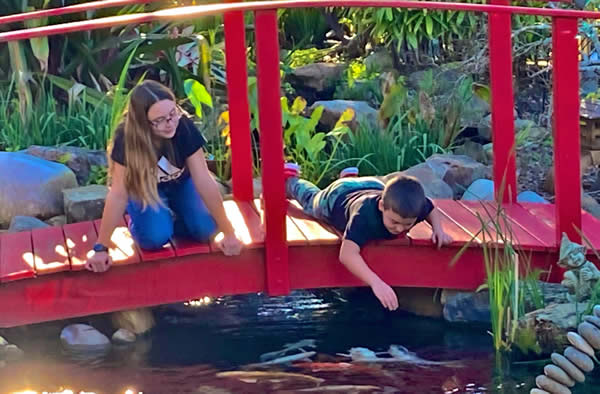
The warmest months of the year are times you expect to enjoy your pond and water garden the most, but anxiety arrives if your fish are suffering as a result of a poorly designed & equipped, dirty, overstocked pond that all contribute to low dissolved oxygen. There you are trying to enjoy some time pondside as that Summer warmth cooks the O2 out when the fish need it most. Supplemental aeration helps during these times of Summer by raising the dissolved oxygen levels. Learn more in our blog “Low Dissolved Oxygen: Koi Summer.”
JUNE PEST CONTROL IN NORTHEAST FLORIDA
June’s heat and moisture make for good conditions for and an explosion of lawn and garden pest species. Chinch bugs, sod webworms, grubs, mole crickets, and fungus are a few of the species attacking the lawn while aphids, thrips, whitefly, leafhoppers, leaf miners, and leafrollers go after the flower beds, trees, and shrubs. The Earth Works lawn care department has a seasonal pre and post-emergent pesticide treatment program and provides instant quotes for all available services. In addition, the garden center has a wide assortment of organic pest control solutions, including Horticultural oil, bacillus thuringiensis, and copper fungicide, along with broad-spectrum bifenthrin, systemic insect spray, and granules.
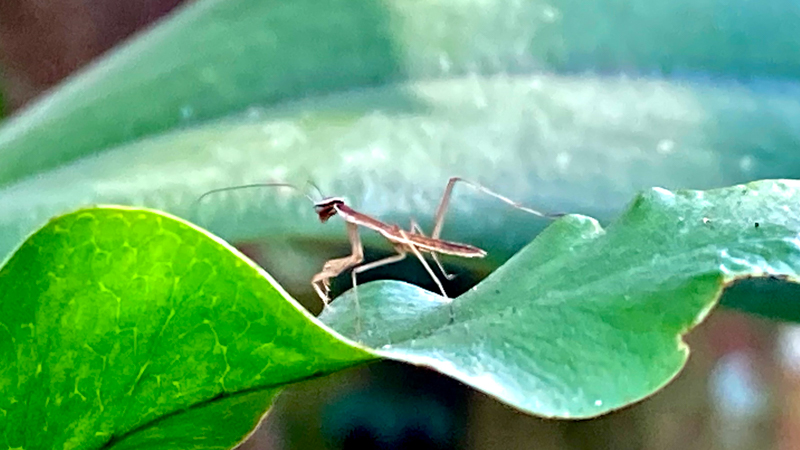
Nurturing predatory species of beneficial insects in the garden, such as ladybugs, green lacewings, and praying mantis, will reduce dependence on chemical treatments for these pests and support a sustainable ecosystem. Wrapping up June lawn and garden tips on the topic of pollinators, Join the Buzz by Entering our Social Media Contest. Share your love of pollinators on our Facebook page and spread the word! Share the favorite POLLINATOR PHOTO you have taken in the comment section—post by June 20, 2021, for a chance to win our fun friends of pollinator kit.
Plus, remember that for comprehensive solutions to your specific lawn, garden and landscaping need contact Earth Works of Jacksonville online and at 904-996-0712. Earth Works operates a retail Garden Center/Plant Nursery in Jacksonville and provides landscaping, hardscaping, water features, lawn care service, lawn spraying, and drainage solutions. Proudly serving clients in Northeast Florida including Jacksonville, Ponte Vedra Beach, Atlantic Beach, Neptune Beach, Jacksonville Beach, Nocatee, St. Johns, Fleming Island, Orange Park, Middleburg, Green Cove Springs, Amelia Island, Fernandina, and St. Augustine. Happy Gardening!
A good starting point for pruning tips with any plant is to remove dead, diseased, or damaged stems as soon as you see them. Dead stems attract insects and invite diseases to develop. Also remove crossing branches, water sprouts (vigorous upright growing shoots that form on trunks or side branches), and suckers (vigorous shoots that develop near or from below ground).
What to Prune When
Spring- Flowering Trees and Shrubs
Early season pruning tips for spring bloomers, such as azalea, bear flowers on wood formed the previous year. The best time to prune them is late spring — immediately after they finish blooming. If you prune them later in the growing season you’ll remove flower buds and decrease the amount of spring bloom.
Hydrangeas
Most hydrangea types bloom on old wood. Prune these types of hydrangeas before midsummer. If you prune them in winter or early spring, you’ll be removing flower buds. With newer reblooming types, such as the Endless Summer Series which bloom on new growth, timing of pruning is less critical. Even if you cut off some of the flower buds by pruning the old stems, the plant will bloom on the new growth.
Shrubs With Showing Blooms
Cut back shrubs grown primarily for their foliage (such as Loropetalum and Ligustrum) almost anytime: except in late autumn. New growth that starts after late season pruning won’t harden off properly before winter. Major pruning is best done when it is dormant.
Clipped Hedges
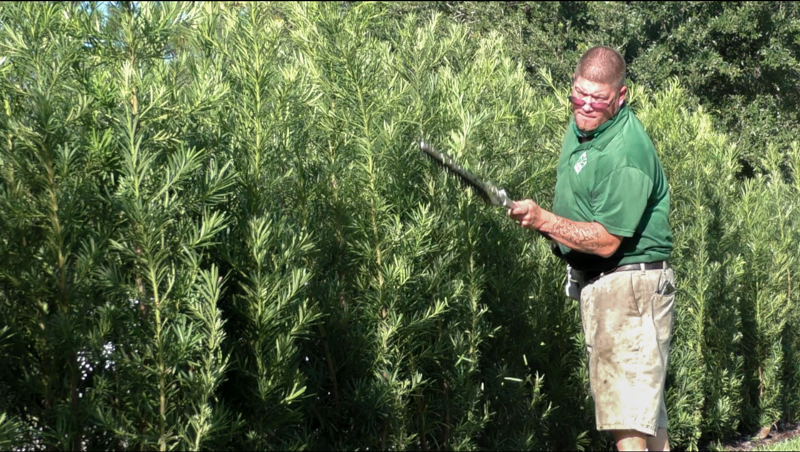
Shrubs such as boxwood and podocarpus are often sheared to form a hedge. To maintain a solid wall of green, shear the new growth frequently during the early part of the growing season. Stop in late autumn.
Roses
Prune climbers and old garden roses that bloom only once per year after they finish blooming. Repeat bloomers, including hybrid teas, floribundas, knockout, and drift shrub roses are pruned mostly to shape the plant or to remove winter-damaged canes. If they become overgrown, cut them back in early spring.
Perennial Flowers
Most perennial flowers look best if you remove faded flowers. This is called deadheading. As a bonus, many perennials will push out another cycle of blooms after deadheading. If your perennial flowers become too tall and leggy, or flop open in the middle, try shearing them back to 6-12 inches above the ground. This type of haircut causes them to become stockier.
Annual Flowers
Deadhead annual flowers regularly to keep them blooming well. Removing the old flowers prevents them from setting seeds and allows plants to put more energy into blooming. Some annuals, such as petunias, sprawl and develop bare stems at their bases. As with perennials, you can shear these rangy plants to force more compact growth and renewed bloom.
Citrus
On young trees, it is important to remove suckers from the base of the tree. Mature citrus trees do not require pruning of the canopy except for substantial injury or after a disease or freeze damage. Unnecessary pruning will reduce fruit production. Pruning of the canopy should be reserved to prevent trees from crowding other plants or buildings. Be sure to remove vertical shoots. Make all pruning cuts flush with the trunk, since stubs may be attacked by rotting organisms which could damage the tree. If you must prune, timing can be tricky and varies by variety. Shoot for after harvest and before flowering.
Plus, remember that for comprehensive solutions to your specific lawn, garden and landscaping need contact Earth Works of Jacksonville online and at 904-996-0712. Earth Works operates a retail Garden Center/Plant Nursery in Jacksonville and provides landscaping, hardscaping, water features, lawn care service, lawn spraying, and drainage solutions. Proudly serving clients in Northeast Florida including Jacksonville, Ponte Vedra Beach, Atlantic Beach, Neptune Beach, Jacksonville Beach, Nocatee, St. Johns, Fleming Island, Orange Park, Middleburg, Green Cove Springs, Amelia Island, Fernandina, and St. Augustine.
You may like the sound of running water, but don’t want a pond. Earth Works of Jacksonville, Florida has a variety of pondless water features on display at our garden center that demonstrate a few of your design possibilities. The hardware for these pondless water features is manufactured by Aquascape Inc that Earth Works also sells as kits to clients who wish to do it yourself (DIY). As Certified Aquascape Contractors (CAC) Earth Works landscape department staff work with clients to develop designs and install in landscapes throughout Northeast, Florida.
Pondless Waterfall Garden Center Displays Include:
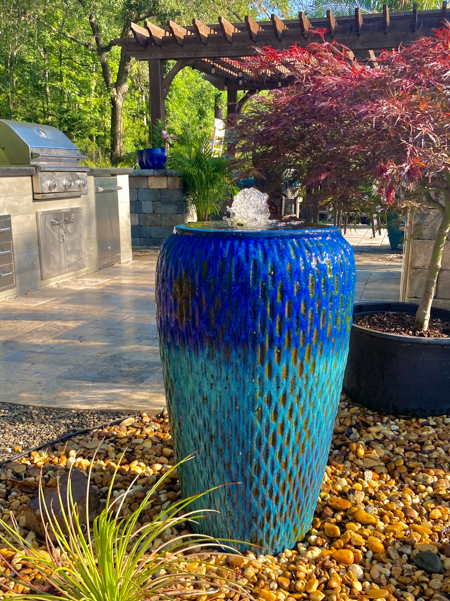
Water Pot Features: Aquabasin 45, 10×10 Pond Liner Pump Size: Ultra Pump 2000 Contact for pricing.
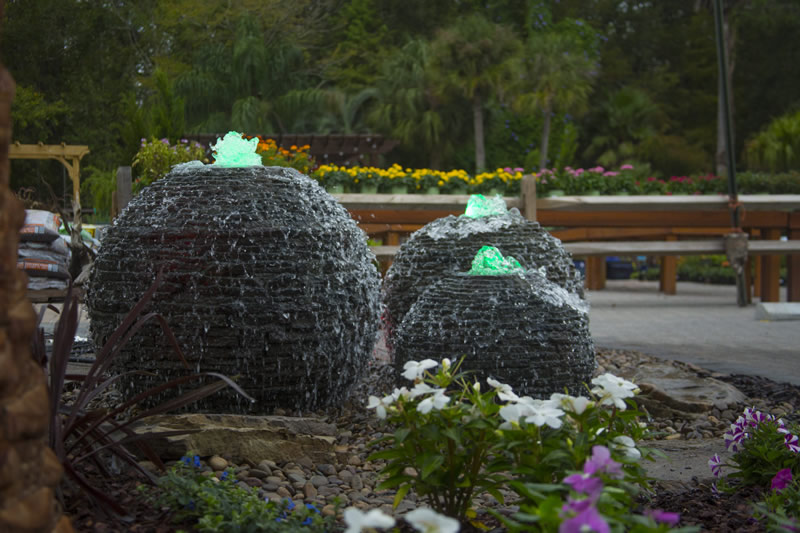
Basalt Columns Size: 1- 24”H, 2-30”H, 3-36”H Features: 2 Night Light, Recirculating system, Large Aquabasin, Built with Mexican Beach Pebble. Pump Size: Ultra 2000 Water Pump. Contact for pricing.
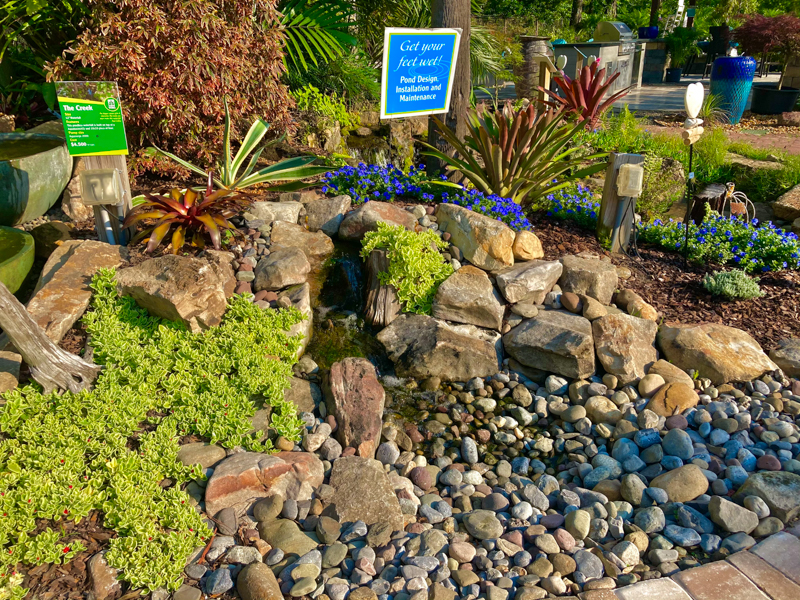
The Creek Size: 12” Waterfall Features: This pondless waterfall is built on top of a Aquabasin (45) and 10×10 piece of liner. Pump Size: Aquasurge 2000 Contact for pricing.
Rocky River Size: 2ft waterfall, 4ft stream. Features: Spillway, Small Aquabloxs, 15×20 Pond Liner, Underlayment, River Jacks and IonGen G2. Pump Size: Aquasurge 5000 Contact for pricing.
Mountain Falls Size: 2.5 ft waterfall x 5ft stream. Features: Low maintenance pondless waterfall, built with Missouri rock. Pump Size: Aquasurge 4000-8000 Adjustable flow pump. With Tennessee Field Stone or Missouri Rock. Contact for pricing.
Stacked Slate Spheres Set of 3 Features: Large Aquablox, Pond Liner, and River Rock. Pump Size: Aquasurge Pro 4000-8000 Contact for pricing.
Entrance Elegance Size 12ft x 8ft Features: Large Aquablox, Pond Linter, Missouri Rock, IonGen G2, Patio Pond 32”, Patio Pond 40”, Curved Stacked Slate Wall 32”. Pump Size: Aquasurge Pro 2000-4000 and Aquasurge Pro 4000-8000. Contact for pricing.
Visit the Earth Works Garden Center to see these water feature options, call 904-996-0714 or request to book a design consultation. Earth Works of Jacksonville is Northeast Florida’s Premier Aquascape Certified Contractor with over 30 years of experience serving clients and delivering available pond options in Northeast Florida. See our garden center POND DISPLAYS here.
Plus, remember that for comprehensive solutions to your specific lawn, garden and landscaping need contact Earth Works of Jacksonville online and at 904-996-0712. Earth Works operates a retail Garden Center/Plant Nursery in Jacksonville and provides landscaping, hardscaping, water features, lawn care service, lawn spraying, and drainage solutions. Proudly serving clients in Northeast Florida including Jacksonville, Ponte Vedra Beach, Atlantic Beach, Neptune Beach, Jacksonville Beach, Nocatee, St. Johns, Fleming Island, Orange Park, Middleburg, Green Cove Springs, Amelia Island, Fernandina, and St. Augustine. Happy Gardening!
Brown palm frond tips, called “frizzle top” on new growth, are a cause for concern for newly planted palm species. Palms depending on size, are often pricey and a prized addition to a homeowners landscape plant collection. As popular palm species originate in all sorts of environments, from deserts to river banks and rainforests, keeping a thriving palm collection requires some knowledge of their specific variety requirements. The slow growth rate in palms coincides with an equally slow display of outward signs problems such as brown palm frond tips. For your palm to flourish it needs the right climate, water, and nutrition free of disease otherwise brown palm frond tips and other problems appear.
When planting your palm, make sure the root ball is placed at the surface or slightly above, not completed buried. Burying the rootball too deep can result in water and iron deficiencies in the palm and brown palm frond tips. In addition, the amount of sun they receive and climate is essential to your palm’s long-term health. Some palms prefer direct sun, others indirect sunlight. High humidity is typically preferred but not something you can only control for container palms indoors.
Too much and too little watering will cause brown palm frond tips. Typically palms prefer moist, well-draining soil. Too much water in poorly draining soil can cause root rot, whereas too little water in sandy soil can also harm your palm. Know the specific requirements of your palm as some such as the Everglades palms and mangrove fan palms grow naturally along river banks and water bodies. In contrast, Bismarck’s palms are extremely drought tolerant doing well in dry heat, desert-like conditions.
Sandy Northeast Florida soil is susceptible to mineral deficiencies negatively impacting palms. These minerals include boron, calcium, iron, magnesium, nitrogen, and potassium. “Magnesium deficiency is very common on highly leached soils in Florida, Hawaii, and other tropical areas,” according to the University of Florida. “It can also occur in container-grown palms if dolomitic limestone has not been added to the substrate. Also, since palms may remain in a container for up to a year or longer, any added dolomite is usually exhausted after six months or so with Mg deficiency symptoms becoming visible as a result. Most species of palms are susceptible to Mg deficiency to some degree, but Phoenix canariensis is by far the most susceptible species to this disorder.
Temperature, pH and certain soil amendments in the soil can result in a deficiency of magnesium that also resultw in frizzle top systems in a variety of palms in Northeast Florida. “Manganese deficiency is very common on alkaline soils, but can occur in containers if drainage is poor or soil temperatures are cool,” according to the University of Florida. “Most species of palms can be affected, but Syagrus romanzoffiana (queen palm), Roystonea regia, (royal palm), Acoelorrhaphe wrightii (paurotis palm), Phoenix roebelenii (pygmy date palm), and Elaeis guineensis (African oil palm) are particularly susceptible.”
Pests including weevils & root rot are often associated with increased stress in newly planted palms. However, in most scenarios, the pruning of your palm should remain the same whether it is healthy or not, considering the plant redirects nutrition from diminishing fronds to elsewhere in the plant. Review our palm pruning video for specific directions on proper palm pruning.
Earth Works has a variety of palm nutritional products and fungicides that will benefit their health. To diagnose the specific cause of brown palm frond tips and other palm problems, take pictures and contact your helpful Earth Works garden center staff.
Plus, remember that for comprehensive solutions to your specific lawn, garden and landscaping need contact Earth Works of Jacksonville online and at 904-996-0712. Earth Works operates a retail Garden Center/Plant Nursery in Jacksonville and provides landscaping, hardscaping, water features, lawn care service, lawn spraying, and drainage solutions. Proudly serving clients in Northeast Florida including Jacksonville, Ponte Vedra Beach, Atlantic Beach, Neptune Beach, Jacksonville Beach, Nocatee, St. Johns, Fleming Island, Orange Park, Middleburg, Green Cove Springs, Amelia Island, Fernandina, and St. Augustine. Happy Gardening!
Low dissolved oxygen levels in ponds is most common in Summer and pose a health risk to koi and other aquatic life that Earth Works help clients remedy. There you are trying to enjoy some time pondside as that Summer warmth cooks the O2 out when the koi and goldfish need it most. Supplemental aeration helps during these times of Summer by raising the dissolved oxygen levels. “Fish require a certain amount of oxygen in the water – at least 5 parts per million,” according to the University of Florida. “Any lower than that, and they begin to have trouble; when dissolved oxygen levels fall below 2 ppm, an immediate fish kill will occur.”
As Certified Aquascape Contractors, Earth Works of Jacksonville designs and builds healthy, low-maintenance ecosystem ponds and provides annual clean-out services to reduce the potential negative impacts of sludge and debris buildup and their consequential aerobic bacterial breakdown. Ecosystem imbalances can occur along with low DO when pond cleaning is not done as needed, in instances of excessive fish stocking, and where there is excessive algae growth. In addition, sludge and debris buildup is broken down by oxygen-dependent bacteria that further reduces the limited O2 supply available to fish. Small amounts of algae are a normal part of a healthy pond ecosystem. However, excessive nutrient buildup from debris and fish waste can result in algae blooms in your pond, with consequences similar to what’s observed in nature. “Trace minerals or nutrients needed by the algae are occasionally used up, causing some or even all, of the bloom to die back temporarily,” according to Freshwater Aquaculture, at US Department of Agriculture. “The resulting bacterial decomposition and loss of normal oxygen production can lead to oxygen depletions and fish kills.” Fish kills aren’t uncommon with ponders who forget and leave the hose filling the pond and many whose koi outgrew the pond and filtration system without getting it updated in time.
You want the best for your fish and you know when your wet pets are happy or not. “A habitually low oxygen level can be linked to slow fish growth and persistent fish sickness, and it may contribute to repetitive parasite outbreaks,” wrote Ellen Kloubec for Pond Trade magazine. “Continued exposure to low DO is also considered a precursor to bacterial infections in fish. Even short periods of oxygen deprivation can have damaging effects.”
It can seem like a cruel joke that your koi and goldfish are least active in Winter when they have the most available dissolved oxygen and are the most active when there is the least amount of DO available. So what are some of the solutions if you are experiencing problems with your pond system or want to be proactive in addressing potential threats before they arise? “Turning over the water is the best way to increase oxygen in your pond,” according to Practical Fishkeeping. “Waterfalls are another excellent way of bringing needed movement and gas exchange. As the thin film of water runs down the slope, it absorbs oxygen which then transfers to the pond below. An air pump will also aerate a pond, although many people believe that the bubbles themselves provide the oxygen content. This is not the case, as the increased surface area and water movement do the work.”
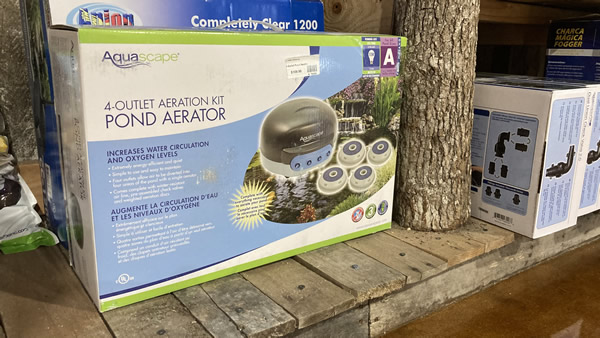
To supplement your pond and water garden dissolved oxygen fish requirements Earth Works Garden Center has available several models of Aquascape Pond Aeration kits that increase water circulation and oxygen levels. Unlike small aquarium-style air stones, these aerators provide greater output with large diffuser discs. “Oxygen is transferred as the bubbles rise through the water column,” according to Craig Tucker, Mississippi State University, published by the Southern Regional Agricultural Center and the Texas Aquaculture Extension Service. “Diffusers for large-scale aeration are usually discs, plates, or tubes constructed of glass-bonded silica, ceramic, porous plastic, or flexible perforated membranes. Diffusers are customarily arranged in a grid pattern over the bottom of the pond, with the number of individual diffusers determined by the oxygen transfer rate of the diffuser and the oxygen consumption rate in the water. Oxygen transfer increases with smaller bubble size, deeper bubble release point, and higher oxygen content in the bubbles.”
Although you cannot count on your fish telling you when they are suffering from low dissolved oxygen signs can include lethargy and them hanging out at the surface doing what’s called “piping” the fish version of gasping for breath. Keep your wet pets properly oxygenated for their health and your sanity when you see them suffering.
If you want a bigger pond for your growing wet pets or you need to get on our schedule for seasonal pond cleanouts contact the Earth Works Landscape Department at 904-996-0712! Earth Works designers and staff at the garden center are ready to assist you and we encourage strolls of the garden center ponds, water features, and wet pets!
Plus, remember that for comprehensive solutions to your specific lawn, garden and landscaping need contact Earth Works of Jacksonville online and at 904-996-0712. Earth Works operates a retail Garden Center/Plant Nursery in Jacksonville and provides landscaping, hardscaping, water features, lawn care service, lawn spraying, and drainage solutions. Proudly serving clients in Northeast Florida including Jacksonville, Ponte Vedra Beach, Atlantic Beach, Neptune Beach, Jacksonville Beach, Nocatee, St. Johns, Fleming Island, Orange Park, Middleburg, Green Cove Springs, Amelia Island, Fernandina, and St. Augustine. Happy Gardening!
By adding a mix of trees, shrubs, vines, and flowers, the hedge becomes wildlife, attracting hedgerows while providing beauty, obstructing views, enhancing privacy, and a host of area ecological benefits. Azaleas, Arborvitae, Bamboo, Boxwood, Yews, Ligustrum, Viburnum, and Oleander are readily available for hedges in landscape design.
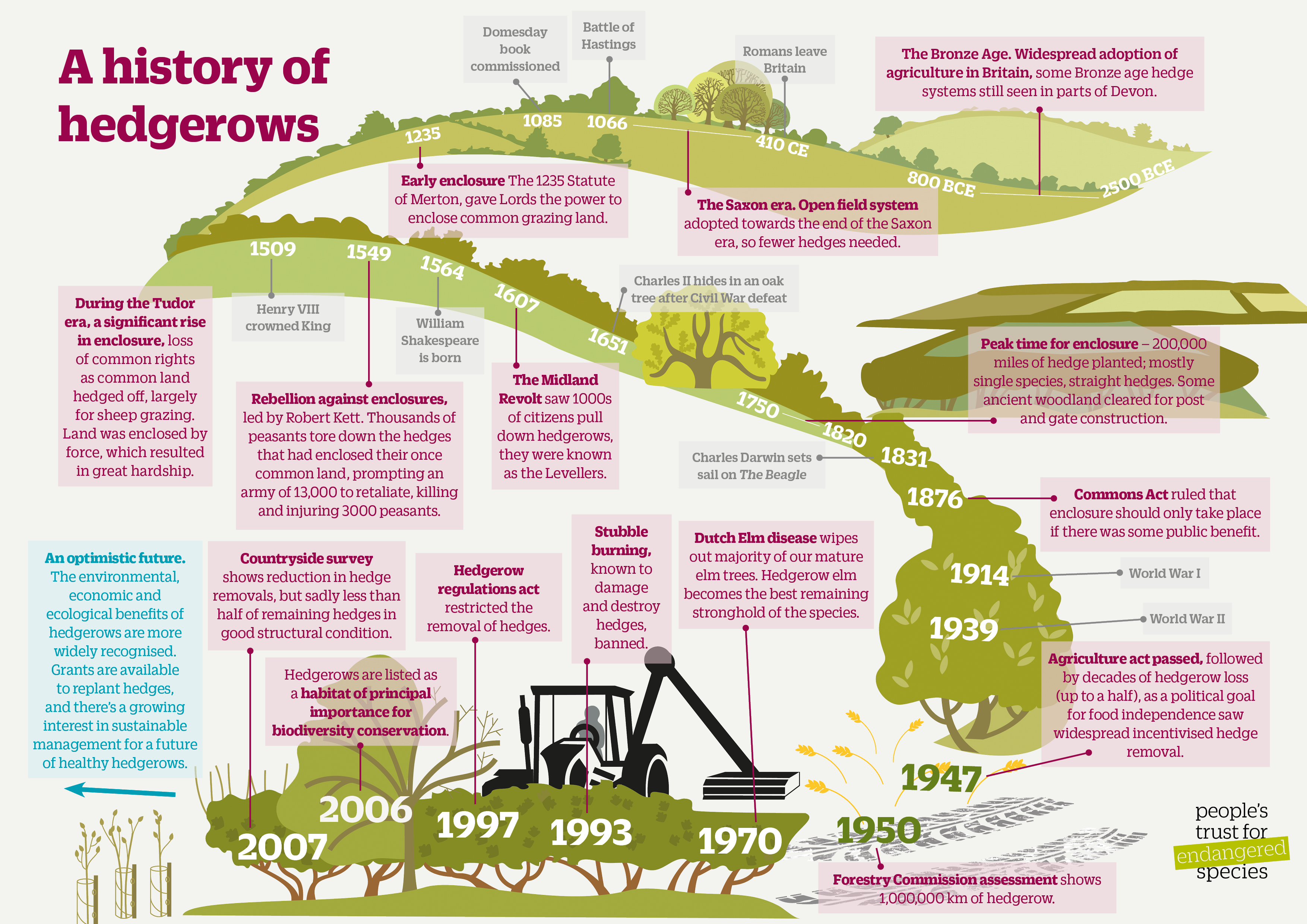
The word hedge, translated from its Old English root word, means enclosure. “Hedges have formed a part of our gardens for at least 2,000 years,” according to the Financial Times. “Among the earliest examples are those used in the landscaping of Roman villas.” Hedgerows consisting of plants anchored together forming living walls were widely used in the United Kingdom for hundreds of years. Still, they waned in popularity after WWII with the rise of industrial farming practices. “Symbolic of the English countryside and teeming with life, there are over 30 different regional styles of hedgerow in the UK,” according to Seedlipdrinks UK. “A border, a boundary, a home, and even a fruit basket, in late Spring, these iconic landmarks come into their own as bright young leaves sprout from bare branches and the first wildflowers appear.”
Americans don’t have this rich history with hedgerows. “Hedgerow plantings were uncommon in the early United States,” according to Oregon State University. “In the 1930s, the U.S. Department of Agriculture’s Shelterbelt Program briefly supported planting trees for windbreaks to prevent soil erosion in the Midwest. Today, as interest surges in sustainable farming methods, more people are turning to this age-old practice.” Government agencies, NGOs, and educational institutions now guide Americans on creating wildlife attracting hedgerows that serve as habitats and corridors while preventing erosion and improving soil conditions.
“Hedgerows certainly will have a natural, informal look, but it’s still important to keep aesthetics in mind,” according to the American Horticultural Society. “Year-round landscape interest can be achieved by selecting plants with attributes that span the seasons. Plants that flower and fruit at different times of the year not only help sustain wildlife, they add pops of seasonal color. Many wildlife-friendly plants contribute textural contrasts to the landscape, while others offer colorful fall foliage or attractive bark for winter interest. Repetition—repeating plants or colors within the hedgerow, or using hedgerow plants in other parts of the landscape—helps create visual flow and harmony within the landscape. Mass plantings or large drifts of color also help unify the space.”
While there are no regional styles of hedgerows that require you to arrange your collection of plants in a particular manner, there are available suggestions. “The most common planting plan is the double line. It is important to offset the 2 rows to give the necessary even distribution of plants along the mature hedge line,” according to Pierce Conservation District. “There are no hard and fast rules for determining the planting space for hedgerows; this depends on the plant selection. For a tight stock-proof hedge, spacing can be as close as 8 -12 inches apart. A good “backbone” plant, which will constitute 60 – 70% of the hedgerow should be among your initial selections. Choose a plant with a good growth rate, resilience to severe pruning, and thorny growth for good stock-proofing capabilities. Once a backbone plant is selected, adding 4-6 additional shrubs or small trees will add value as wildlife habitat as well as reduce any gaps resulting from a particular species dying out.”
Many of the hedgerows around us may have been created by accident within informal gardens as layers of plantings that provide habitat and food for pollinators, birds, amphibians, reptiles and a mammal or two. If interested in creating or adding to your own wildlife attracting hedgerows book a consult with an Earth Works Landscape Designer. Visit our garden center and a garden guide will assist you with a mix of plants for hedgerows in Northeast Florida.
For comprehensive solutions to your specific lawn, garden and landscaping needs contact Earth Works of Jacksonville online and at 904-996-0712. Earth Works operates a retail Garden Center/Plant Nursery in Jacksonville and provides landscaping, hardscaping, water features, lawn care service, lawn spraying, and drainage solutions. Proudly serving clients in Northeast Florida including Jacksonville, Ponte Vedra Beach, Atlantic Beach, Neptune Beach, Jacksonville Beach, Nocatee, St. Johns, Fleming Island, Orange Park, Middleburg, Green Cove Springs, Amelia Island, Fernandina, and St. Augustine. Happy Gardening!
MAY WEATHER IN NORTHEAST FLORIDA May lawn and garden tips starts with recognition that this is the second and final full month of Spring as temperature increases heading to Summer. “Daily high temperatures increase by 5°F, from 82°F to 87°F, rarely falling below 74°F or exceeding 93°F,” according to weatherspark.com. “Daily low temperatures increase by 7°F, from 62°F to 70°F, rarely falling below 53°F or exceeding 74°F.” This is the peak plant production period for many plants before some stifling in the coming Summer months. Average Jacksonville rainfall for May is 2.5 inches, which is slightly lower than April but much less than the approximate 6.5 inches June and July averages.
MAY PLANTINGS IN NORTHEAST FLORIDA
May is prime time for planting pollinator-friendly flowering plants in Northeast Florida. Lantana, milkweed, salvia, begonia, coleus, cuphea, and passion vines are but a few of the long lists that bloom and are ready to plant from your neighborhood garden center. In addition, consider warm-season herbs and vegetables, including basil, okra, peas, rosemary, and sweet potatoes for growing in May. It is wide open season on getting started with container gardening, potted plants, and houseplants. Earth Works garden center, landscape designers, and lawn care are available to assist you in developing a beautiful, healthy, and manageable lawn and garden.
MAY PRUNING IN NORTHEAST FLORIDA Our May pruning tips for Northeast, Florida start with the recognition that April and May are times when most of your trees and shrubs are putting out new growth. Consider replacing the deciduous trees and shrubs that don’t appear to be coming back from the Winter cold, disease, or parasites. If plants including crape myrtles, hibiscus, and roses aren’t showing signs of budding with new growth on bare branches, prune back judiciously, looking for live wood before removal and replacement. Prune your Spring flowering plants and hedge plants such as azaleas and oleander back shortly after blooms subside to allow maximum growth ahead of their next bloom cycle on new growth. Plants with dead growth that are damaged, diseased can cut out at any time.
MAY FERTILIZATION & SOIL AMENDMENTS IN NORTHEAST FLORIDA May lawn and garden tips emphasizes fertilization schedules that vary greatly among ornamental plants, fruits, and vegetables. Fertilization needs depend on the soil fertility for starters and the nutrient requirements of the specific plants. Native plants are adapted to local soil conditions and need less fertilization than plants categorized as moderate to heavy feeders. A benefit to consults with a landscape designer is their horticultural knowledge in assisting you to devise a plan that takes plant care and fertilization into consideration. Heavy feeders such as Bird of Paradise can benefit from biweekly fertilization during their growing season. In contrast, Florida native plants require very little fertilization, although mulch and composted soil amendments will more closely mimic their native soil constituents than not. “Of the 17 elements essential for plant growth, eight are micronutrients: boron (B), chlorine (CI), copper (Cu), iron (Fe), manganese (Mn), molybdenum (Mo), zinc (Zn) and nickel (Ni),” according to Ohio State University. “Micronutrients are essential plant nutrients that are found in trace amounts in tissue, but play an imperative role in plant growth and development. Without these nutrients, plant nutrition would be compromised leading to potential declines in plant productivity.” In addition, foliar fertilization helps deliver micronutrients otherwise unavailable by broadcast methods of slow-release fertilizers in high pH soils. Thus, it’s also important to know your soil pH, a free test with recommendations for amendments where necessary by the University of Florida is encouraged. For more information, read “Soil Testing in Northeast Florida.”
MAY LAWN CARE IN NORTHEAST FLORIDA If suffering from soil compaction, consider doing core aeration and top dressing with soil amendments that will facilitate the bio availability of micro-nutrients and provide better water retention ahead of extreme Summer conditions. “Keep your St. Augustine between two to four inches in height,” according to Sod Solutions. “These heights slightly vary for different brand names of St. Augustine. For example, Palmetto should be maintained at a height of 1.5–2.5 inches whereas CitraBlue should be kept at a height of 2.5–3.5 inches during the spring.” Although St. Augustine grass is the most common turf in Florida there are numerous other varieties that do best if not scalped too short. Keep your mower blades sharp and water adequately.
MAY LAWN & GARDEN PEST CONTROL IN NORTHEAST FLORIDA
As part of May lawn and garden tips be on the lookout for any signs of weeds, insects, mold, and fungus in the lawn and garden. Good weather for the lawn and garden is likewise suitable for insects and other pests. Chinch bugs, sod webworms, grubs, and mole crickets are a few that begin successive life cycles in untreated lawn turf in Spring ahead of Summer rains. Meanwhile, many other pests will feast on the roots, stems, leaves, and fruit of ornamental plants, citrus, and vegetables in the garden. Aphids, lace bugs, mealybugs, nematodes, scale, and whiteflies are a few of the common pests that can devastate the garden. Know that the insects, both beneficial and otherwise, outnumber us. “In the world, some 900 thousand different kinds of living insects are known,” according to the Smithsonian. “Most authorities agree that there are more insect species that have not been described (named by science) than there are insect species that have been previously named. Conservative estimates suggest that this figure is 2 million, but estimates extend to 30 million. “ A healthy lawn and garden are best not left to chance but better managed with a proactive insect management plan. Address the potential threats in advance of infestations and be vigilant in inspecting the landscape for signs of new arrivals. May is too late for best results with pre-emergent herbicides as soil temperatures are above 55F, at which point seeds began bursting onto the scene. However, pre-emergents can continue to be a useful though less practical part of your insect management plan. May is prime time for post-emergent herbicide applications on the weed seedlings, vegetative & flower stages when average temperatures are between 65F and 85F. Biologic controls such as the bacteria bacillus thuringiensis are an organic resource for pest control. In addition, good cultural practices are a good starting point for nurturing healthy populations of beneficial insects that lower pest levels in an ecologically friendly manner. The healthier the plant with proper nutrition and planted in the proper location for its needs, the less susceptible the plant will be to pests and subsequent decline. A few examples include June-drop in Florida citrus beginning in May. Don’t worry so much about the flower drop that won’t hold fruit as the more significant the flowering, the lower the percentage of flowers producing fruit to harvest. Stress from insufficient water and nutrients and other environmental conditions, including pests, can increase the adverse impact of June-drop. There is a myriad of interactions between plants and insects in the landscape, with most being benign while others can cause great harm. For example, the bronzing of leaves on recently bloomed-out azaleas results from lace bugs that can cause tremendous damage if not controlled with biological controls such as green lacewings, lady beetles, or insecticides.
For comprehensive solutions to your specific lawn, garden and landscaping need contact Earth Works of Jacksonville online and at 904-996-0712. Earth Works operates a retail Garden Center/Plant Nursery in Jacksonville and provides landscaping, hardscaping, water features, lawn care service, lawn spraying, and drainage solutions. Proudly serving clients in Northeast Florida including Jacksonville, Ponte Vedra Beach, Atlantic Beach, Neptune Beach, Jacksonville Beach, Nocatee, St. Johns, Fleming Island, Orange Park, Middleburg, Green Cove Springs, Amelia Island, Fernandina, and St. Augustine. Happy Gardening!
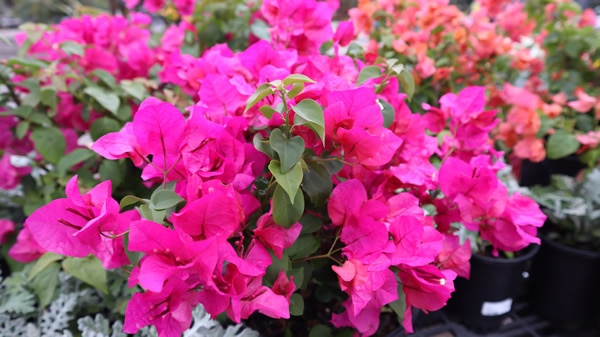
If you’ve ever driven past a fence line or garden wall absolutely covered in hot pink blooms and wondered whether you could pull that off in your own yard, the answer is probably yes. Bougainvillea grows well in Northeast Florida, and when it’s happy, it’s one of the showiest plants you can put in the ground.
The keyword is happy. Bougainvillea has opinions about where it lives, and planting it in the wrong spot is the fastest way to end up with a sulky, non-blooming shrub. Get the placement right, and this plant will reward you with color for most of the year with very little fuss.
What Bougainvillea Actually Is
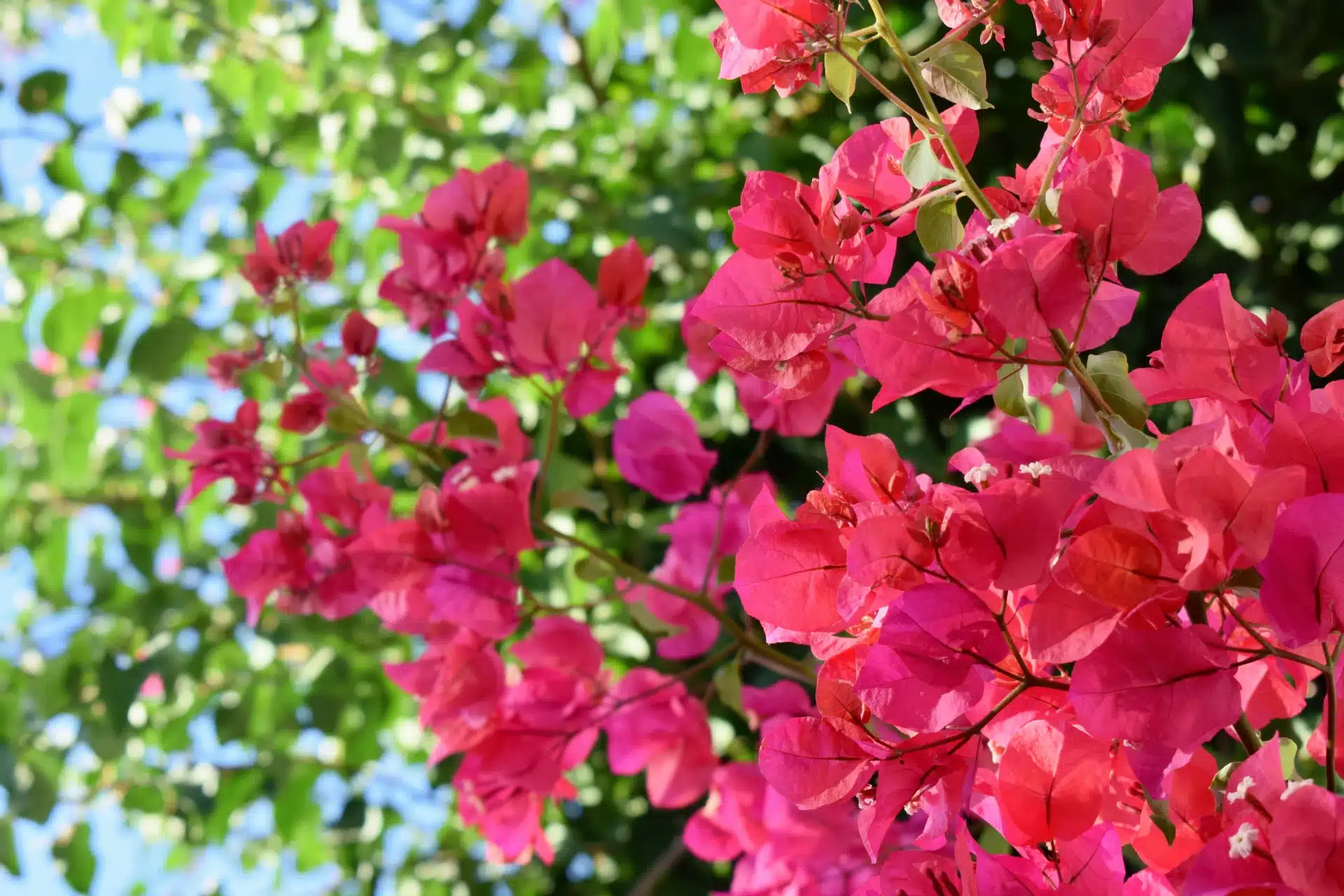
Bougainvillea is a Brazilian coastal native plant that comes in bush, tree, and vine form. What most people think of as the flower is actually a colorful bract, a modified leaf, that surrounds three petite flowers. Those bracts come in shades of magenta, orange, red, white, and coral, and they appear in waves throughout the year in sunny, dry conditions.
It’s hardy in USDA zones 9 to 11, which puts Jacksonville right at the edge of viability. We’re designated zone 8b at the lower end and zone 9a in the upper region, which means bougainvillea can thrive here but does require a little extra attention during cold snaps, especially in the first couple of seasons.
The Right Spot Makes All the Difference for Growing Bougainvillea Successfully
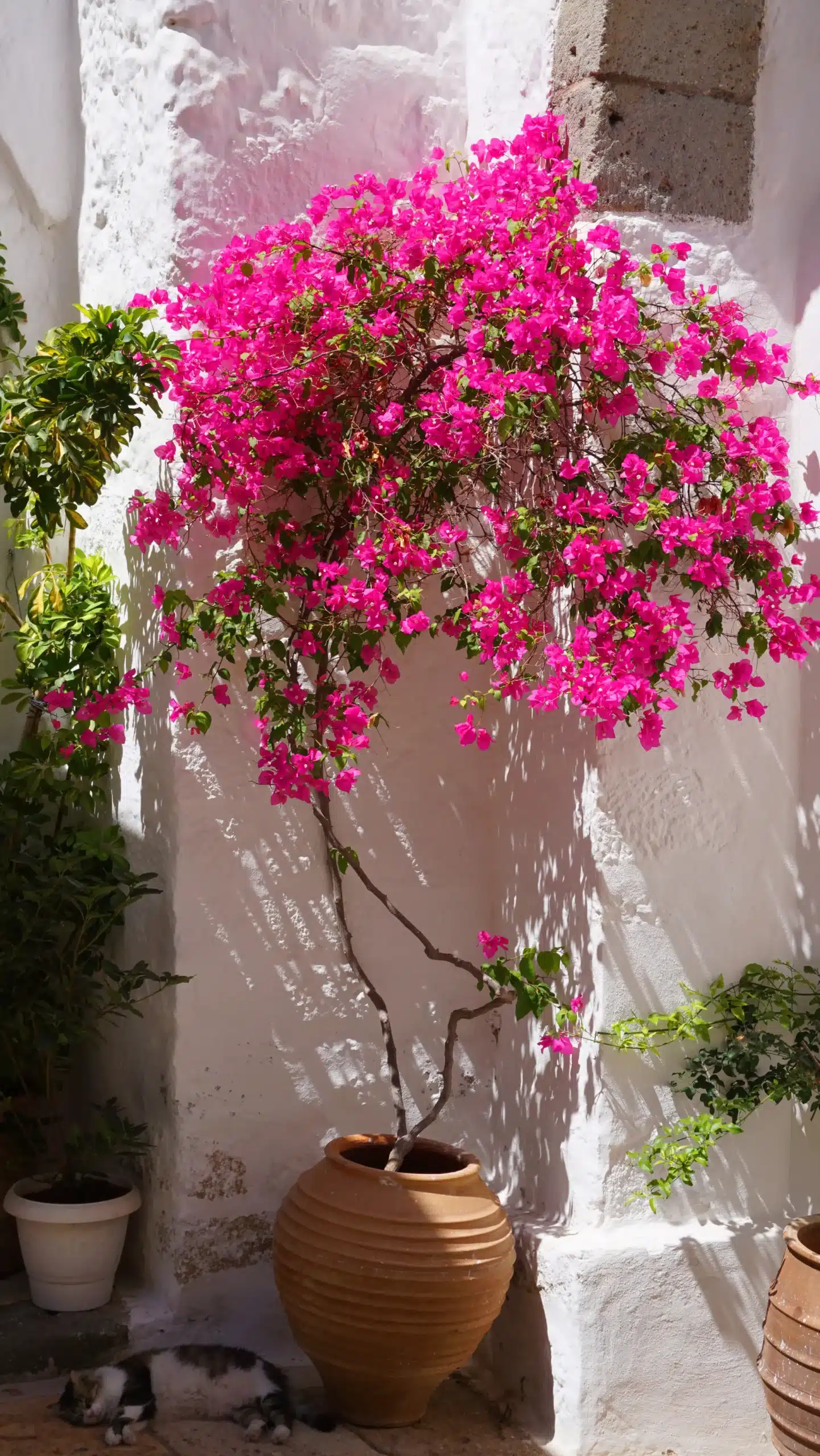
“Bougainvillea is a fantastic plant if you have the right spot for it,” says Matt Barlow, Garden Center Co-Manager at Earth Works Gardens. “The right spot is that place in the garden that’s hot, that’s sandy, that’s dry, gets sun all day, where nothing else wants to grow. That’s where the bougainvillea wants to be. It is a perfect solution for that place in the garden where it can be very difficult to grow other things, especially if it’s getting blasted with the afternoon death rays come June, July, August, September, and sometimes October.”
The spots to avoid are just as clear. Low-lying areas, shady corners, and anywhere that stays wet for long periods are wrong for bougainvillea. These plants do not like wet feet, and poor drainage is one of the most reliable ways to kill them.
Bougainvillea is also both salt and drought-tolerant, which makes it a genuinely useful plant for coastal Jacksonville landscapes where other options struggle. If you’re looking for other plants that handle our conditions well, our Garden Center team can point you in the right direction.
What to Expect from Your Bougainvillea in Cold Weather
Northeast Florida’s winters are unpredictable. Some years bring just a few light frost events. Other years bring hard freezes that knock plants back significantly. Bougainvillea can handle it, but new plants need a little help getting established.
“They are a hardy perennial here, although if we have hard frosts, hard freezes, they can be knocked back considerably,” says Barlow. “I have seen bougainvilleas come back from some very cold temperatures. After the first winter or two, the maintenance on them in the winter is much less. In the first season or two, you might want to cover and protect them for the first couple of years to make sure their roots become established. Once the roots become established, they will bounce back very quickly in the spring once the temperatures perk back up.”
The practical takeaway: don’t give up on a frost-damaged bougainvillea too quickly. Give it time to come back once warm weather returns.
Pruning Bougainvillea in Florida
Timing your pruning correctly makes a real difference in how well bougainvillea blooms. According to the University of Florida, the best time to prune is in late winter or early spring after it flowers, or at the start of the rainy season. Waiting until late summer or early fall can reduce flowering during the following winter.
Different varieties bloom best at different times of year, so it’s worth following the grower’s recommendation for the specific variety you have.
Feeding and Fertilizing Bougainvillea in Jacksonville
Bougainvillea benefits from regular feeding, but there’s a balance to strike. Over-fertilizing pushes the plant toward foliage growth at the expense of blooms, which is the opposite of what most people want.
“Feeding is very important with the bougainvilleas,” says Barlow. “You want to keep them on a regular feeding schedule. For those of you who don’t like to use a water-soluble liquid fertilizer, even a slow-release quarterly feed will encourage the blooming.”
If you’re growing bougainvillea in containers, keep in mind that they actually bloom best when slightly pot-bound. Resist the urge to move them into a larger pot too soon.
Stop in and See What We Have at Earth Works
Earth Works Gardens carries a wide selection of bougainvillea along with the soil amendments, fertilizers, and pond supplies your garden needs. Our team is working with horticulturists who can point you toward the right variety for your space and answer questions about your specific growing conditions.
Come in and talk to us at our Beach Blvd. location. We’d be happy to help with any of your gardening needs.
Frequently Asked Questions about Growing Bougainvillea in Jacksonville, FL
Can bougainvillea survive winter in Jacksonville, FL?
Yes, with some caveats. Jacksonville sits at the lower edge of zone 8b and upper zone 9a, so bougainvillea can survive here but may get knocked back by hard freezes. In the first couple of seasons, covering plants during cold snaps gives the roots time to establish. Once established, they bounce back reliably after frost damage.
How much sun does bougainvillea need?
Full sun, all day. Bougainvillea needs direct sunlight to bloom well. Partial shade will keep the plant alive, but it significantly reduces flowering. The hotter and sunnier the spot, the better it performs.
Why is my bougainvillea not blooming?
A few common culprits can keep your bougainvillea from blooming: too much shade, over-fertilization with nitrogen-heavy products, too much water, or pruning at the wrong time of year. Bougainvillea blooms best when it’s slightly stressed. Reduce watering, make sure it’s in full sun, and switch to a bloom-boosting fertilizer if needed.
Does bougainvillea do well in containers in Florida?
Yes, and container growing actually works well because bougainvillea blooms better when slightly pot-bound. Use a well-draining mix, make sure the container gets full sun, and keep up with a regular feeding schedule.
Is bougainvillea salt-tolerant?
Yes. Bougainvillea handles salt spray well, making it a strong choice for coastal Jacksonville landscapes and beach-adjacent properties where other plants struggle.
When should I prune bougainvillea in Northeast Florida?
Late winter or early spring, after it flowers, or at the start of the rainy season. Avoid pruning in late summer or early fall, as this can reduce blooming the following winter.
What soil does bougainvillea prefer?
Well-draining, sandy soil. Bougainvillea is native to coastal Brazil and naturally grows in dry, poor conditions. Jacksonville’s sandy soil is actually well-suited to it. Avoid amending the soil too heavily or planting in areas where water tends to collect.